JSTOR Global Plants Home
  • Home
  • Browse
  • About
  • Access
  • Account
    • Saved Items
    • Profile
  • Log in

Global Plants

Skip to Main Content
  • JSTOR Global Plants Home
  • Global Plants

    • Browse
    • About
    • Access
    • Account
      • Saved Items
      • Profile
Log in
  • Browse
  • About
  • Access
  • Account
    • Saved Items
    • Profile
Advanced Search

Compilation
Erica incomta

3 Images see all

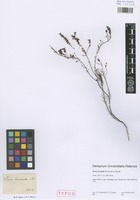
Syntype of Erica incomta Klotzsch ex Benth. [family ERICACEAE]
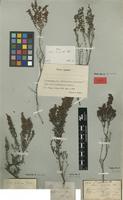
Type? of Erica incomta Klotzsch ex Benth. [family ERICACEAE]
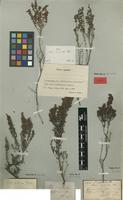
Filed as Erica incomta Klotzsch ex Benth. [family ERICACEAE]
Previous
Next

Name

Identification
Erica incomta Klotzsch ex Benth. [family ERICACEAE ] (stored under name); Verified by Not on sheet, Erica copiosa J.C.Wendl. [family ERICACEAE ] Verified by Not on sheet,
Related name
  • Erica copiosa
  • Erica incomta
  • Erica asperrima

Flora

Entry for ERICA copiosa Wendl. [family ERICACEAE]
Herbarium
Royal Botanic Gardens, Kew (K)
Collection
Flora Capensis
Resource Type
Reference Sources
Entry From
Flora Capensis, Vol 4, page 2, (1909) Author: By H. BOLUS, F. GUTHRIE, and N. E. BROWN.
Names
ERICA copiosa Wendl. [family ERICACEAE], Eric. Ic. fasc. 25, 3, t. 1
ERICA incomta Klotzsch ex Benth. [family ERICACEAE], in DC. Prodr. vii. 690.
Information
erect, about 1 ft. high, somewhat slender; branches numerous, often diffuse, mostly hirsute with coarse spreading hairs, with many short lateral branchlets bearing abundant flowers; leaves more or less spreading, linear to lanceolate, thick, sulcate, rarely narrow-ovate and open-backed, mostly hispidulous, sometimes glabrescent, mostly 1–1 1/2 lin. long; inflorescence strictly terminal, often pseudo-racemose by crowding on the short branchlets; pedicels about 1 lin. long; bracts variable, mostly remote and small, or minute, occasionally (as in the type specimen) the lowest one larger and foliaceous; sepals lanceolate or oblong-lanceolate, usually less than 3/4 lin. long, leaf-like or coloured; corolla narrow-campanulate (in the type) to broad-campanulate, or cyathiform, from a little longer than its width to a little shorter, the mouth more or less widened, glabrous, or rarely puberulous, about 1 lin. long; segments mostly distinctly and sometimes widely spreading, from 1/2 the length of the tube to equal its length; filaments slender, bent below the anther; anthers included, sometimes manifest, oblong, with more or less obliquity, subcuneate, or narrow-elliptic, usually 1/4– 1/3 (rarely 1/5) lin. long, muticous or minutely or long aristate; pore less than 1/2 the length of the cell, style exserted; stigma capitate; ovary usually hispidulous, or at least towards the summit. null
Distribution
COAST REGION Caledon Div.; Caledon, Zeyher, 7! in Herb. Trin. Coll., Dublin. Mossel Bay Div.; near Great Brak River, Galpin, 3701! George Div.; near George, Alexander, 7! Knysna Div.; Woodlands, Galpin, 3712! Uitenhage Div.; Elands River Mountains, Ecklon & Zeyher! in Herb. Berlin. Van Stadensberg Range, West, 4! Var. β: Swellendam Div., Schlechter, 2089! Uitenhage Div.; Zuurberg Range, Bolus, 9112! Var. γ: Stellenbosch Div., Pappe! Tulbagh Div.; Witsenberg Vlakte, Pappe, 39! George Div., Schlechter, 5813! Knysna Div.; near Plettenberg Bay, Burchell, 5334! near Touw River, Burchell, 5722! Var. δ: Clanwilliam Div.; Cederberg Range, near Sneeuw Kop, 4500 ft., Bodkin in Herb. Bolus, 8678!EASTERN REGION Griqualand East, Tyson, 1783! 2859!SOUTH AFRICA without locality, Lichtenstein!
Notes
The type is Wendland's excellent figure and description; and we have besides, by the courtesy of Prof. Dr. Engler, Director of the Royal Bot. Mus. of Berlin (whose generous assistance in this and many other instances we gratefully acknowledge) been favoured with the opportunity of seeing the type of Klotzsch's E. incomta and of dissecting the flower. This agrees very well with Wendland's. The stigma is clearly capitate, not peltate as described by Bentham. The varieties are fairly distinct as to the sepals, but are closely connected in almost every other character. Most of them are marked by a general roughness to the touch.

Related Materials

  • Terms and Conditions
  • Privacy Policy
  • Cookie Policy
  • Cookie Settings
  • Accessibility
  • Help
  • Contact Us
  • Facebook
  • Twitter
ITHAKA

JSTOR is part of ITHAKA, a not-for-profit organization helping the academic community use digital technologies to preserve the scholarly record and to advance research and teaching in sustainable ways.

©2000-2026 ITHAKA. All Rights Reserved. JSTOR®, the JSTOR logo, JPASS®, Aluka®, and ITHAKA® are registered trademarks of ITHAKA.

╳