JSTOR Global Plants Home
  • Home
  • Browse
  • About
  • Access
  • Account
    • Saved Items
    • Profile
  • Log in

Global Plants

Skip to Main Content
  • JSTOR Global Plants Home
  • Global Plants

    • Browse
    • About
    • Access
    • Account
      • Saved Items
      • Profile
Log in
  • Browse
  • About
  • Access
  • Account
    • Saved Items
    • Profile
Advanced Search

Compilation
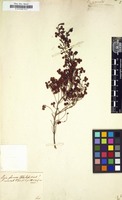
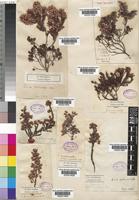
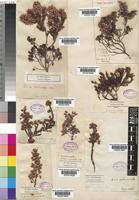
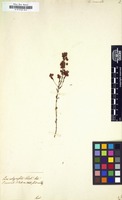
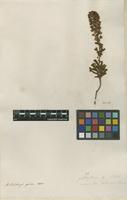
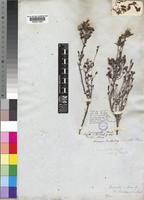
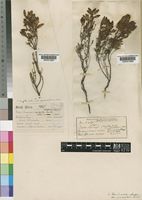
Erica incarnata

7 Images see all

Filed as Erica incarnata [family ERICACEAE]
Erica lateralis Willd. [family ERICACEAE]
Filed as Erica incarnata [family ERICACEAE]
Erica savilea Andrews [family ERICACEAE]
Erica savileae Andrews [family ERICACEAE]
Filed as Erica guttiflora Salisb. [family ERICACEAE]
Previous
Next

Name

Identification
Erica incarnata Thunb. [family ERICACEAE ] Erica savilea Andrews [family ERICACEAE ] (stored under name); Erica savileana Andr. [family ERICACEAE ] Verified by Bolus, H., Erica incarnata Benth [family ERICACEAE ]
Related name
  • Erica guttiflora
  • Erica lateralis
  • Erica savileae
  • Erica pedunculata
  • Erica savileana
  • Erica incarnata
  • Erica savilea

Flora

Entry for ERICA incarnata Thunb. [family ERICACEAE]
Herbarium
Royal Botanic Gardens, Kew (K)
Collection
Flora Capensis
Resource Type
Reference Sources
Entry From
Flora Capensis, Vol 4, page 2, (1909) Author: By H. BOLUS, F. GUTHRIE, and N. E. BROWN.
Names
ERICA incarnata Thunb. [family ERICACEAE], Diss. Erica, 50, not of Andr., nor of Benth.
ERICA amœna Salisb. [family ERICACEAE], Trans. Linn. Soc. vi. 329, not of Wendl.
Information
erect, a foot or more high; branches virgate, subflexuous, thinly villous; leaves 3-nate, adpressed or slightly spreading, narrow-ovate, obtuse, somewhat concave on the upper surface, glabrous, 1 1/4–1 1/2 lin. long; flowers usually 3-nate, more rarely in 5–6-flowered umbels, erect or suberect; pedicels slender, glabrous, about 3 lin. long; bracts leaf-like, narrow-lanceolate, acute, the two upper approximate, adpressed, the lowest at or near the base, larger and more spreading; sepals narrow-lanceolate, acute, glabrous, margins naked, 1 1/2 lin. long; corolla inflated-urceolate, not tapering but suddenly contracted at the neck, or narrow-ovoid, 3–4 1/2 lin. long; limb spreading, small; segments rounded; anthers oblong, somewhat incurved, slightly prognathous, a little over 1/2 lin. long; pore about 1/3 of the cell; cristate at the base; crests lanceolate, acuminate, dentate on the outer margin, about 1/2 the length of the cell; ovary upon a stipe of about its own length, or in some specimens longer, and about 1/3 of its own diameter. null
Distribution
COAST REGION Clanwilliam Div.; on the Cederberg Range near Sneeuw Kop and Wupperthal, 3500–4500 ft., Bodkin in Herb. Bolus, 8630! Leipoldt, 621!SOUTH AFRICA without locality, Thunberg!
Notes
We have compared this with Thunberg's type, which Bentham does not appear to have seen. The plants so named by him, or distributed by others under this name, are forms of E. Savilea, from which this differs by the position of its bracts, by the shape of its sepals, anthers and their appendages, and by the longer and narrower stipe of the ovary. The pedicels, bracts and sepals, and in some specimens the flower-buds, are uniformly deep red.

Related Materials

  • Terms and Conditions
  • Privacy Policy
  • Cookie Policy
  • Cookie Settings
  • Accessibility
  • Help
  • Contact Us
  • Facebook
  • Twitter
ITHAKA

JSTOR is part of ITHAKA, a not-for-profit organization helping the academic community use digital technologies to preserve the scholarly record and to advance research and teaching in sustainable ways.

©2000-2026 ITHAKA. All Rights Reserved. JSTOR®, the JSTOR logo, JPASS®, Aluka®, and ITHAKA® are registered trademarks of ITHAKA.

╳