JSTOR Global Plants Home
  • Home
  • Browse
  • About
  • Access
  • Account
    • Saved Items
    • Profile
  • Log in

Global Plants

Skip to Main Content
  • JSTOR Global Plants Home
  • Global Plants

    • Browse
    • About
    • Access
    • Account
      • Saved Items
      • Profile
Log in
  • Browse
  • About
  • Access
  • Account
    • Saved Items
    • Profile
Advanced Search

Compilation
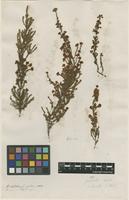
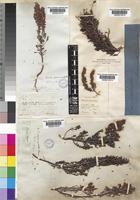
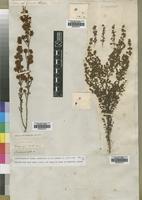
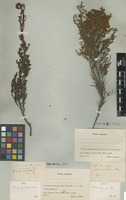
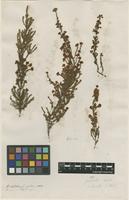
Erica imbecilla

5 Images see all

Filed as Erica gracilis J.C.Wendl. [family ERICACEAE]
Type? of Erica imbecilla Sweet [family ERICACEAE]
Erica paniculata unrecorded [family ERICACEAE]
Filed as Erica gracilis J.C.Wendl. [family ERICACEAE]
Previous
Next

Name

Identification
Erica imbecilla Sweet [family ERICACEAE ] Erica gracilis J.C.Wendl. [family ERICACEAE ] (stored under name);
Related name
  • Erica imbecilla
  • Erica paniculata
  • Erica gracilis

Flora

Entry for ERICA gracilis Wendl. [family ERICACEAE]
Herbarium
Royal Botanic Gardens, Kew (K)
Collection
Flora Capensis
Resource Type
Reference Sources
Entry From
Flora Capensis, Vol 4, page 2, (1909) Author: By H. BOLUS, F. GUTHRIE, and N. E. BROWN.
Names
ERICA gracilis Wendl. [family ERICACEAE], Bot. Beobacht. 47;—Benth. in DC. Prodr. vii. 677; Willd. Sp. Pl. ii. 365; Salisb. in Trans. Linn. Soc. vi. 375; Andr. Heathery, t. 68? and Col. Heaths, t. 98?; Wendl. Eric. Ic. fasc. 8, 9.
ERICA tenuissima Wendl. [family ERICACEAE], l.c. fasc. 6, 9.
ERICA tenera Klotzsch ex Benth. [family ERICACEAE], l.c. 677.
ERICA imbecilla Sweet. [family ERICACEAE], Hort. Brit. ed. i. 258.
ERICA neglecta G. Don [family ERICACEAE], Gen. Syst. iii. 792.
Information
a slender branched erect shrub, under 1 ft. high; branches ascending or spreading, pubescent; leaves erect or sometimes incurved or spreading, imbricate, linear, keeled or round-backed, slender, glabrous, 1–2 lin. long; flowers 4-nate, on rather short branchlets; pedicels 1–2 1/2 lin. long; bracts remote, small; sepals ovate-lanceolate to lanceolate, ciliolate or naked, about 1/2 lin. long; corolla urceolate, mouth usually slightly (rarely much) contracted, rosy, 1 1/4–2 (mostly 1 1/2) lin. long; segments small, erect or spreading (probably always spreading at full maturity); anthers included, ovate, obtuse, glabrous, margins naked, little more than 1/5 lin. long, broad-aristate or subcristate; pore about 1/2 as long as the cell; awns deflexed close to the cells, broadish-subulate, entire or minutely lacerate, from 1/2 as long to nearly as long as the cells; style included; stigma capitellate; ovary sessile on a broad disk, glabrous. null
Distribution
COAST REGION common from Swellendam Div. eastward to Humansdorp Div., from 250–3000 ft., Niven, 14! Alexander, 19! Zeyher, 3255! Bolus, 2392! 5840! 9233! Schlechter, 2228! 2066! 5835! 5991! Galpin, 3674!SOUTH AFRICA without locality, Herb. Salisbury! and cultivated specimens!
Notes
In the wild state this species is fairly constant in its characters and is generally recognizable by its small sepals and anthers. In cultivation, however, it seems to have varied, and this has given rise to some doubt and confusion as to the figures. It is very uncertain whether Andrews' figure is the same as Wendland's plant; we have seen no specimens with such globose corollas; nor can we cite, as does Bentham, Loddiges, Bot. Cab. t. 244.

Related Materials

  • Terms and Conditions
  • Privacy Policy
  • Cookie Policy
  • Cookie Settings
  • Accessibility
  • Help
  • Contact Us
  • Facebook
  • Twitter
ITHAKA

JSTOR is part of ITHAKA, a not-for-profit organization helping the academic community use digital technologies to preserve the scholarly record and to advance research and teaching in sustainable ways.

©2000-2026 ITHAKA. All Rights Reserved. JSTOR®, the JSTOR logo, JPASS®, Aluka®, and ITHAKA® are registered trademarks of ITHAKA.

╳