JSTOR Global Plants Home
  • Home
  • Browse
  • About
  • Access
  • Account
    • Saved Items
    • Profile
  • Log in

Global Plants

Skip to Main Content
  • JSTOR Global Plants Home
  • Global Plants

    • Browse
    • About
    • Access
    • Account
      • Saved Items
      • Profile
Log in
  • Browse
  • About
  • Access
  • Account
    • Saved Items
    • Profile
Advanced Search

Compilation
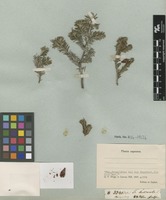
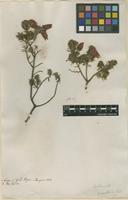
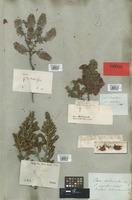
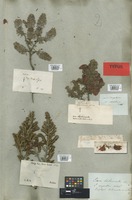
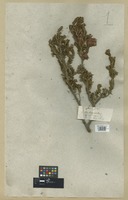
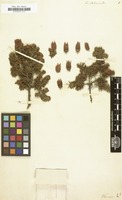
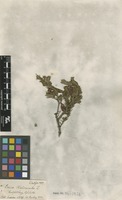
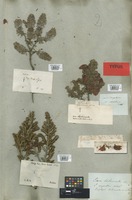
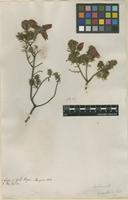
Erica halicacaba

9 Images see all

Filed as Erica halicacaba L. [family ERICACEAE]
Filed as Erica halicacaba Linn [family ERICACEAE]
Filed as Erica halicacaba [family ERICACEAE]
Filed as Erica halicacaba L. [family ERICACEAE]
Type of Erica rupestris Salisb. [family ERICACEAE]
Filed as Erica halicacaba L. [family ERICACEAE]
Previous
Next

Name

Identification
Erica halicacaba L. [family ERICACEAE ] (stored under name); Verified by Not on sheet, Erica rupestris Salisb. [family ERICACEAE ] Verified by Smith, Sir James Edward, Erica halicacaba L. [family ERICACEAE ] Verified by Groves, E.W., 1996
Related name
  • Erica rupestris
  • Erica halicacaba

Flora

Entry for ERICA Halicacaba Linn. [family ERICACEAE]
Herbarium
Royal Botanic Gardens, Kew (K)
Collection
Flora Capensis
Resource Type
Reference Sources
Entry From
Flora Capensis, Vol 4, page 2, (1909) Author: By H. BOLUS, F. GUTHRIE, and N. E. BROWN.
Names
ERICA Halicacaba Linn. [family ERICACEAE], Plant. Rar. Afr. 11;—Amœn. Acad. vi. 88, and. Mant. Alt. 374; Bauer, Exot. Pl. t. 2; Wendl. Eric. Ic. fasc. 6, 7; Andr. Heathery, t. 164, and Col. Heaths, t. 99; Benth. in DC. Prodr. vii. 623.
ERICA rupestris Salisb. [family ERICACEAE], in Trans. Linn. Soc. vi. 353, not of Andr.
ERICA grossa Salisb. [family ERICACEAE], Prodr. 292.
Information
procumbent, or erect against the steep sides of rocks; branches divaricate, flexuous, stout, woody, rigid, brittle, puberulous, densely leafy or covered with the scars of old leaf-cushions, 6–12 in. long; leaves 3-nate, very closely set, spreading or squarrose-recurved, linear, round-backed, sulcate, rigid, glabrous, 4–7 lin. long; flowers mostly solitary, sometimes 2–3-nate, at length pendulous; pedicels puberulous, 2–3 lin. long; bracts approximate, ovate, acuminate, keeled, scarious, about 3 lin. long; sepals like the bracts but much larger and more adpressed, 4–5 lin. long; corolla ovoid or ovoid-tubular, inflated, glabrous, pale yellow, 8–11 lin. long, by about 3 lin. in diam. at the widest part; segments erect, and at length connivent, long, tapering, obtuse, nearly 1/2 the length of the entire corolla; filaments rather broad, dilated and thickened below the anther, very little bent, 5–6 lin. long; anthers oblong, acute, affixed dorsally at the very base of the deeply parted divaricate cells, 1 1/4–1 3/4 lin. long, aristate or muticous; pore nearly 2/3 the length of the cell; awns spreading and upcurved, or decurved, from 1/8– 1/3 of the cell in length; style straight, shorter than the corolla-segments, but mostly manifest; stigma subsimple, small; ovary globose, rough, glabrous. null
Distribution
COAST REGION Cape Div.; in rocky places on the mountains of the Cape Peninsula from Table Mountain to Simons Town, from 1000 ft. upwards, now becoming scarce: Masson, Thunberg, Burchell, 625! Zeyher, 3241! Harvey, 175! Bolus, 4473! Guthrie, 672! Wolley Dod, 2037! Bentham mentions Stellenbosch Div. as a locality, but we have not been able to find any record of stations outside of the Cape Peninsula.
Notes
The anthers are called muticous by Bentham; yet Linnaeus describes them as aristate, and they are so figured by Bauer and by Wendland; Andrews shows them as muticous, and we have found both forms.

Related Materials

  • Terms and Conditions
  • Privacy Policy
  • Cookie Policy
  • Cookie Settings
  • Accessibility
  • Help
  • Contact Us
  • Facebook
  • Twitter
ITHAKA

JSTOR is part of ITHAKA, a not-for-profit organization helping the academic community use digital technologies to preserve the scholarly record and to advance research and teaching in sustainable ways.

©2000-2026 ITHAKA. All Rights Reserved. JSTOR®, the JSTOR logo, JPASS®, Aluka®, and ITHAKA® are registered trademarks of ITHAKA.

╳