JSTOR Global Plants Home
  • Home
  • Browse
  • About
  • Access
  • Account
    • Saved Items
    • Profile
  • Log in

Global Plants

Skip to Main Content
  • JSTOR Global Plants Home
  • Global Plants

    • Browse
    • About
    • Access
    • Account
      • Saved Items
      • Profile
Log in
  • Browse
  • About
  • Access
  • Account
    • Saved Items
    • Profile
Advanced Search

Compilation
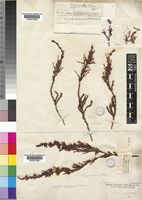
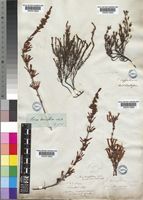
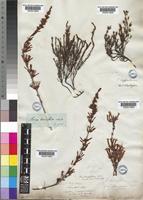
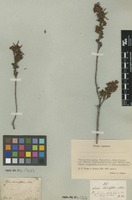
Erica cylindrica

8 Images see all

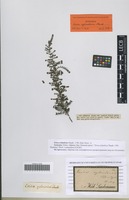
Type of Erica fistulaeflora Salisb. [family ERICACEAE]
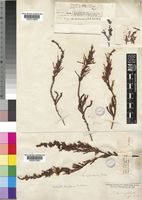
Erica cylindrica Thunb. [family ERICACEAE]
Filed as Erica daphniflora Salisb. [family ERICACEAE]
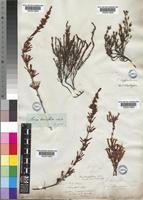
Syntype of Erica cylindrica Thunb. [family ERICACEAE]
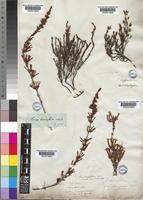
Erica cylindrica Thunb. [family ERICACEAE]
Previous
Next

Name

Identification
Erica cylindrica Thunb. [family ERICACEAE ] (stored under name); Erica fistulaeflora Salisb. [family ERICACEAE ] Erica tenuiflora Andrews [family ERICACEAE ]
Related name
  • Erica cylindrica
  • Callista tenuiflora
  • Erica cliffordiana
  • Erica tenuiflora
  • Erica fistulaeflora

Flora

Entry for ERICA dubia Rach [family ERICACEAE]
Herbarium
Royal Botanic Gardens, Kew (K)
Collection
Flora Capensis
Resource Type
Reference Sources
Entry From
Flora Capensis, Vol 4, page 2, (1909) Author: By H. BOLUS, F. GUTHRIE, and N. E. BROWN.
Names
ERICA dubia Rach [family ERICACEAE], in Linnæa, xxvi. 776
ERICA cylindrica Wendl. [family ERICACEAE], Eric. Ic. fasc. 11, 7, not of Thunb. nor Andr.
Information
erect, glabrous, with subvirgate branches, 2–3 ft. high; leaves 3–4-nate, erect-spreading, linear, 3–4 lin. long; flowers solitary or geminate, spreading; bracts remote, foliaceous, small; sepals ovate-lanceolate, acuminate, keel-tipped, ciliate-serrulate, foliaceous, 2 1/2–3 lin. long; corolla tubular, straight, wider at the base and apex, the middle somewhat contracted, clear yellow, 8 lin. long; limb short, erect; anthers subovate, muticous, included; ovary glabrous. null
Distribution
SOUTH AFRICA Known to us only from cultivated specimens and Wendland's excellent figure and description.
Notes
Allied to E. bibax, yet apparently distinct by its more foliaceous sepals and the different manner in which the anthers are affixed to the filament.

Related Materials

  • Terms and Conditions
  • Privacy Policy
  • Cookie Policy
  • Cookie Settings
  • Accessibility
  • Help
  • Contact Us
  • Facebook
  • Twitter
ITHAKA

JSTOR is part of ITHAKA, a not-for-profit organization helping the academic community use digital technologies to preserve the scholarly record and to advance research and teaching in sustainable ways.

©2000-2026 ITHAKA. All Rights Reserved. JSTOR®, the JSTOR logo, JPASS®, Aluka®, and ITHAKA® are registered trademarks of ITHAKA.

╳