JSTOR Global Plants Home
  • Home
  • Browse
  • About
  • Access
  • Account
    • Saved Items
    • Profile
  • Log in

Global Plants

Skip to Main Content
  • JSTOR Global Plants Home
  • Global Plants

    • Browse
    • About
    • Access
    • Account
      • Saved Items
      • Profile
Log in
  • Browse
  • About
  • Access
  • Account
    • Saved Items
    • Profile
Advanced Search

Compilation
Erica chlamydiflora

3 Images see all

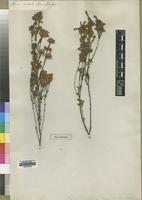
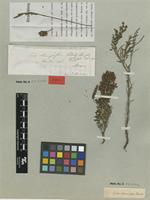
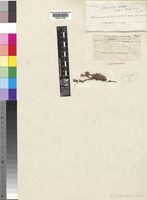
Type? of Erica chlamydiflora Salisb. [family ERICACEAE]
Type of Erica chlamydiflora Salisb. [family ERICACEAE]
Previous
Next

Name

Identification
Erica chlamydiflora Salisb. [family ERICACEAE ] (stored under name);
Related name
  • Erica chlamydiflora
  • Erica brevifolia

Flora

Entry for ERICA chlamydiflora Salisb. [family ERICACEAE]
Herbarium
Royal Botanic Gardens, Kew (K)
Collection
Flora Capensis
Resource Type
Reference Sources
Entry From
Flora Capensis, Vol 4, page 2, (1909) Author: By H. BOLUS, F. GUTHRIE, and N. E. BROWN.
Names
ERICA chlamydiflora Salisb. [family ERICACEAE], in Trans. Linn. Soc. vi. 338;—Benth. in DC. Prodr. vii. 656.
ERICA viscaria Roxb. ex Salisb. [family ERICACEAE], l.c. not of Linn.
Information
slender, erect, 1–1 1/2 ft. or more high; branches subvirgate, pallid, pubescent, glabrous or glabrescent; leaves 3-nate, erect, often adpressed, linear-lanceolate or oblong, subobtuse, sulcate, glandular-hirsute or glabrous, ciliate or at length naked, imbricate in the uppermost, or equalling or shorter than the internodes in the lower parts of the branches, 2–2 1/2 lin. long; flowers sub-3-nate, clustered or more often lax; pedicels 2–3 lin. long; bracts, 2 upper subapproximate, lowest median, lanceolate, ciliate, 1 1/2 lin. long; sepals lanceolate, acute or acuminate, not or scarcely imbricating at the base, spreading or sometimes somewhat recurved towards the apex, keeled or the keel sometimes obsolete, mostly faintly wrinkled across the keel near the base, 1 3/4–2 lin. long, pale purple or lilac, reaching a little below or above the corolla; corolla urceolate-tubular, very little inflated below or contracted at the throat, subtetragonous, prominently 4-nerved, viscidulous, 1 1/2–1 3/4 lin. long; segments rounded, stellate-patent or subrecurved, concolorous, about 1/4 the length of the tube; anthers longitudinally semilanceolate, 5 1/2 times as long as their greatest width, tapering to the apex but scarcely acute, smooth; cells deeply partite, between 2/5 and 1/2 lin. long, appendiculate; pore more than 1/2 the length of the cell; appendages lanceolate, acute, incurved, incised, 1/3 the length of the cell; style included, or just manifest above the corolla-tube; stigma capitate; ovary glabrous. null
Distribution
COAST REGION Cape Div.; eastern slopes of Table Mountain, above Constantia, in the Cape Govt. Herb., without collector's name, but with the locality number 85 of Ecklon & Zeyher on the label! Stellenbosch Div.; Hottentots Holland Mountains, Masson in Herb. Salisbury! Caledon Div.; mountains near the Zondereinde River, Grisbrook in Herb. Guthrie, 4975!
Notes
We have seen and examined Salisbury's type. The species is allied to E. gnaphaloides. The slenderness of the whole flower, the sepals more spreading and less imbricate at the base than is usual, and their almost lilac colour, serve generally to distinguish this species, which is by no means common.

Related Materials

  • Terms and Conditions
  • Privacy Policy
  • Cookie Policy
  • Cookie Settings
  • Accessibility
  • Help
  • Contact Us
  • Facebook
  • Twitter
ITHAKA

JSTOR is part of ITHAKA, a not-for-profit organization helping the academic community use digital technologies to preserve the scholarly record and to advance research and teaching in sustainable ways.

©2000-2026 ITHAKA. All Rights Reserved. JSTOR®, the JSTOR logo, JPASS®, Aluka®, and ITHAKA® are registered trademarks of ITHAKA.

╳