JSTOR Global Plants Home
  • Home
  • Browse
  • About
  • Access
  • Account
    • Saved Items
    • Profile
  • Log in

Global Plants

Skip to Main Content
  • JSTOR Global Plants Home
  • Global Plants

    • Browse
    • About
    • Access
    • Account
      • Saved Items
      • Profile
Log in
  • Browse
  • About
  • Access
  • Account
    • Saved Items
    • Profile
Advanced Search

Compilation
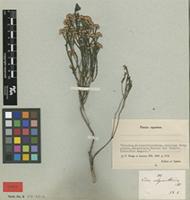
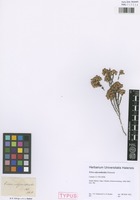
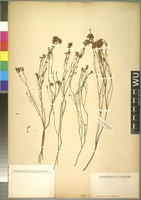
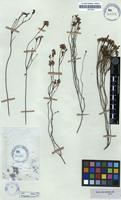
Erica calycanthoides

11 Images see all

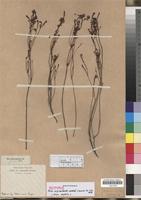
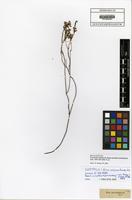
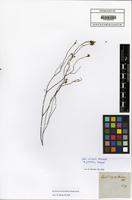
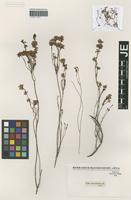
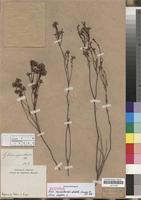
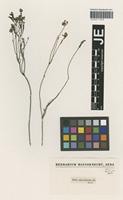
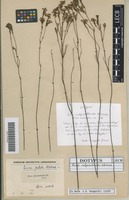
Isotype of Erica calycanthoides Klotzsch [family ERICACEAE]
Isotype of Erica calycanthoides Klotzsch 1838 [family ERICACEAE]
Type? of Erica calycanthoides Klotzsch 1838 [family ERICACEAE]
Isotype of Erica calycanthoides Klotzsch [family ERICACEAE]
Syntype of Erica calycanthoides Klotzsch [family ERICACEAE]
Isotype of Erica calycanthoides Klotzsch [family ERICACEAE]
Type of Erica calycanthoides Klotzsch [family ERICACEAE]
Filed as Erica calycanthoides Kl. [family ERICACEAE]
Isotype of Erica calycanthoides Klotzsch [family ERICACEAE]
Previous
Next

Name

Identification
Erica calycanthoides Klotzsch 1838 [family ERICACEAE ] (stored under name); Verified by Not on sheet,
Related name
  • Erica calycanthoides
  • Erica corifolia

Flora

Entry for ERICA corifolia Linn. [family ERICACEAE]
Herbarium
Royal Botanic Gardens, Kew (K)
Collection
Flora Capensis
Resource Type
Reference Sources
Entry From
Flora Capensis, Vol 4, page 2, (1909) Author: By H. BOLUS, F. GUTHRIE, and N. E. BROWN.
Names
ERICA corifolia Linn. [family ERICACEAE], Sp. Pl. ed. 1, 355, in an extended sense;—Berg. Pl. Cap. 108; Bauer, Exot. Pl. t. 21; Benth. in DC. Prodr. vii. 652.
ERICA corifolia Thunb. [family ERICACEAE], Diss. Erica, 46, partly; see Rach in Linnæa, xxvi. 779.
ERICA corifolia Wendl. var. spicata [family ERICACEAE], Eric. Ic. fasc. 24, 185, t. 70.
ERICA calycina Andr. [family ERICACEAE], Heathery, t. 8, and Col. Heaths, t. 8; Wendl. l.c. fasc. 10, 11; Lodd. Bot. Cab. t. 594.
ERICA calycina Andr. var. melastoma [family ERICACEAE], Heathery, t. 254.
ERICA articularis Curt. [family ERICACEAE], Bot. Mag. t. 423.
“ERICA tunicata Bartl. [family ], in Linnæa, vii. 636,” acc. to Benth.
“ERICA Alopecias Tausch [family ], in Flora, 1837, 498,” acc. to Benth.
ERICA bracteata Thunb. [family ERICACEAE], Diss. Erica, 13.
ERICA obvallaris Salisb. [family ERICACEAE], in Trans. Linn. Soc. vi. 386
“ERICA hyssopifolia Salisb. [family ], l.c. 387,” acc. to Benth.
“ERICA obcordata Sinclair [family ], Hort. Eric. Wob. 17,” acc. to Benth.
ERICA polygalæflora Klotzsch [family ERICACEAE], in Linnæa, xii. 537.
ERICA patula Klotzsch [family ERICACEAE], l.c. 538.
ERICA calycanthoides Klotzsch [family ERICACEAE], l.c. 539.
ERICA obtecta Tausch [family ERICACEAE], in Flora, 1839, 638.
ERICA togatoides Forbes [family ERICACEAE], Hort. Wob. 86.
ERICA erectiuscula Wendl. ex Klotzsch [family ERICACEAE], l.c., 536.
ERICA pigra Soland. ex Salisb. [family ERICACEAE], in Trans. Linn. Soc. vi. 387.
Information
usually 1–1 1/2 ft. high; branches erect or spreading, mostly glabrous, rarely puberulous; leaves mostly 3-nate, in one form (E. patula, Klotzsch) often opposite, erect or adpressed, often imbricate, linear to lanceolate, rarely narrow-ovate, acute, keeled or sulcate, concave, the younger ciliate or naked, 1 1/2–4 1/2 lin. long, the floral sometimes larger, scarious or sepaloid; flowers in terminal clusters, rarely lax; pedicels 1 1/2–2 (rarely 3) lin. long; bracts, two median or nearly so, third basal or wanting, spathulate or oblanceolate, mostly naked, rarely softly ciliate, 1 1/2–4 lin. long; sepals wide-spreading, imbricate below, a little longer or a little shorter than the corolla, rarely about 1/2 its length, obovate or lanceolate, acute, keeled or keel-tipped, very smooth, sometimes shining bright rosy to white, 1 1/2–4 lin. long; corolla varying between tubular-urceolate and ovoid-urceolate, never much inflated at the base or contracted at the throat, bright red to white, 1 1/2–5 lin. long; segments mostly ovate, acute or acuminate, sometimes short and broader than long, discoloured or at length brownish, mostly from 1/4– 1/3 the length of the tube; anthers from cuneate to oblong, 1/3– 2/5 lin. long, crested; pore 1/2 the length of the cell or more; crests lanceolate to ovate, incised or serrulate, about 1/2 the length of the cell; style included; stigma capitate. null
Distribution
COAST REGION frequent on the plains and mountains from Tulbagh Div. to George Div., Thunberg, Burchell, 7661! 7938! Ecklon & Zeyher, 3267! 3268! 3271! MacOwan & Bolus, Herb. Norm. Austr.-Afr., 21! 1304! Guthrie, 1305! 2282! 2287! 2502! 2794! 3613! 4591! Bolus, 1199! 4172! 5431! 6742! 6895! 7512! 8494! 9168! Schlechter, 2267! 5414! 7262! 9508! 10360! Galpin, 3615! 3617! 4941! Wolley Dod, 295! 894! 904!
Notes
A very variable species, which has been unduly divided by the earlier authors, and even Bentham observed under E. corifolia: “A variable species, nor is it separated by any certain characters from its neighbours, since it is connected by intermediate forms with the preceding species [E. bracteata, Thunb. ] and with the four following [E. polygalæflora, patula, nodiflora, and teretiuscula ].” We have examined a very large suite of specimens, and in the result find that it runs into three chief forms, which cannot even be separated into varieties, since they are all connected by intermediates. These are: A. Corolla 3 1/2–5 lin. long; floral leaves often larger and sepaloid; sepals from a little shorter than, to a little exceeding the corolla. This form answers broadly to E. bracteata, Thunb. B. Corolla mostly 2–3 lin. long; floral leaves like the cauline; sepals from 3/4 of the corolla to equal to it in length. This seems to be E. corifolia as understood by Linnæus and the older authors, and as figured by Bauer, by Andrews, l.c. t. 8, and by Wendland, l.c. fasc. 24, t. 70. C. Corolla 1 1/2–2 lin. long, its segments sometimes, but not always, obtuse and broader than long; sepals often white or pallid, in length as in B; leaves often all opposite, or 3-nate and opposite on the same plant. These answer mostly to E. patula, Klotzsch, and in part to E. polygalæflora, Klotzsch, besides others. The nearest allies to the species, as we understand it, are E. nodiflora and E. articularis.

Related Materials

  • Terms and Conditions
  • Privacy Policy
  • Cookie Policy
  • Cookie Settings
  • Accessibility
  • Help
  • Contact Us
  • Facebook
  • Twitter
ITHAKA

JSTOR is part of ITHAKA, a not-for-profit organization helping the academic community use digital technologies to preserve the scholarly record and to advance research and teaching in sustainable ways.

©2000-2026 ITHAKA. All Rights Reserved. JSTOR®, the JSTOR logo, JPASS®, Aluka®, and ITHAKA® are registered trademarks of ITHAKA.

╳