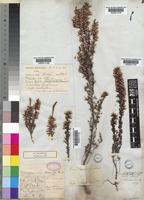
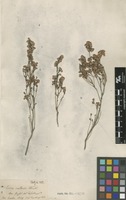
erect, 1–1 1/2 ft. high; branches glabrous or occasionally puberulous; leaves 3-nate, mostly erect or subspreading, longer or sometimes shorter than the internodes, mostly ovate-oblong or oblong, blunt, sulcate, thick, glabrous, usually 1–1 1/2 lin. long, rarely in “drawn-up” specimens linear, subspreading-recurved, 2 lin. long; flowers usually 3-nate, sometimes clustered on short approximate branchlets, sometimes 2-nate or solitary; pedicels puberulous, 1 1/2–2 lin. long; bracts remote, small, about 1 lin. long; sepals ovate or obovate, acute, not keeled, but shortly keel-tipped, and like the bracts mostly cartilaginous, thick, viscid, shining, about 1 1/2 lin. long, a little shorter than, to as long as the corolla; corolla subcyathiform-campanulate or urceolate-campanulate, throat scarcely contracted, viscidulous, pale pink to rosy red, 1 3/4–2 lin. long; segments slightly spreading, semiovate, about 1/2 the tube in length; filaments slender; anthers included, subterminal, ovate-oblong, very obtuse; cells bipartite, stalked upon the decurrent connective (as in E. baccans and E. Lycopodiastrum), a little over 1/4 lin. long, aristate; pore nearly as long as the cell; awns decurrent along the filament for about 1/2 their length, then free, spreading, subulate, about as long as the cell; style included, short; stigma capitellate; ovary glabrous. null