JSTOR Global Plants Home
  • Home
  • Browse
  • About
  • Access
  • Account
    • Saved Items
    • Profile
  • Log in

Global Plants

Skip to Main Content
  • JSTOR Global Plants Home
  • Global Plants

    • Browse
    • About
    • Access
    • Account
      • Saved Items
      • Profile
Log in
  • Browse
  • About
  • Access
  • Account
    • Saved Items
    • Profile
Advanced Search

Compilation
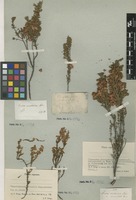
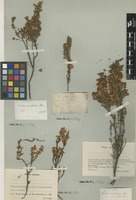
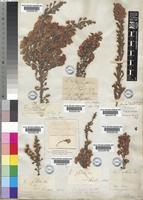
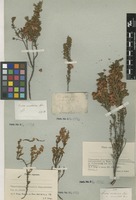
Erica anthina

4 Images see all

Erica moschata unrecorded [family ERICACEAE]
Filed as Erica anthina Spreng. [family ERICACEAE]
Filed as Erica cristiflora Salisb. [family ERICACEAE]
Previous
Next

Name

Identification
Erica moschata unrecorded [family ERICACEAE ] (stored under name); Erica anthina Spreng. [family ERICACEAE ]
Related name
  • Erica anthina
  • Erica moschata

Flora

Entry for ERICA moschata Andr. [family ERICACEAE]
Herbarium
Royal Botanic Gardens, Kew (K)
Collection
Flora Capensis
Resource Type
Reference Sources
Entry From
Flora Capensis, Vol 4, page 2, (1909) Author: By H. BOLUS, F. GUTHRIE, and N. E. BROWN.
Names
ERICA moschata Andr. [family ERICACEAE], Heathery, t. 226, not of Lodd;—Andr. Col. Heaths, t. 248; Benth. in DC. Prodr. vii. 683.
ERICA florida Lodd. [family ERICACEAE], Bot. Cab. t. 234, not of Thunb.
ERICA anthina Spreng. [family ERICACEAE], Syst. Veg. ii. 196, acc. to Benth. & Rach.
Information
erect, 1 ft. or more high; branches few, puberulous, with lateral floriferous branchlets 1–1 1/2 in. long; leaves erect or somewhat spreading, straight or incurved, imbricate but scarcely crowded, lanceolate-linear, subobtuse, pallid, glabrous, the younger ciliolate, 2–3 lin. long; flowers mostly cernuous, not clustered, corolline; pedicels pubescent, 1 1/2–2 1/2 lin. long; bracts subremote or subapproximate, lax, ovate or cordate, acute, keeled, scarious, coloured, about 1 1/4 lin. long; sepals, 2 orbicular, 2 narrower and ovate, obtuse, apiculate, otherwise like the bracts and about as long, rarely reaching to the top of the corolla-tube; corolla obconic or subfunnel-shaped, widely spreading to the mouth, rosy, 2 1/2–4 lin. long; segments continuous, ovate, rounded, variable in length, from less than 1/2 the tube to a little longer than it; anthers included, the lower portion suborbicular, produced above into a contracted acuminate apex for from 1–1 1/2 times the length of the pore, coarsely shaggy and ciliate, foxy-brown, 2/3– 3/4 lin. long; pore about 1/3 the length of the cell; style exserted, very slender; stigma obconic, very small; ovary glabrous. null
Distribution
COAST REGION Tulbagh Div.; Witsen Berg, Ecklon & Zeyher! Winterhoek Berg, 4000 ft., Bolus, 6350! Worcester Div.; Brand Vlei, Masson, 36! Dutoits Peak, 4800 ft., Marloth, 2412!SOUTH AFRICA without locality, Miller! Herb. Salisbury! and cultivated specimens!
Notes
Closely allied, perhaps too closely, to E. cristæflora. It differs by the larger flowers, larger, more acuminate and more shaggy anthers, and also somewhat in habit; the flowers being fewer, less clustered, more cernuous, the branches fewer, the leaves longer and paler. The flowers are fragrant as d by Andrews, and also by Marloth, who likens their odour to that of Disa graminifolia, Ker-Gawl.

Related Materials

  • Terms and Conditions
  • Privacy Policy
  • Cookie Policy
  • Cookie Settings
  • Accessibility
  • Help
  • Contact Us
  • Facebook
  • Twitter
ITHAKA

JSTOR is part of ITHAKA, a not-for-profit organization helping the academic community use digital technologies to preserve the scholarly record and to advance research and teaching in sustainable ways.

©2000-2026 ITHAKA. All Rights Reserved. JSTOR®, the JSTOR logo, JPASS®, Aluka®, and ITHAKA® are registered trademarks of ITHAKA.

╳