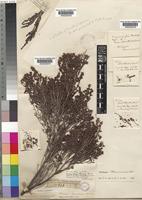
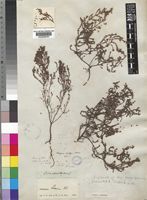
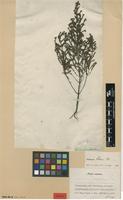
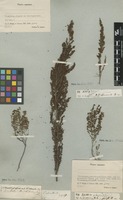
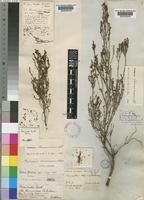
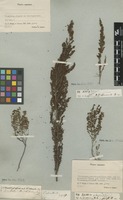
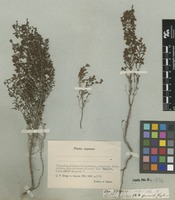
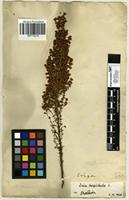
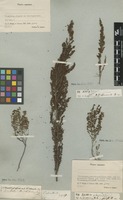
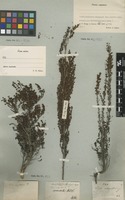
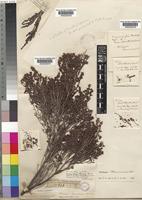
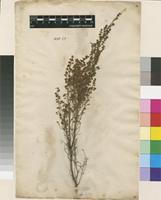
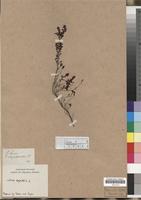
strong-growing, much-branched, of various aspect, commonly 2–3 ft. high, less in dry places, or reaching 5–6 ft. in favourable situations; branches pubescent or hirsute, usually rigid; leaves more or less spreading, from linear and sulcate, to ovate or oblong and then open-backed, often incurved, usually scabrid and hirsute, rarely glabrescent, 1–2 1/2 lin. long; flowers on short more or less distinguishable branchlets, not in dense crowded masses; pedicels 1/3– 1/2 (very rarely 1) lin. long; bracts 3, variable, mostly subremote or remote, occasionally subbasal; sepals linear to lanceolate, foliaceous or cartilaginous, usually reaching as high as the corolla-tube, more rarely equalling the corolla, often viscid; corolla mostly broad-urceolate, sometimes narrower, or occasionally globose-urceolate, at maturity almost always more or less contracted at the throat, generally pale rosy, rarely red, 3/4–1 lin. long; segments more or less spreading, rounded, about 1/4– 1/3 the length of the tube; filaments capillary, mostly about as long as the anthers; anthers included, mostly lateral, rarely sublateral, oblong and obtuse, or longitudinally semiovate, tapering at the base, subacute, smooth, pallid, submembranous, 1/4– 1/3 lin. long, muticous; pore about 1/2 the length of the cell; style shortly exserted; stigma peltate or cyathiform; ovary more or less hispidulous, rarely glabrous. null