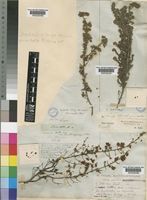
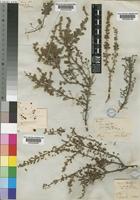
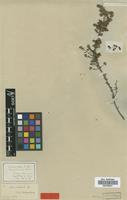
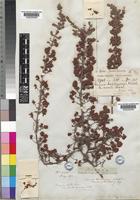
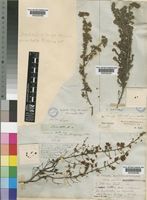
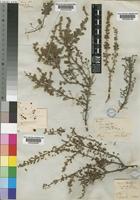
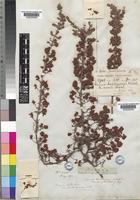
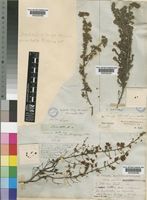
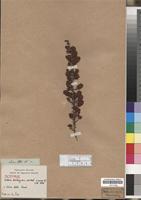
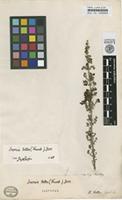
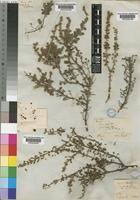
a bush, 2–4 ft. high; branches stout, hairy with rather long spreading hairs or shortly subhispid; leaves 3-nate, spreading or reflexed, 1–3 lin. long with the petiole, usually curved, angular, or ridged and glabrous on the upper side, varying from with long white spreading hairs to subechinate on the back; flowers in compound clusters at the ends of short lateral branches, usually composed of 2 to several clusters of 2–3 flowers on minute axillary branchlets; pedicels 1/4– 1/3 lin. long; bracts 3, adpressed to the calyx, 2/3–1 lin. long and broad, elliptic-ovate, subacute, glabrous or puberulous, serrulate-ciliate, white; calyx equally 4-partite; segments 1–1 1/2 lin. long, 2/3–1 lin. broad, elliptic-oblong, obtuse, white, glabrous or puberulous, serrulate-ciliate, the cilia often gland-tipped and minutely hispid; corolla 1 1/4–1 3/4 lin. long, with the greater part included, urceolate, 4-angled, narrowed from the much inflated base, but scarcely or not at all constricted below the erect rounded lobes, glabrous or occasionally very minutely puberulous, white; stamens about as long as the corolla-tube; filaments filiform, glabrous; anthers 1/3 lin. long, oblong, with contiguous parallel cells, spurless, smooth; ovary rather broadly and obtusely conical, 4-angled, 4-celled, thinly or densely covered with long and very fine woolly hairs at the top; style included or shortly exserted, filiform, glabrous; stigma simple, scarcely or but slightly enlarged. Klotzsch in Linnæa, xii. 218; null