

Compilation
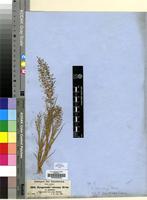
Eragrostis retinorrhea
1 Images see all
Name
Identification
Eragrostis retinorrhea Steud. [family GRAMINEAE ] (stored under name); Verified by Not on sheet,
Related name
- Eragrostis retinorrhea
Flora
Entry for ERAGROSTIS viscosa (Retz.) Trin. [family POACEAE]
Herbarium
Royal Botanic Gardens, Kew (K)
Collection
Flora of Tropical East Africa
Resource Type
Reference Sources
Entry From
Flora of Tropical East Africa, Part (Part 2), page 177, (1974) Author: W. D. CLAYTON, S. M. PHILLIPS AND S. A. RENVOIZE
Names
ERAGROSTIS viscosa (Retz.) Trin. [family POACEAE], in Mém. Acad. Sci. Petersb., sér. 6, 1: 397 (1830); R.K.G.: 17 (1958); Ann. list Nyasaland grasses: 41 (1958); G.T.: 36 (1965); Clayton in F.W.T.A., ed. 2, 3: 386 (1972). Type: India, Malabar, Koenig (LD, holo.)
Poa viscosa Retz. [family POACEAE], Obs. Bot. 4: 20 (1786)
Eragrostis retinorrhea Steud. [family POACEAE], Syn. Pl. Glum. 1: 268 (1854). Type: Ethiopia, Tigre, Gapdia, Schimper 824 (K, iso. !)
Eragrostis strigosa Anderss. [family POACEAE], in Peters, Reise Mossamb., Bot. 1: 559 (1864); Piovano in Webbia 13: 308 (1957). Type: Mozambique, Peters (K, iso. !)
Eragrostis tenella (Retz.) Stapf var. viscosa [family POACEAE], in Hook, f., Fl. Brit. Ind. 7: 315 (1896)
Eragrostis transvaalensis Gand. [family POACEAE], in Bull. Soc. Bot. Fr. 66: 299 (1920). Type: South Africa, Transvaal, Machaben, Schlechter 4659 (LY, holo. !, K, iso. !)
Eragrostis hirsutissima Peter [family POACEAE], F.D.O.-A. 1, Anh.: 103, t. 60/3 (1931). Types: Tanzania, Pare District, Lembeni to Kaili Mt., Peter 41625b & Dodoma, Peter 44427 (both B, syn. †)
Information
Tufted annual; culms 10–40 cm. high, erect. Leaf-blades flat, 4–10 cm. long, 2–5 mm. wide, sticky on keel and margins towards the base; sheath sticky below the collar. Panicle ovate to narrowly oblong, 4–15 cm. long, glabrous or pilose in the axils, the branches sticky from yellowish oblong glandular patches to which grains of sand and debris adhere. Spikelets 5–15-flowered, ovate-oblong, 1.5–4.5 mm. long, yellowish to purplish, breaking up from the apex, the rhachilla fragile; glumes narrowly ovate, subequal, 0.6–1.2 mm. long, the keel usually thickened by a linear sticky yellow gland, acute; lemmas oblong-elliptic, 0.7–1.4 mm. long, glabrous, broadly obtuse, sometimes obscurely mucronate; palea-keels ciliate with hairs 0.1–0.5 mm. long; anthers 3, 0.2–0.3 mm. long. Caryopsis narrowly ellipsoid, 0.5–0.7 mm. long.
Range
DISTR. K6; T1–4, 5, 7 eastwards from Nigeria through India to Thailand and the Philippines, southwards to South Africa; a few records in tropical America
Altitude range
1000–1700 m.
Distribution
KENYA Masai District Selengai, 25 Mar. 1956, Napper 524! & Amboseli National Park, 80 km. E. of Namanga, 5 June 1962, Bogdan 5502 ! & N. side of Lake Amboseli, 16 June 1957, Greenway 9212 !TANZANIA Musoma District near Eastern Boundary of Serengeti National Park, Engari Nanyuki [Nyanuki] Springs, 5 June 1962, Greenway & Turner 10703 !TANZANIA Mbulu District Sambala Hill, 19 May 1929, B. D. Burtt 2607 !TANZANIA Arusha District Nduruma, June 1928, Haarer 1401 !
Notes
The spikelets resemble those of E. tenella, from which E. viscosa may be distinguished by the sticky secretions, denser panicle and glandular glumes and leaf-sheaths; but the boundary is not sharp and intermediates can be found. There is an obvious difference between Asiatic and African plants of E. viscosa in that the former have shorter palea hairs (mostly 0.1–0.2 mm., as compared to 0.3–0.5 mm.) and, in general, are less sticky. However, there is some overlap, and the geographical separation of individual specimens by these characters is unreliable. There seems no point in making a formal taxonomic distinction.