JSTOR Global Plants Home
  • Home
  • Browse
  • About
  • Access
  • Account
    • Saved Items
    • Profile
  • Log in

Global Plants

Skip to Main Content
  • JSTOR Global Plants Home
  • Global Plants

    • Browse
    • About
    • Access
    • Account
      • Saved Items
      • Profile
Log in
  • Browse
  • About
  • Access
  • Account
    • Saved Items
    • Profile
Advanced Search

Compilation
Eragrostis paniciformis

10 Images see all

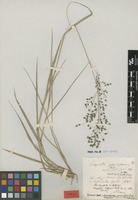
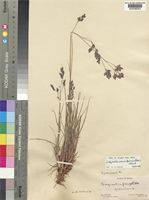
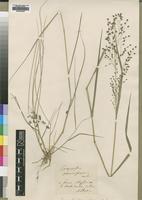
Type? of Poa paniciformis A.Braun [family POACEAE]
Type of Poa paniciformis A.Braun [family POACEAE]
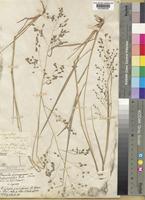
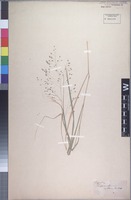
Type? of Eragrostis paniciformis (A.Braun) Steud. [family POACEAE]
Syntype of Eragrostis amabilis (L.) Wight & Arn. var. duriuscula K.Schum. [family POACEAE]
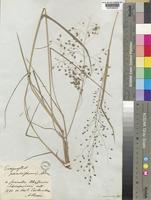
Type of Eragrostis fumigata Peter [family POACEAE]
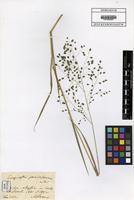
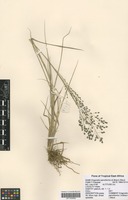
Isotype of Eragrostis paniciformis (A. Braun) Steud. [family POACEAE]
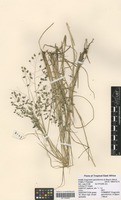
Type of Poa paniciformis A.Br. [family POACEAE]
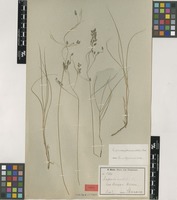
Filed as Eragrostis paniciformis (A. Braun) Steud. [family POACEAE]
Type of Eragrostis paniciformis (A.Br.) Steud. [family POACEAE]
Filed as Eragrostis paniciformis (A. Braun) Steud. [family POACEAE]
Previous
Next

Name

Identification
Eragrostis paniciformis (A.Br.) Steud. [family POACEAE ] (stored under name);
Related name
  • Eragrostis paniciformis
  • Poa paniciformis
  • Eragrostis fumigata

Flora

Entry for ERAGROSTIS paniciformis (A. Br.) Steud. [family POACEAE]
Herbarium
Royal Botanic Gardens, Kew (K)
Collection
Flora of Tropical East Africa
Resource Type
Reference Sources
Entry From
Flora of Tropical East Africa, Part (Part 2), page 177, (1974) Author: W. D. CLAYTON, S. M. PHILLIPS AND S. A. RENVOIZE
Names
ERAGROSTIS paniciformis (A. Br.) Steud. [family POACEAE], ,Syn. Pl. Glum. 1: 268 (1854); Ann. list grasses Ug.: 19 (1947); F.P.N.A. 3: 164 (1955); F.P.S. 3: 458 (1956); R.K.G.: 21(1958); I.G.U.: 32(1960); G.T.: 32(1965). Type: cultivated in Germany at Karlsruhe from seed collected by Schimper in Ethiopia (K, iso.!)
Poa paniciformis A. Br. [family POACEAE], in Flora 24: 274 (1841)
Eragrostis keniensis Pilg. [family POACEAE], in N.B.G.B. 9: 1125(1927). Type: Mt. Kenya, Coles Mill, Fries 1082 (UPS, holo.!)
Eragrostis fumigata Peter [family POACEAE], F.D.O.-A. 1, Anh.: 109, fig. 64/3 (1930). Type: Tanzania, Buha District, Bikare to Mkigo, Peter 38772 (B, holo. †)
Information
Loosely tufted perennial; culms 15–90 cm. high, erect or geniculate. Leaf-blades flat, 3–15 cm. long, 2–5 mm. wide. Panicle ovate, 4–22 cm. long, spreading or somewhat contracted, much branched, the spikelets borne on long slender pedicels. Spikelets 10–26-flowered, narrowly ovate, ovate or ovate-oblong, 4–9 mm. long, 3–5 mm. wide, greyish green to dark green, the rhachilla ± covered by the base of the closely imbricate lemmas, breaking up from the base, the rhachilla persistent; glumes subequal, narrowly ovate, 2–3 mm. long, acute; lemmas broadly ovate-elliptic, 2–2.7 mm. long, the surface ± granular, rounded and somewhat gibbous on the back, the tip abruptly cuspidate to an acute apex or sometimes obtusely triangular; palea falling soon after the lemma, the keels ciliolate with hairs 0.1–0.2 mm. long (these not always well developed in the lower florets); anthers 3, 0.–5–0.7 mm. long. Caryopsis ellipsoid, 0.8–1.2 mm. long. Fig. 60/10, p. 190.
Range
DISTR. U1, 3; K3–7; T1, 3–6
Altitude range
1300–2600 m.
Distribution
KENYA Trans-Nzoia District Kitale, 14 Sept. 1958, Napper 815 !KENYA Nakuru District Elmenteita, Soysambu Estate, 2 Aug. 1947, Bogdan 1000!KENYA Kisumu-Londiani District Fort Ternan scarp, 8 Dec. 1956, Verdcourt 1621!TANZANIA Bukoba District Mshamba, Dec. 1931, Haarer 2341!TANZANIA Ufipa District Nsanga Mt., 13 Mar. 1959, McCallum Webster T.97 ! & Kalambo R. near Kalambo village, 13 Dec. 1958, Vesey-FitzGerald 2070 !UGANDA Busoga District Igwe, 18 Oct. 1950, G. H. Wood Y.11!UGANDA Mbale District Buginyanya, 17 Aug. 1927, Snowden 1178 ! & Bulago, 28 Aug. 1932, A. S. Thomas 330 !
Distribution (external)
Sudan
Ethiopia
Zambia
Notes
E. paniciformis grades into 36, E. chalarothyrsos and 33, E. botryodes. The abruptly narrowed lemma-tip and concealed rhachilla are aids to recognition, but the most reliable distinguishing feature is the palea with its ciliolate keels.

Related Materials

  • Terms and Conditions
  • Privacy Policy
  • Cookie Policy
  • Cookie Settings
  • Accessibility
  • Help
  • Contact Us
  • Facebook
  • Twitter
ITHAKA

JSTOR is part of ITHAKA, a not-for-profit organization helping the academic community use digital technologies to preserve the scholarly record and to advance research and teaching in sustainable ways.

©2000-2026 ITHAKA. All Rights Reserved. JSTOR®, the JSTOR logo, JPASS®, Aluka®, and ITHAKA® are registered trademarks of ITHAKA.

╳