JSTOR Global Plants Home
  • Home
  • Browse
  • About
  • Access
  • Account
    • Saved Items
    • Profile
  • Log in

Global Plants

Skip to Main Content
  • JSTOR Global Plants Home
  • Global Plants

    • Browse
    • About
    • Access
    • Account
      • Saved Items
      • Profile
Log in
  • Browse
  • About
  • Access
  • Account
    • Saved Items
    • Profile
Advanced Search

Compilation
Eragrostis acraea

3 Images see all

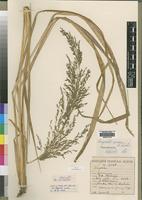
Isotype of Eragrostis acraea DeWinter [family POACEAE]
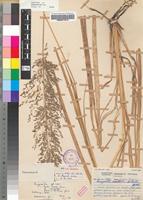
Holotype of Eragrostis acraea De Winter [family POACEAE]
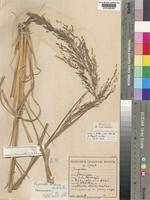
Syntype of Eragrostis acraea De Winter [family POACEAE]
Previous
Next

Name

Identification
Isotype of Eragrostis acraea DeWinter [family POACEAE ] (stored under name); Verified by Winter,B.,
Related name
  • Eragrostis acraea

Flora

Entry for Eragrostis acraea De Winter [family GRAMINEAE]
Herbarium
Royal Botanic Gardens, Kew (K)
Collection
Flora Zambesiaca
Resource Type
Reference Sources
Entry From
FZ, Vol 10, Part 2, (1999) Author: T. Cope
Names
Eragrostis acraea De Winter [family GRAMINEAE], in Kirkia 1: 100 (1961). —Simon in Kirkia 8: 26 (1971). —Gibbs Russell et al., Grasses Southern Africa [Mem. Bot. Surv. S. Africa No. 58]: 144 (1990). TAB. 24, fig. 12. Type: Zimbabwe, Vumba Mts., Obermeyer 2046 (PRE, holotype; BM; BOL; K; SRGH).
Information
Densely caespitose perennial without rhizomes or stolons; culms stout, up to 200 cm tall, erect, usually unbranched, glabrous at the nodes, eglandular; basal leaf sheaths glabrous, firmly chartaceous, glossy yellow, terete, eglandular, persistent or decaying into parallel fibres; ligule a line of hairs; leaf laminas 15–40(60) cm × 6–12(15) mm, linear, rigid and pungent, flat (involute on drying), glabrous or sparsely pilose, eglandular.Panicle 15–70 cm long, narrowly oblong-elliptic, rather dense and usually contracted, the spikelets evenly distributed on pedicels 2–6 mm long, the primary branches 1–several at a node but scarcely whorled, terminating in a fertile spikelet, glabrous in the axils, eglandular.Spikelets 3–7 × 2–2.5 mm, oblong to lanceolate-oblong, laterally compressed, 5–7(12)-flowered, the florets disarticulating from below upwards, the rhachilla persistent; glumes unequal, keeled, narrowly lanceolate in profile, densely scaberulous all over, acute at the apex, the inferior 1–1.5 mm long, reaching to c. 2/3 the way along the adjacent lemma, the superior 1.6–2(2.3) mm long, reaching to about the middle of the adjacent lemma; lemmas 2.3–2.8 mm long, keeled, narrowly elliptic to lanceolate-elliptic in profile, firmly membranous with somewhat indistinct lateral nerves, diverging from the rhachilla at 45°, those in opposite rows not imbricate, the rhachilla visible between them, greyish-green, densely scaberulous all over, subacute to acute at the apex; palea deciduous with or soon after the lemma, scaberulous on the flanks, the keels slender, wingless, scabrid; anthers 3, 1.3–1.5 mm long.Caryopsis 0.7–1 mm long, oblong-elliptic, dorsally grooved.
Habitat
Submontane grassland and forest margins, and on grassy rocky hillsides, often on granite sands
Altitude range
1050–2000 m.
2000
1050
Distribution
Zimbabwe W Matobo Distr., Besna Kobila Farm, 1465 m, xii.1957, Miller 4822 (COI; K; PRE).Mozambique MS Serra de Choa, Catandica (Vila Gouveia), 1200 m, 8.ix.1943, Torre 5890 (LISC).Zimbabwe C Harare (Salisbury), 27.i.1931, Stent & Rattray 3618 (BM; K).Zimbabwe E Chimanimani Distr., Glencoe Forest Reserve, iv.1955, Armitage 91/55 (K; PRE; SRGH).
Distribution (external)
South Africa (Transvaal)

Related Materials

  • Terms and Conditions
  • Privacy Policy
  • Cookie Policy
  • Cookie Settings
  • Accessibility
  • Help
  • Contact Us
  • Facebook
  • Twitter
ITHAKA

JSTOR is part of ITHAKA, a not-for-profit organization helping the academic community use digital technologies to preserve the scholarly record and to advance research and teaching in sustainable ways.

©2000-2026 ITHAKA. All Rights Reserved. JSTOR®, the JSTOR logo, JPASS®, Aluka®, and ITHAKA® are registered trademarks of ITHAKA.

╳