JSTOR Global Plants Home
  • Home
  • Browse
  • About
  • Access
  • Account
    • Saved Items
    • Profile
  • Log in

Global Plants

Skip to Main Content
  • JSTOR Global Plants Home
  • Global Plants

    • Browse
    • About
    • Access
    • Account
      • Saved Items
      • Profile
Log in
  • Browse
  • About
  • Access
  • Account
    • Saved Items
    • Profile
Advanced Search

Compilation
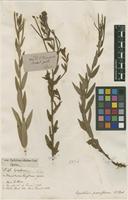
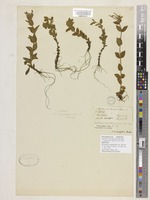
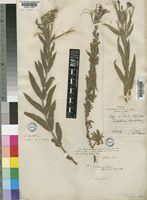
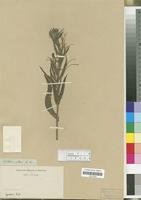
Epilobium villosum

4 Images see all

Filed as Epilobium parviflorum Schreb. [family ONAGRACEAE]
Epilobium trichophyllum Hausskn. [family ONAGRACEAE]
Epilobium hirsutum L. [family ONAGRACEAE]
Filed as Epilobium hirsutum L. [family ONAGRACEAE]
Previous
Next

Name

Identification
Epilobium hirsutum L. [family ONAGRACEAE ] (stored under name); Verified by Not on sheet, Epilobium villosum Thunb. [family ONAGRACEAE ] Verified by Not on sheet,
Related name
  • Epilobium parviflorum
  • Epilobium villosum
  • Epilobium hirsutum

Flora

Entry for EPILOBIUM hirsutum Linn. [family ONAGRACEAE]
Herbarium
Royal Botanic Gardens, Kew (K)
Collection
Flora Capensis
Resource Type
Reference Sources
Entry From
Flora Capensis, Vol 2, page 503, (1894) Author: (BY W. H. HARVEY.)
Names
EPILOBIUM hirsutum Linn. [family ONAGRACEAE], ;—DC. Prodr. 3, p. 42. E. Bot. t. 838.
EPILOBIUM villosum Thunb. [family ONAGRACEAE], Cap. p. 374. DC. l. c. Drege! 6851. Zey.! 545.
Information
stem tall, erect, much branched, terete, softly hairy and villous; leaves opposite and alternate, villous, lanceolate or oblongo-lanceolate, sessile or half-clasping, unequally and rather sharply serrulate; stigma deeply 4- lobed, its lobes strongly revolute. Stem 3–5 feet high, robust, pyramidal, with many lateral branches. Pubescence copious, soft, and somewhat hoary, but variable in amount and in the length of the hairs. Leaves mostly lanceolate; the lower ones opposite, broader, and more oblong. Flowers bright purple. I cannot separate this from the European E. hirsutum; Cape specimens differ as much among themselves, in hairiness, shape, and size of leaves and size of flower, as any of them do from the European plant. Seringe (DC. l. c.) chiefly relies in distinguishing E. villosum from E. hirsutum, on the stigma, which he states to be “somewhat thicker and more convolute” in E. villosum.
Distribution
SOUTH AFRICA Moist places and by river-banks. Districts of Cape, Uitenhage, and Albany, E. & Z.! Worcester, Pappe! Stellenbosch, W. H. H. Dutoitskloof, Kamdebo, Sneeuwberg; and several localities in Caffraria, Drege! Natal, Sanderson! (Herb. Sd., D.)

Related Materials

  • Terms and Conditions
  • Privacy Policy
  • Cookie Policy
  • Cookie Settings
  • Accessibility
  • Help
  • Contact Us
  • Facebook
  • Twitter
ITHAKA

JSTOR is part of ITHAKA, a not-for-profit organization helping the academic community use digital technologies to preserve the scholarly record and to advance research and teaching in sustainable ways.

©2000-2026 ITHAKA. All Rights Reserved. JSTOR®, the JSTOR logo, JPASS®, Aluka®, and ITHAKA® are registered trademarks of ITHAKA.

╳