

Compilation
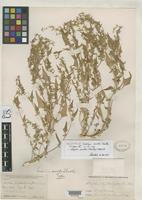
Endolepis covillei
1 Images see all
Name
Identification
Endolepis covillei Standley, P.C. 1916 [family CHENOPODIACEAE ] (stored under name); Verified by Welsh, S.L.,
Related name
- Endolepis covillei
Common name
- Coville’s orach, Flora of North America Vol. 4
Flora
Entry for Atriplex covillei (Standley) J. F. Macbride [family CHENOPODIACEAE]
Herbarium
Flora of North America (FNA)
Collection
Flora of North America
Resource Type
Reference Sources
Entry From
Flora of North America, Vol 4,
Names
Atriplex covillei (Standley) J. F. Macbride [family CHENOPODIACEAE], Contr. Gray Herb., 53 : 11. 1918
Endolepis covillei Standley [family ], in N. L. Britton et al., N. Amer. Fl., 21: 73. 1916
Treatment Author(s)
Stanley L. Welsh
Information
Herbs, spreading, 1–4(–5) dm and as broad. Stems terete, sparsely scurfy when young. Leaves: petiole to 1/2 as long as blade (becoming subsessile distally); blade green or finally stramineous, (10–)20–50 × 6–30 mm, firm, base abruptly acute to narrowly cuneate, apex acute to attenuate, sparsely scurfy. Staminate flowers in sessile glomerules in distal axils, often mixed with pistillate ones, staminate calyx deeply 5-cleft; lobes obtuse, not appendaged. Pistillate flowers with calyx of (1–)3(–5) hyaline sepals. Fruiting bracteoles sessile or stipitate, 6–12 × 4–7 mm, margin mostly 3-lobed, with elongate terminal lobe triangular to lanceolate, 2 short rounded lobes at base or sides merely rounded at base, united to beyond middle. Seeds dark reddish brown, 1–1.5 mm.
Phenology
jun-aug (summer), sep-nov (fall)
Altitude range
800–1700 m;
Distribution
USA Calif.USA Nev.USA Oreg.
Discussion
Endolepis covillei was treated within the synonymy of Atriplex phyllostegia (Torrey) S. Watson by H. M. Hall and F. E. Clements (1923).
H. C. Stutz et al. (1993) placed Atriplex covillei within Endolepis, based in large part on the presence of a perianth subtending the pistil within the fruiting bracteoles and on the lack of Kranz anatomy in the leaves. The pattern of venation is, nevertheless, very similar to that in species with Kranz anatomy. The presence of perianth scales in the pistillate flowers of A. covillei has been regarded as evidence of relationship with A. suckleyi. Despite placement of these taxa within Endolepis by Stutz et al. Atriplex covillei is possibly more closely allied to the morphologically similar and partially sympatric A. phyllostegia than it is to strongly dissimilar and the distantly disjunct A. suckleyi. Stutz and his associates placed great emphasis on the presence of reduced perianth segments subtending the pistil within the fruiting bracteoles of A. covillei. Calyces per se, otherwise known only in A. suckleyi and A. pleiantha, probably have arisen independently. Their presence does not necessarily indicate a close relationship. Stutz et al. pointed to other differences aside from the calyx of the pistillate flowers, and it is apparent that the two entities can stand as distinct species. To segregate A. covillei within a separate genus and to ally it with a species to which its relationships are obscure at best, stretches logic beyond reason.