

Compilation
Embelia nyassana
1 Images see all
Name
Identification
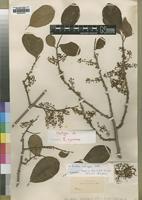
Isotype of Embelia nyassana Gilg [family MYRSINACEAE ] Embelia schimperi Vatke [family MYRSINACEAE ] (stored under name);
Related name
- Embelia nyassana
- Embelia schimperi
Flora
Entry for Embelia schimperi Vatke [family MYRSINACEAE]
Herbarium
Royal Botanic Gardens, Kew (K)
Collection
Flora Zambesiaca
Resource Type
Reference Sources
Entry From
FZ, Vol 7, Part 1, page 198, (1983) Author: F. K. Kupicha
Names
Embelia abyssinica Baker [family MYRSINACEAE], in F.T.A. 3: 497 (1877). Type from Ethiopia.
Embelia guineensis Baker [family MYRSINACEAE], tom. cit.: 496 (1877). — Mez, tom. cit.: 331 (1902). — Hepper, loc. cit. Type from Guinea.
Embelia nyassana Gilg [family MYRSINACEAE], in Engl., op. cit. 30: 96 (1901). — Mez, tom. cit.: 329 (1902). — S.Moore in Journ. Linn. Soc.,Bot .40:130(1911). — Eyles inTrans. Roy. Soc. S. Afr.5: 436 (1916). — Burtt Davy & Hoyle, N.C.L.: 55 (1936). Type from “Nyassaland” (Malawi), Buchanan 42 (BM, isotype).
Embelia retusa Gilg [family MYRSINACEAE], in Engl., tom. cit.: 95 (1901). — Mez, tom. cit.: 330 (1902). Syntypes from Zaire.
Embelia gilgii Mez [family MYRSINACEAE], loc. cit. Svntypes from Togo and Sierra Leone.
Embelia bambuseti Gilg & Schellenb. [family MYRSINACEAE], in Engl., Bot. Jahrb. 48: 520 (1912). Type from Tanzania.
Embelia tibatiensis Gilg & Schellenb. [family MYRSINACEAE], tom. cit.: 521 (1912). Syntypes from Cameroon.
Embelia tessmannii Gilg & Schellenb. [family MYRSINACEAE], tom. cit.: 522 (1912). Type from Equatorial Guinea.
Embelia dasyantha Gilg & Schellenb. [family MYRSINACEAE], loc. cit. Type from Cameroon.
Embelia batesii S. Moore [family MYRSINACEAE], in Journ. Bot. 63: 147 (1925). Type from Cameroon.
Embelia spp. [family MYRSINACEAE], — Eyles, loc. cit.
Embelia sp. a [family MYRSINACEAE], — Hepper in F.W.T.A. ed. 2, 2: 32 (1963).
Embelia schimperi Vatke [family MYRSINACEAE], in Linnaea 40: 206(1876). — Mez in Engl., Pflanzenr. IV, 236: 329 (1902). — Hepper in F.W.T.A. ed. 2, 2: 32 (1936). — Brenan in Mem. N.Y. Bot. Gard. 8: 498 (1954). — F. White, F.F.N.R.: 316 (1962). — R. B. Drumm. in Kirkia 10: 265 (1975). — P. Halliday in F.T.E.A., Myrsinaceae: in print. Type from Ethiopia.
Embelia sp. [family MYRSINACEAE], — Dyer in Fl. Southern Afr.26: 5 (1963).
Embelia kilimandscharica Gilg [family MYRSINACEAE], in Engl., Bot. Jahrb. 19, Beibl. 47: 45 (1894). — Mez, tom. cit.: 326 (1902). Type from Tanzania.
Pattara pellucida Hiern [family MYRSINACEAE], Cat. Afr.Pl. Welw. 3: 639 (1898). Type from Angola.
Embelia pellucida Hiern K. Schum. [family MYRSINACEAE], in Just’s Bot. Jahresb. 26: 390 (1900). Type as above.
Embelia mujenja Gilg [family MYRSINACEAE], in Engl, op. cit. 28: 446 (1900). — Mez, tom. cit.: 330 (1902). Type from Tanzania.
Information
Scandent shrub or liane climbing to 6 m. by means of hard persistent lateral short shoots, with long trailing branches up to 5 cm. or more in diameter; young stems glabrous; bark greyish or blackish, that of twigs longitudinally furrowed, with prominent lenticels. Plants dioecious or more rarely flowers hermaphrodite. Leaves 2·5–10 x 1·5–6 cm., elliptic, obovate or suborbicular, apiculate, acute, obtuse or emarginate at apex, almost truncate to tapering at base, entire, clustered at ends of branches; petiole 0·5–1 cm. long; lamina glossy, pale to dark green, thinly fleshy to coriaceous, inconspicuously to prominently nerved, with or without obvious black resin–dots (these punctate or shortly linear), glabrous. Racemes 2·5–3 cm. long, 15–35–flowered, cylindrical, borne on lateral short shoots on old wood proximal to current year’s leaves, densely pubescent with short gland–tipped hairs; pedicels 3–6 mm. long, each subtended by a triangular bract c. 1 mm. long, with triangular to ovate lobes c. 2 x length of tube, glandular–pubescent, often with a few black resin–dots on abaxial side; petals free, 2·6–3·2 mm. long, oblong to narrowly ovate, white, cream–coloured, greenish or yellowish, sparsely to densely glandular–pubescent especially on margin and inner surface, often with black resin–dots on abaxial side. male flower: stamens functional; anthers 1–1·2 mm. long, oblong, yellow, with black dot on outer side near point of attachment; filament adnate to petal for a variable distance (up to middle of petal), elongating during anthesis so that the anther is eventually well exserted from flower; gynoecium 0·8– 1·2 mm. long, rudimentary. female flower: stamens as in male flower but anthers triangular, functionless and filaments scarcely elongating; gynoecium 3–3·2 mm. long, clavate, the stigma conspicuously lobed. hermaphrodite flower with stamens as in male flower and ovary as in female flower. Fruit c. 5 mm. in diameter, globose or compressed–globose, 1–seeded, greenish at first becoming scarlet when ripe. Seed globose with basal cavity.
Habitat
On river banks, in ravine forests and at forest margins, and in woodland on termitaria.
Range
Widespread in tropical Africa
Distribution
Mozambique MS Báruè, 17 km. from Catandica (Vila Gouveia), c. 1500 m., fr. immat. 13.xii.1965, Torre & Correia 13624 (LISC).Mozambique T Angonia, between Cólubuè and Vila Coutinho, c. 1500 m., fr. 7.iii.1964, Correia 175 (LISC; MO).Mozambique Z Gúruè (VilaJunqueiro),st. 7.vii.1942, Hornby 4–556 (K; PRE).Malawi S Thondwe (Ntondwe), fl. 21.x.1905, Cameron 159 (K).Malawi C Dedza Distr., Chongoni Forest near Nchinje stream, fr. 19.xii.1957, Adlard 270 (MAL; SRGH).Zambia C Roma Township, Lusaka, fl. buds 17.xii.1963, Angus 3815 (K).Zambia W Ndola, fr. immat. 18.xii.1954, Fanshawe 1730 (K; SRGH).Zambia N Mbala (Abercorn), near L. Chila, 1680 m ., fl. 11.xii.1954, Siame 530 (K).Mozambique N Massangulo, st. 15.v.1948, Pedro & Pedrogão 3529 (LMA).Malawi N Mzimba Distr., 1 .5km. W. ofLupaso School near Mzuzu, 1370 m., fr. 31.i.1971, Pawek 4351 (K; MAL).Zimbabwe E Inyanga Distr., Eastern Highlands Tea Estate, fl. & fr. immat. 17.xi.1960, Wild 5277 (K; PRE; SRGH).Zambia B Mongu Distr., Luanginga R., c. 6 km. NW. of Sandaula Pontoon, fl. & fr. 17.xi.1959, Drummond & Cookson 6587 (K; LISC; PRE; SRGH).Caprivi Strip Mpila I., 910 m., fr. 15.i.1959, Killick & Leistner 3387 (K).
Notes
This very widespread tropical African species is variable in leaf characters, and the many synonyms were based on particular leaf–forms, these often being paralleled in distant regions. The type specimen of E. schimperi (Ethiopia) has oblong–elliptic, rather coriaceous leaves rounded–acute at both ends, with prominent reticulate venation and apparently no resin–dots. The type specimens of E. guineensis (Sierra Leone), E. pellucida (Angola) and E. nyassana (Malawi) have obovate leaves of thin chartaceous texture (when dry), rounded at apex, tapering at base, with venation very inconspicuous or impressed and then the lamina puckered along each nerve; there are numerous conspicuous resin–dots. In F.W.T.A., Hepper recognised these two extreme forms and a third, species A, with the leaf–shape and resin–dots of “E. guineense” but the texture and strong venation of “E. schimperi”.Throughout tropical Africa, there is some degree of correlation between leaf–shape, leaf–texture and geography, in that the elliptic, coriaceous, strongly veined leaf is predominant in Ethiopia and countries of the F.T.E.A. area while the obovate, chartaceous, weak–veined, punctate leaf is the usual form in the F.Z. area. In Angola, Zaire and W. tropical Africa, both forms are equally represented. Despite this partial geographical separation, I am not convinced that if the specimens of each extreme form were grouped together they would represent two genuine genetically distinct taxa, and in any case many intermediates would remain. More work needs to be done to discover whether the differences are taxonomically significant or merely environmental. Brenan (in Mem. N.Y. Bot. Gard. 8: 490, 1954) took a similar view, though on a more limited scale, when he proposed that E. schimperi was the correct name for E. ahyssinica, E. kilimandscharica, E. nyassana and (probably) E. mujenja and E. pellucida.A few specimens from the extreme W. of the F.Z. area have rather small leaves, probably reflecting the relatively dry environment in these localities. They include Killick & Leistner 3387 (K) from the Caprivi Strip, which Dyer in Fl. Southern Afr.26: 5 (1963) mentions as possibly belonging to E. ruminata, and Codd 7316 (BM; K) from Zambia (B) which P. Halliday in Kew Bull. 32: 294 (1978) cites under E. xylocarpa. Drummond & Cookson 6587 (K; LISC; PRE; SRGH) from the same area is a similar form. A single gathering from Zimbabwe (E: Inyanga Distr., Stapleford, Chisanza R., 1220 m., fr. 4.iv.1962, Wild 5696 (FHO; PRE)) is very unusual in having dentate leaves. E. ruminata (E. Mey. ex. A. DC.) Mez, from S. Africa, is closely related to E. schimperi. It differs in having generally much smaller leaves (1–7 x 0·7–3 cm.), rather contorted branches with much closer nodes than in E. schimperi, and shorter, fewer–flowered racemes (up to 1 cm. long with up to 10 flowers).