JSTOR Global Plants Home
  • Home
  • Browse
  • About
  • Access
  • Account
    • Saved Items
    • Profile
  • Log in

Global Plants

Skip to Main Content
  • JSTOR Global Plants Home
  • Global Plants

    • Browse
    • About
    • Access
    • Account
      • Saved Items
      • Profile
Log in
  • Browse
  • About
  • Access
  • Account
    • Saved Items
    • Profile
Advanced Search

Compilation
Elytraria minor

4 Images see all

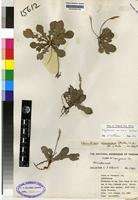
Isotype of Elytraria minor Dokosi [family ACANTHACEAE]
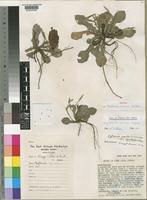
Holotype of Elytraria minor Dokosi [family ACANTHACEAE]
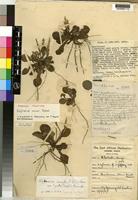
Isotype of Elytraria minor Dokosi [family ACANTHACEAE]
Previous
Next

Name

Identification
Elytraria minor Dokosi [family ACANTHACEAE ] (stored under name); Verified by Not on sheet,
Related name
  • Elytraria acaulis
  • Elytraria unrecorded
  • Elytraria minor

Flora

Entry for Elytraria minor Dokosi [family ACANTHACEAE]
Herbarium
Royal Botanic Gardens, Kew (K)
Collection
Flora of Tropical East Africa
Resource Type
Reference Sources
Entry From
Flora of Tropical East Africa, page 1, (2008) Author: Kaj Vollesen
Names
Elytraria minor Dokosi [family ACANTHACEAE], in Adansonia 18: 433 (1979). Type: Kenya, Lamu District: Mambasasa, Utwani Forest Reserve, Greenway & Rawlins 9366 (EA!, holo.; K!, iso.)
Information
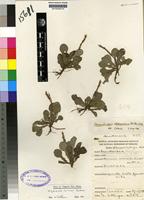
Acaulescent perennial herb with a short creeping or suberect sometimes branched rootstock, apical part (where leaves attached) with short (under 1 mm long) puberulous hairs. Leaves in a basal rosette, appressed to the ground, often variegated with pale green areas along midrib and lateral veins, subsessile or with petiole up to 1.5(–2) cm long; lamina lyrate, obovate-spathulate in outline, terminal segment elliptic to orbicular, largest 2.5–10≈1–4.2 cm, apex subacute to truncate, base attenuate, decurrent, margin on terminal segment entire to crenate; below sparsely puberulous along midrib and lateral veins and often with very fine scattered hairs on lamina, above with sparse curly hairs on midrib and usually scattered hairs on lamina. Spikes 1.5–6.5(–9) cm long, unbranched or branched; peduncle 1–7.5(–9.5) cm long; sterile bracts imbricate, ovate, 3–5.5(–6) mm long, acuminate to cuspidate, glabrous but for a finely ciliate margin, very finely rugose on back, indistinctly keeled; fertile bracts green or pale green, broadly ovate, 5–6.5 mm long, acuminate to cuspidate, ± a narrow scarious margin, glabrous but for a finely ciliate margin, sometimes indistinctly keeled; bracteoles lanceolate, 3–4 mm long (including a dorsally attached mucro up to 1 mm long), acuminate, crisped-puberulous in a central band and finely ciliate near apex. Sepals ciliate near apex, otherwise glabrous; dorsal elliptic, 3–4 mm long, broadly rounded to truncate (rarely subacute); lateral and ventral lanceolate to narrowly elliptic, 3.5–4.5 mm long (including a dorsally attached mucro 0.5–1 mm long). Corolla white or cream, often cleistogamous or apparently only opening partially; tube 2–3.5 mm long; lobes 1.5–3 mm long, sometimes bifid. Stamens 2, subsessile; anthers ± 0.5 mm long. Capsule 4–5 mm long, glabrous. Seed ± 0.75 mm long, pitted. Fig. 1, 1–7, p. 13.
Range
DISTR. K 7; T 3, 6 not known elsewhere
Altitude range
15–450(–650) m
Distribution
KENYA Lamu District Utwani Forest, 31 Aug. 1956, Rawlins 34! & Mambasasa, 30 Jan. 1958, Verdcourt 2131!KENYA Kilifi District Sokoke Forest, near Jilore Forest Station, 28 Aug. 1971, Faden 71/798!TANZANIA Tanga District 8 km SE of Ngomeni, 29 July 1953, Drummond & Hemsley 3508!TANZANIA Lushoto District E Usambara Mts, Sigi, 30 May 1917, Peter 60525!TANZANIA Morogoro District Nguru Mts, Turiani, Diwali River, 23 Nov. 1955, Milne-Redhead & Taylor 7360!
Notes
This is obviously closely related to the widespreadE. acaulis, but deserves to be treated as a distinct species. Superficially most similar to forms ofE. acauliswith lyrate leaves, but distinguished by the smaller flowers, differently shaped and smaller sepals, smaller capsule and rootstock with short puberulous hairs. In Kenya and Tanzania where both species occur there are also differences in habitat withE. acaulisusually growing on clayey floodplains andE. minoron lighter soils in coastal forest.

Related Materials

  • Terms and Conditions
  • Privacy Policy
  • Cookie Policy
  • Cookie Settings
  • Accessibility
  • Help
  • Contact Us
  • Facebook
  • Twitter
ITHAKA

JSTOR is part of ITHAKA, a not-for-profit organization helping the academic community use digital technologies to preserve the scholarly record and to advance research and teaching in sustainable ways.

©2000-2026 ITHAKA. All Rights Reserved. JSTOR®, the JSTOR logo, JPASS®, Aluka®, and ITHAKA® are registered trademarks of ITHAKA.

╳