JSTOR Global Plants Home
  • Home
  • Browse
  • About
  • Access
  • Account
    • Saved Items
    • Profile
  • Log in

Global Plants

Skip to Main Content
  • JSTOR Global Plants Home
  • Global Plants

    • Browse
    • About
    • Access
    • Account
      • Saved Items
      • Profile
Log in
  • Browse
  • About
  • Access
  • Account
    • Saved Items
    • Profile
Advanced Search

Compilation
Eleocharis tortilis

4 Images see all

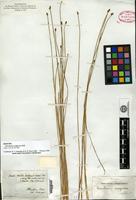
Isotype of Eleocharis compressa Sullivant [family CYPERACEAE]
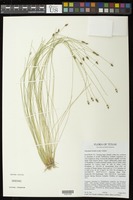
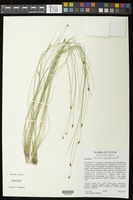
Eleocharis tortilis (Link) Schult. [family CYPERACEAE]
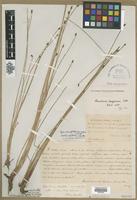
Type? of Eleocharis compressa Sull. [family CYPERACEAE]
Previous
Next

Name

Identification
Isotype of Eleocharis compressa Sullivant [family CYPERACEAE ] (stored under name); Verified by Sull., 1842 Eleocharis tortilis Schultes [family CYPERACEAE ] Verified by E. Tuckerman,
Related name
  • Eleocharis tortilis
  • Eleocharis compressa

Flora

Entry for Eleocharis tortilis (Link) Schultes [family CYPERACEAE]
Herbarium
Flora of North America (FNA)
Collection
Flora of North America
Resource Type
Reference Sources
Entry From
Flora of North America, Vol 23,
Names
Eleocharis tortilis (Link) Schultes [family CYPERACEAE], Mant., 2: 92. 1824
Scirpus tortilis Link [family CYPERACEAE], Jahrb. Gewächsk., 1(3): 78. 1820
Treatment Author(s)
S. Galen Smith*
Jeremy J. Bruhl*
M. Socorro González-Elizondo*
Francis J. Menapace*
Information
Plants perennial, forming dense clumps, not stoloniferous, rhizomatous. Rhizomes usually present, caudexlike, ascending, 1 mm thick, hidden by crowded culms; internodes and scales not evident. Culms sometimes spirally twisted, usually minutely red-spotted at 30X, acutely triangular or sometimes elliptic, 15–70 cm × 0.3–0.5(–1) mm, soft (to firm), often minutely granular at 10X. Leaves: distal leaf sheaths persistent, stramineous to green, often minutely red-spotted, membranous to papery, apex subacute to narrowly acute, often with toothlike callus. Spikelets: basal spikelets absent; never proliferous, ovoid to lanceoloid or ellipsoid, terete, 4–12 × 2–4 mm, apex acute; proximal scale empty, deciduous, clasping 1/2 of culm, similar to floral scales; subproximal scale often empty; floral scales spiraled, 10–25, 5–6 per mm of rachilla, pale orange-brown, midrib regions broadly pale green to colorless, broadly ovate, 2–2.5(–3.5) × 1.5–2 mm, central area and often flanks papery to cartilaginous or sometimes membranous, midrib evident, apex subacute (to rounded). Flowers: perianth bristles 4–6, bright brown, stout, equaling to slightly exceeding tubercle; spinules dense, retrorse, sharply acute; stamens 3; anthers 0.5–0.9 mm; styles 3-fid. Achenes medium brown or yellowish or greenish, obpyriform, obtusely (often obscurely) compressed trigonous, angles evident, 1.2–1.7(–2.4) × 0.9–1.2(–2.2) mm, apex constricted proximal to tubercle, coarsely cancellate at 10X, each face with 8–10 longitudinal rows of distinctly depressed, enlarged cells. Tubercles brown to greenish (or bone-white), pyramidal, trigonous or cross section plano-convex, 0.3–0.7(–1) × 0.3–0.6(–0.9) mm, distinctly shorter or narrower than achene, apex acute, often acuminate.
Phenology Fruiting
spring
mar
apr
may
fall
sep
oct
nov
Altitude range
10–100 m;
Distribution
USA Ala.USA Ark.USA Fla.USA Ga.USA La.USA Md.USA Miss.USA N.J.USA N.C.USA S.C.USA Tenn.USA Tex.USA Va.
Discussion
Eleocharis tortilis differs consistently from E. tuberculosa only in tubercle size. Most specimens of E. tortilis have culms that are sharply trigonous and no more than 0.5 mm wide. However, about two-thirds of the specimens of E. tortilis from Texas resemble E. tuberculosa in having culms that are elliptic or subelliptic in cross section and that sometimes reach 1 mm wide. Those elliptic-culmed plants may deserve taxonomic recognition. I have not seen voucher specimens for reports in the literature (H. K. Svenson 1937; M. L. Brown and R. G. Brown 1984) for Alabama (Mobile, 1800s), Delaware (1908), Maryland (1863–1878), and New York (Long Island, 1903).

Related Materials

  • Terms and Conditions
  • Privacy Policy
  • Cookie Policy
  • Cookie Settings
  • Accessibility
  • Help
  • Contact Us
  • Facebook
  • Twitter
ITHAKA

JSTOR is part of ITHAKA, a not-for-profit organization helping the academic community use digital technologies to preserve the scholarly record and to advance research and teaching in sustainable ways.

©2000-2026 ITHAKA. All Rights Reserved. JSTOR®, the JSTOR logo, JPASS®, Aluka®, and ITHAKA® are registered trademarks of ITHAKA.

╳