JSTOR Global Plants Home
  • Home
  • Browse
  • About
  • Access
  • Account
    • Saved Items
    • Profile
  • Log in

Global Plants

Skip to Main Content
  • JSTOR Global Plants Home
  • Global Plants

    • Browse
    • About
    • Access
    • Account
      • Saved Items
      • Profile
Log in
  • Browse
  • About
  • Access
  • Account
    • Saved Items
    • Profile
Advanced Search

Compilation
Eleocharis tenuis

10 Images see all

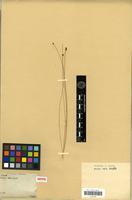
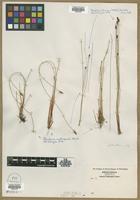
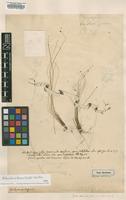
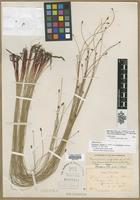
Isotype of Scirpus tenuis Willd. [family CYPERACEAE]
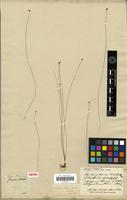
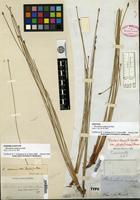
Type? of Eleocharis capitata var. pseudoptera Weath. [family CYPERACEAE]
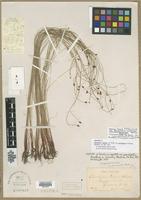
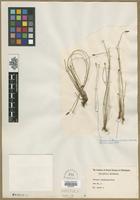
Type? of Eleocharis cylindrica Buckley [family CYPERACEAE]
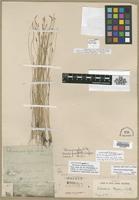
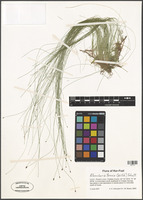
Filed as Scirpus sp. [family CYPERACEAE]
Isotype of Eleocharis compressa Sullivant [family CYPERACEAE]
Filed as Scirpus sp. [family CYPERACEAE]
Filed as Eleocharis tenuis (Willd.) Schult. [family CYPERACEAE]
Lectotype of Scirpus capitatus L. [family CYPERACEAE]
Type? of Eleocharis capitata var. pseudoptera Weath. [family CYPERACEAE]
Previous
Next

Name

Identification
Scirpus capitatus L. [family CYPERACEAE ] (stored under name); Eleocharis tenuis Link [family CYPERACEAE ] Verified by Charles Baron Clarke, Eleocharis tenuis (Willd.) Schult. [family CYPERACEAE ] Verified by Elizabeth Fortson Wells,
Related name
  • Scirpus tenuis
  • Scirpus capitatus
  • Eleocharis acuminata
  • Scirpus quadrangulatus
  • Eleocharis cylindrica
  • Eleocharis tenuis
  • Eleocharis capitata
  • Eleocharis compressa
  • Scirpus sp.
Common name
  • Éléocharide grêle, Flora of North America Vol. 23
  • dog’s hair, Flora of North America Vol. 23
  • Éléocharide à tige ailée, Flora of North America Vol. 23
  • Éléocharide elliptique, Flora of North America Vol. 23
  • Slender spike-rush, Flora of North America Vol. 23

Flora

Entry for Eleocharis elliptica Kunth [family CYPERACEAE]
Herbarium
Flora of North America (FNA)
Collection
Flora of North America
Resource Type
Reference Sources
Entry From
Flora of North America, Vol 23,
Names
Eleocharis elliptica Kunth [family CYPERACEAE], Enum. Pl., 2: 146. 1837
Eleocharis capitata (Linnaeus) R. Brown var. borealis Svenson [family CYPERACEAE]
Eleocharis compressa Sullivant var. atrata Svenson [family CYPERACEAE]
Eleocharis compressa var. borealis Drepalik & Mohlenbrock [family CYPERACEAE]
Eleocharis tenuis (Willdenow) Schultes var. atrata (Svenson) B. Boivin [family CYPERACEAE]
Eleocharis tenuis var. borealis (Svenson) Gleason [family CYPERACEAE]
Treatment Author(s)
S. Galen Smith*
Jeremy J. Bruhl*
M. Socorro González-Elizondo*
Francis J. Menapace*
Information
Plants perennial, mat-forming; rhizomes evident, fairly long to long, 0.5–2.5 mm thick, hard, cortex persistent, longer internodes 2–10 mm, scales persistent, sometimes decaying to coarse fibers, 5–10 mm, membranous to papery. Culms subterete to sometimes compressed, to (2–)3 times as wide as thick, often with (4–)5–10 ridges or angles, 5–90 cm × 0.3–0.8 mm, firm to soft, spongy. Leaves: distal leaf sheaths persistent, not splitting, proximally dark red, distally green to stramineous or red, thinly papery to membranous, apex usually red-brown, obtuse to subacute, often callose, tooth to 0.5 mm usually present on some culms. Spikelets ovoid, 3–8 × 2–3(–4) mm, apex obtuse (to acute); proximal scales amplexicaulous, apex entire; subproximal scale with a flower; floral scales spreading in fruit, 10–30, 5–7 per mm of rachilla, medium to very dark brown, midrib region often paler, ovate, 1.7–3 × 1–1.5 mm, apex rounded to obtuse (or acute), entire or shallowly notched (emarginate) or sometimes cut to 0.5(–0.7) mm deep, apical colorless hyaline part at least as wide as long, 0.2–0.7 mm, carinate in distal part of spikelet. Flowers: perianth bristles absent or rarely 1–3, pale brown, to 1/2 of achene length, sparsely retrorsely spinulose; stamens 3; anthers orange-brown, 0.8–1.7 mm; styles 3-fid or some 2-fid. Achenes persistent after scales fall, usually lemon yellow or dark yellow, orange, or medium brown, rarely greenish, obpyriform, nearly equilaterally to compressed-trigonous, often some biconvex, angles evident to prominent, 0.7–1.2 × 0.6–0.9 mm, neck short or absent, finely to coarsely rugulose at 10X, 12–20 horizontal ridges in vertical series, usually finely cancellate at 10–20X. Tubercles brown to whitish, greatly depressed, apiculate, sometimes pyramidal, 0.1–0.25 × 0.25–0.45 mm. 2n = 38.
Phenology Fruiting
spring
mar
apr
may
summer
jun
jul
aug
Altitude range
0–1000 m;
Distribution
USA Conn.USA IdahoUSA Ill.USA Ind.USA IowaUSA MaineUSA Mass.USA Mich.USA Minn.USA Mont.USA N.H.USA N.J.USA N.Y.USA N.Dak.USA Pa.USA Tenn.USA Vt.USA W.Va.USA Wis.Canada Alta.Canada B.C.Canada Man.Canada Nfld. and Labr.Canada N.W.T.Canada N.S.Canada Ont.Canada Que.Canada Sask.
Discussion
Eleocharis elliptica is very variable in rhizome thickness, internode length, culm thickness and cross section shape, presence of a tooth on the distal leaf sheath, floral scale shape, stigma number, and achene color, cross section shape, and surface sculpturing. It is difficult to separate E. elliptica from E. tenuis and E. compressa.
Three varieties have been recognized: (1) E. elliptica var. elliptica, characterized by rhizomes 0.5–1.5 mm thick with the longer internodes 2.5–10 mm, culms terete to subterete, and floral scales entire to shallowly emarginate; (2) E. elliptica var. atrata (Svenson) S. G. Smith, characterized by rhizomes 1.5–2.5 mm thick with the longer internodes very crowded to 5 mm, culms often compressed, to 2 times wider than thick, and floral scales mostly emarginate or deeply cut; 3) E. elliptica var. pseudoptera (Svenson) L. J. Harms, herein placed in E. tenuis.
Varieties of Eleocharis elliptica are not formally recognized herein because they intergrade greatly. Eleocharis elliptica var. atrata is intermediate between E. elliptica var. elliptica and E. compressa var. compressa; it has usually been placed in E. compressa but is better placed in E. elliptica because the type of var. atrata is more like E. elliptica (S. G. Smith 2001). Eleocharis tenuis var. pseudoptera Svenson might also be treated as E. elliptica var. pseudoptera following L. J. Harms (1972), who also reported that he produced fertile E. compressa × E. elliptica hybrids. I have not seen voucher specimens for any of the chromosome numbers or hybrids that Harms reported for any of the species and varieties discussed above. My field observations in calcareous fens in Wisconsin suggest that E. elliptica var. elliptica is adapted to microhabitats where the surface soil is permanently saturated by groundwater discharge; E. compressa var. compressa is adapted to microhabitats such as depressions in prairies and exposed limestone that are dry in summer; E. elliptica var. atrata is adapted to microhabitats that are intermediate between those of typical E. elliptica and those of E. compressa (S. G. Smith 2001).

Related Materials

  • Terms and Conditions
  • Privacy Policy
  • Cookie Policy
  • Cookie Settings
  • Accessibility
  • Help
  • Contact Us
  • Facebook
  • Twitter
ITHAKA

JSTOR is part of ITHAKA, a not-for-profit organization helping the academic community use digital technologies to preserve the scholarly record and to advance research and teaching in sustainable ways.

©2000-2026 ITHAKA. All Rights Reserved. JSTOR®, the JSTOR logo, JPASS®, Aluka®, and ITHAKA® are registered trademarks of ITHAKA.

╳