JSTOR Global Plants Home
  • Home
  • Browse
  • About
  • Access
  • Account
    • Saved Items
    • Profile
  • Log in

Global Plants

Skip to Main Content
  • JSTOR Global Plants Home
  • Global Plants

    • Browse
    • About
    • Access
    • Account
      • Saved Items
      • Profile
Log in
  • Browse
  • About
  • Access
  • Account
    • Saved Items
    • Profile
Advanced Search

Compilation
Ectadium latifolium

2 Images see all

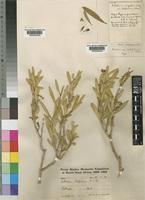
Type of Ectadium latifolium (Schinz) N.E.Br. [family ASCLEPIADACEAE]
Ectadium latifolium (Schinz) N.E.Br. [family ASCLEPIADACEAE]
Previous
Next

Name

Identification
Ectadium latifolium (Schinz) N.E.Br. [family ASCLEPIADACEAE ] (stored under name);
Related name
  • Ectadium virgatum
  • Ectadium latifolium

Flora

Entry for ECTADIUM latifolium N. E. Br. [family ASCLEPIADACEAE]
Herbarium
Royal Botanic Gardens, Kew (K)
Collection
Flora Capensis
Resource Type
Reference Sources
Entry From
Flora Capensis, Vol 4, page 518, (1909) Author: By N. E. BROWN.
Names
ECTADIUM latifolium N. E. Br. [family ASCLEPIADACEAE]
ECTADIUM virgatum Schinz var. latifolium [family ASCLEPIADACEAE], in Verhandl. Bot. Ver. Brandenb. xxx. 261.
Information
a shrub 1 1/2–3 ft. high; leaves 2 1/4–3 1/4 in. long, 5–7 lin. broad, lanceolate, acute, tapering to the base, very thick and coriaceous, tomentose on both sides when young, becoming glabrous in the adult stage and densely reticulate-punctate on both sides; petioles 1 1/2–2 lin. long; cymes similar to those of E. virgatum, but larger, white-tomentose; bracts 2 lin. long, subulate; pedicels 1–1 1/2 lin. long; sepals 3–3 1/2 lin. long, 3/4–1 lin. broad, lanceolate, acuminate, tomentose; corolla hypocrateriform; tube 2 1/2–2 3/4 lin. long, cylindric, pubescent outside; lobes 2 1/2–3 lin. long, 1–1 1/6 lin. broad, oblong, obtuse, glabrous on both sides; corona-lobes 1/2– 2/3 lin. long, erect, subulate from a deltoid-oblong base, usually with an indication of a minute tooth on each side at the termination of the dilated part; anther-appendages 1 1/2–1 3/4 lin. long, connivent-erect, filiform, densely white-hairy; apex of the style deeply bifid, 1/4 lin. long; follicles about 2 1/2 in. long; seeds 4 1/2 lin. long. null
Distribution
WESTERN REGION Great Namaqualand; near Angra Pequena, in loose sand, Schenck, 11! 30, Schinz.
Notes
Although very similar to E. virgatum, E. Meyer, this plant essentially differs by its larger flowers, and especially in its leaves, which are at least twice as thick as those of E. virgatum, and, in the adult state, are densely covered with minute irregular pits, which appear, when viewed under a lens, as if placed between a very dense network of veins. I find no trace of such structure in the leaves of E. virgatum.

Related Materials

  • Terms and Conditions
  • Privacy Policy
  • Cookie Policy
  • Cookie Settings
  • Accessibility
  • Help
  • Contact Us
  • Facebook
  • Twitter
ITHAKA

JSTOR is part of ITHAKA, a not-for-profit organization helping the academic community use digital technologies to preserve the scholarly record and to advance research and teaching in sustainable ways.

©2000-2026 ITHAKA. All Rights Reserved. JSTOR®, the JSTOR logo, JPASS®, Aluka®, and ITHAKA® are registered trademarks of ITHAKA.

╳