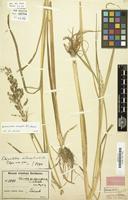
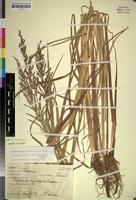
Entry for ECHINOCHLOA crus-galli (L.) P. Beauv. [family POACEAE]
Entry From
Flora of Tropical East Africa, page 451, (1982) Author: W. D. CLAYTON and S.A. RENVOIZE
Names
ECHINOCHLOA crus-galli (L.) P. Beauv. [family POACEAE], Ess. Agrost.: 53, 161 (1812); F.T.A. 9: 610 (1920). Type: Europe (typification undecided)
Panicum crus-galli L. [family POACEAE], Sp. Pl.: 56 (1753)
Echinochloa subverticillata Pilg. [family POACEAE], in N.B.G.B. 15: 451 (1941). Type: Namibia, Tsumeb, Dinter 2490 (B, holo.!)
Echinochloa glabrescens Kossenko [family POACEAE], in Bot. Mat. Gerb. Bot. Inst. Komarov 11: 40 (1949). Type: India, Rottler in Wallich 8687B (K, holo.!)
Notes
E. crus-galli is distinguished by its untidy racemes of acuminate or awned spikelets. It is a polymorphic weed of warm temperate and subtropical regions, whose numerous intergrading races are apparently the consequence of cleistogamous self-pollination. There is much uncertainty as to which segregates are worth recognising as species (see, for example, Gould, Fairbrothers & Ali in Amer. Midi. Nat. 87: 36–59 (1972) for N. America; and Vickery in Flora New South Wales, Gram.: 189–211 (1975) for Australia).The specimens cited are unusual in that the lower lemma is indurated. Such specimens are found occasionally among populations of E. crus-galli (notably in India), and have been separated as E. glabrescens. E. oryzoides (Ard.) Fritsch is a close relative of E. crus-galli adapted to life as a weed of rice fields, but not yet found in East Africa. It has simple racemes, spikelets 3.8–6.5 mm. long and upper lemma 3.5–5 mm. long.