JSTOR Global Plants Home
  • Home
  • Browse
  • About
  • Access
  • Account
    • Saved Items
    • Profile
  • Log in

Global Plants

Skip to Main Content
  • JSTOR Global Plants Home
  • Global Plants

    • Browse
    • About
    • Access
    • Account
      • Saved Items
      • Profile
Log in
  • Browse
  • About
  • Access
  • Account
    • Saved Items
    • Profile
Advanced Search

Compilation
Englerodendron usambarense

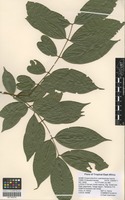
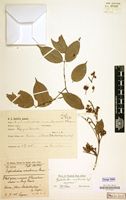
2 Images see all

Filed as Englerodendron usambarense Harms [family CAESALPINIACEAE]
Isotype of Englerodendron usambarense Harms [family LEGUMINOSAE]
Previous
Next

Name

Identification
Isotype of Englerodendron usambarense Harms [family LEGUMINOSAE ] (stored under name); Verified by Not on sheet.,
Related name
  • Englerodendron usambarense

Flora

Entry for ENGLERODENDRON usambarense Harms [family LEGUMINOSAE-CAESALPINIOIDEAE]
Herbarium
Royal Botanic Gardens, Kew (K)
Collection
Flora of Tropical East Africa
Resource Type
Reference Sources
Entry From
Flora of Tropical East Africa, page 1, (1967) Author: J. P. M. Brenan
Names
ENGLERODENDRON usambarense Harms [family LEGUMINOSAE-CAESALPINIOIDEAE], in E.J. 40: 28, fig. 2 (1907); L.T.A.: 692 (1930); T.T.C.L.: 102 (1949). Type: Tanganyika, Lushoto District, between Amani and Bomole, Engler 3436 (B, holo, † & iso. (in Peter 48011)!)
Information
Shrub or tree up to 25 m. high; bark smooth, grey-brown to dark brown; branchlets brown-puberulous to shortly brown-tomentellous, soon glabrescent. Leaves: petiole with rhachis 4–12.5(–15) cm. long; leaflets elliptic to lanceolate, 2.5–10.8(–12.5) cm. long, 1–4.9(–6) cm. wide, narrowly acuminate, ± pubescent or puberulous on midrib beneath, more sparingly so on lateral nerves and surface. Flowers white. Pedicels ± 6–11 mm. long, dark-brown-tomentellous; bracteoles ± 7–12 mm. long and 7–8 mm. wide, dark-brown-tomentellous outside, more shortly so inside. Hypanthium 4–7 mm. long, patchily puberulous to subglabrous. Petals oblong-oblanceolate, 10–12(–15, fide Harms) mm. long, 3–5 mm. wide, pubescent on claw. Pods obliquely rotund to oblong-elliptic, 4–9.5(–12.5, fide Semsei 3014) cm. long, 3.7–5 cm. wide, densely brown-tomentellous or shortly tomentose. Seeds ± 3.7 × 3.1 cm., compressed. Fig. 31.
Range
DISTR. T3 not known elsewhere
Altitude range
760–1000 m.
Distribution
TANGANYIKA Lushoto District Amani, 21 Dec. 1928, Greenway 1061 ! & Sangarawe, 19 Jan. 1937, Greenway 4860 ! & Kwamkoro, 12 Nov. 1959, Semsei 2942 !
Notes
There is a certain amount of variation in the indumentum. The two extremes are:a. Pubescence on midrib and lateral nerves of the leaflets beneath inconspicuous, appressed; hairs mostly straight.b. Pubescence on midrib and lateral nerves of the leaflets beneath conspicuous, coarser and spreading; hairs mostly crisped. The indumentum on the petiolules, rhachides, petioles and young branchlets is also somewhat denser and more spreading in b.Extreme (a) is exemplified by Greenway 4670 !, from Tanganyika, Lushoto District, Tongwe–Mlinga, (b) by Semsei 2833 !, from Tanganyika, Lushoto District, Amani West Forest Reserve. I do not see any satisfactory reason for giving formal recognition to these two extremes, since there do not appear to be other characters correlated, and intermediates occur, of which Greenway 1061 and 4860, cited above, are examples. The isotype, Engler 3436, is similar to Greenway 1061.

Related Materials

  • Terms and Conditions
  • Privacy Policy
  • Cookie Policy
  • Cookie Settings
  • Accessibility
  • Help
  • Contact Us
  • Facebook
  • Twitter
ITHAKA

JSTOR is part of ITHAKA, a not-for-profit organization helping the academic community use digital technologies to preserve the scholarly record and to advance research and teaching in sustainable ways.

©2000-2026 ITHAKA. All Rights Reserved. JSTOR®, the JSTOR logo, JPASS®, Aluka®, and ITHAKA® are registered trademarks of ITHAKA.

╳