JSTOR Global Plants Home
  • Home
  • Browse
  • About
  • Access
  • Account
    • Saved Items
    • Profile
  • Log in

Global Plants

Skip to Main Content
  • JSTOR Global Plants Home
  • Global Plants

    • Browse
    • About
    • Access
    • Account
      • Saved Items
      • Profile
Log in
  • Browse
  • About
  • Access
  • Account
    • Saved Items
    • Profile
Advanced Search

Compilation
Encephalartos ferox

3 Images see all

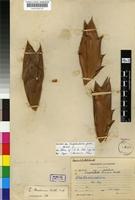
Syntype of Encephalartos ferox G.Bertol. [family ZAMIACEAE]
Encephalartos ferox G.Bertol.
Previous
Next

Name

Identification
Encephalartos ferox G.Bertol. [family ZAMIACEAE ]
Related name
  • Encephalartos ferox

Flora

Entry for Encephalartos ferox [family ZAMIACEAE]
Herbarium
South African National Biodiversity Institute, Compton Herbarium, Cape Town (SAM)
Collection
Flora of Southern Africa
Resource Type
Reference Sources
Entry From
Flora of South Africa, (2003) Author: Dr J.P. Roux
Names
Encephalartos ferox [family ZAMIACEAE]
Common names
E. kosiensis Hutch, in Kew Bull. 1932 : 512 (1932); Hutch. & Rattr. in F.C. 5, 2 (Suppl.) : 34 (1933); Compton in Hook. Icon, t.3220 (1933); Ogalvie in Kew Bull. 1939 : 655, PL 4 (1939); M. R. Henderson in Journ. S. Afr. Bot. 11 : 27 (1954); Schelpe in S. A. Journ. Sci. 47 : 16 (1950). Syntypes: Natal, Zululand, Aitken & Gale 63; Lugge NH16507. E. sp., Aitken & Gale in Bot. Survey S. Afr. Mem. 2 : 18 (1921).
Information
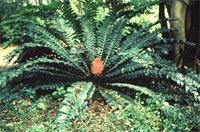
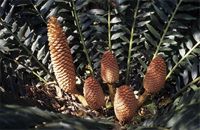
Stems unbranched or occasionally branched from base, majority less than 1 m tall and only rarely are they 2 m or more tall, about 30 cm diam. Leaves several to many in a whorl, 1-2 m long including petiole 20-30 cm long; rhachis nearly straight, erect spread­ing, at first tomentose, glabrescent except for pulvinus; leaflets mainly overlapping in the upper half, more spaced in lower half, reduced in size gradually towards base of rhachis into a few to several prickles; median leaflets broadest towards apex, more or less oblong-elliptic, up to about 15 cm long and 3-5 cm broad, rarely up to 5 cm broad, 2-4 small teeth on upper and lower margin and termin­ating in 3-5 broadly triangular pungent lobes at the apex. Cones 1-3 together on stout short peduncles, glabrous, shrimp-pink to red (Brazil Red, R.C.S.). Male cones subcylindric, narrowed to both ends, up to about 40 cm long, 7-10 cm diam.; median scales 3-4 cm long, 2-5-3 cm broad, 9-15 mm thick verti­cally with sharp lateral ridges; bulla face pro­jecting into a decurved beak about 1 cm long, upper and lower facets somewhat rugcs?, terminal facet 6-10 mm broad, and about 6 mm wide vertically. Female cones ovoid to ovate-oblong in outline, 25-50 cm long, 20-40 cm diam., median scales 5-6 • 7 cm long; bulla 4-5-7 cm broad, 3-5-5-5 cm thick vertically, with lateral ridges extending into incurved lateral lobes almost to the main axis, upper and lower facets finely wrinkled in basal half, somewhat rugose on apical half, round­ed, terminal facet slightly concave, 2-3 cm broad and about 2 cm wide vertically. Seeds scarlet, 4 • 5-5 cm long, 1 • 5-2 cm diam., angled by compression, with fleshy beak. Fig. 7.
Use
22. Encephalartos ferox Bertol. f. in Mem. Accad. Sci. Bologn. 3 : 264 (1851); Prain in Kew Bull. 1916 : 180 (1916); F.T.A. 6, 2 : 352 (1917); Schuster in Pflanzenr. 4, 1:113 (1932); Lewis in F.Z. 1 : 81, t.l, fig. B (1960); Paiva in Estud. Bot. 28 : 21 (1961); R. A. Dyer in Bothalia 8 : 499 (1965). Type: Mozambique, Fornasini.
Range
Locally common in coastal bush and grassveld from about 400 miles north of Lourenco Marques to Sordwana Bay in Zululand; a solitary plant reported about 25 miles inland from Sordwana Bay. Map 4. Natal.—Zululand, Aitken & Gale 63; Lugge NH 16507; Prosser 1984.

Related Materials

  • Terms and Conditions
  • Privacy Policy
  • Cookie Policy
  • Cookie Settings
  • Accessibility
  • Help
  • Contact Us
  • Facebook
  • Twitter
ITHAKA

JSTOR is part of ITHAKA, a not-for-profit organization helping the academic community use digital technologies to preserve the scholarly record and to advance research and teaching in sustainable ways.

©2000-2026 ITHAKA. All Rights Reserved. JSTOR®, the JSTOR logo, JPASS®, Aluka®, and ITHAKA® are registered trademarks of ITHAKA.

╳