JSTOR Global Plants Home
  • Home
  • Browse
  • About
  • Access
  • Account
    • Saved Items
    • Profile
  • Log in

Global Plants

Skip to Main Content
  • JSTOR Global Plants Home
  • Global Plants

    • Browse
    • About
    • Access
    • Account
      • Saved Items
      • Profile
Log in
  • Browse
  • About
  • Access
  • Account
    • Saved Items
    • Profile
Advanced Search

Compilation
Dyschoriste sallyae

5 Images see all

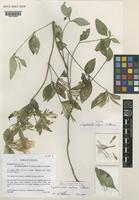
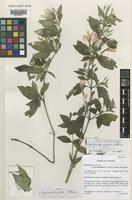
Isotype of Dyschoriste sallyae Vollesen [family ACANTHACEAE]
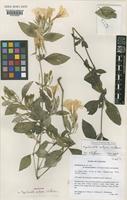
Holotype of Dyschoriste sallyae Vollesen [family ACANTHACEAE]
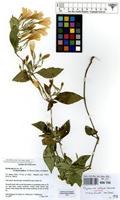
Isotype of Dyschoriste sallyae Vollesen [family ACANTHACEAE]
Previous
Next

Name

Identification
Isotype of Dyschoriste sallyae Vollesen [family ACANTHACEAE ] (stored under name); Verified by Not on sheet,
Related name
  • Dyschoriste thunbergiiflora
  • Dyschoriste sallyae

Flora

Entry for Dyschoriste sallyae Vollesen [family ACANTHACEAE]
Herbarium
Royal Botanic Gardens, Kew (K)
Collection
Flora of Tropical East Africa
Resource Type
Reference Sources
Entry From
Flora of Tropical East Africa, page 1, (2008) Author: Kaj Vollesen
Names
Dyschoriste sallyae Vollesen [family ACANTHACEAE], sp. nov. a D. thunbergiiflora habitu herbaceo perenni caulibus prostratis e caudice lignoso orientibus (nec habitu erecto fruticoso nec suffruticoso) differt, atque in silvis humidis Brachystegiae nec in dumosis aridis Acaciae crescit. Type: Tanzania, Mpanda District: Chala–Mpanda road, Bidgood et al. 3877 (K!, holo.; BR!, C!, CAS!, DSM!, EA!, K!, NHT!, P!, iso.)
Information
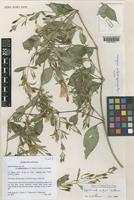
Perennial herb with several trailing stems from woody rootstock; stems to 75 cm long, puberulous or retrorsely sericeous-puberulous when young, with or without stalked capitate glands intermixed. Leaves ovate to elliptic, largest 4.5–8≈2–3.2 cm, apex acute to subacuminate, sparsely sericeous-puberulous along veins. Flowers in open axillary dichasial 1–7-flowered cymes, often 1 flower and two aborted buds towards tip of stems, cymes sometimes aggregated towards tip of stems; peduncle and branches 2–15 mm long, sparsely to densely glandular-puberulous; outer bracts elliptic, up to 2 cm long or like inner bracts and bracteoles: linear-lanceolate and up to 6 mm long, indumentum as leaves; pedicels to 2 cm long. Calyx puberulous with mixture of stalked glands and non-glandular hairs, ciliate on teeth, 13–20 mm long; teeth 7–10 mm long, same length or slightly longer than tube, cuspidate. Corolla with limb nearly symmetric (trumpet-shaped with throat expanded downwards), white (rarely very pale mauve), with orange tube and orange patches at base of lower lip and in throat, sparsely puberulous and with scattered capitate glands, 35–50 mm long of which the linear tube 12–20 mm, the throat 12–15 mm and the limb 11–15 mm, limb and throat same length; lobes obovate-spathulate, eventually recurved. Free part of filaments 6–8 and 9–10 mm long, with scattered capitate glands towards apex; anthers 2–2.5 mm long, spurs ± 1/2 mm long. Style apically with mixture of hairs and stalked capitate glands. Capsule and seed not seen.
Range
DISTR. T 4 not known elsewhere
Altitude range
1300 m
Distribution
TANZANIA Mpanda District Urema [Karema], Homo Hills, June 1928, C.H.B. Grant s.n.! & 78 km on Chala–Mpanda road, 11 May 1997, Bidgood et al. 3877! & 24 May 2000, Bidgood et al. 4428!
Notes
This species differs fromD. thunbergiiflora in little more than its herbaceous growth form with trailingbranches. But it also has a different ecology and very disjunct distribution. Despite its large spectacular flowers it is known only from these three collections.

Related Materials

  • Terms and Conditions
  • Privacy Policy
  • Cookie Policy
  • Cookie Settings
  • Accessibility
  • Help
  • Contact Us
  • Facebook
  • Twitter
ITHAKA

JSTOR is part of ITHAKA, a not-for-profit organization helping the academic community use digital technologies to preserve the scholarly record and to advance research and teaching in sustainable ways.

©2000-2026 ITHAKA. All Rights Reserved. JSTOR®, the JSTOR logo, JPASS®, Aluka®, and ITHAKA® are registered trademarks of ITHAKA.

╳