JSTOR Global Plants Home
  • Home
  • Browse
  • About
  • Access
  • Account
    • Saved Items
    • Profile
  • Log in

Global Plants

Skip to Main Content
  • JSTOR Global Plants Home
  • Global Plants

    • Browse
    • About
    • Access
    • Account
      • Saved Items
      • Profile
Log in
  • Browse
  • About
  • Access
  • Account
    • Saved Items
    • Profile
Advanced Search

Compilation
Dyschoriste pilifera

5 Images see all

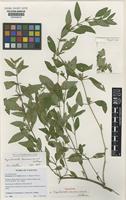
Holotype of Dyschoriste tanzaniensis Vollesen [family ACANTHACEAE]
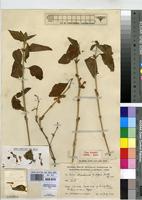
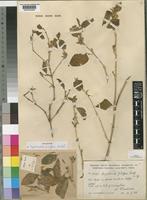
Type of Dyschoriste pilifera Hutch. [family ACANTHACEAE]
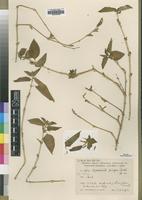
Isotype of Dyschoriste pilifera Hutch. [family ACANTHACEAE]
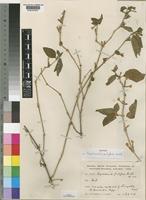
Holotype of Dyschoriste pilifera Hutch. [family ACANTHACEAE]
Previous
Next

Name

Identification
Dyschoriste pilifera Hutch. [family ACANTHACEAE ] (stored under name);
Related name
  • Dyschoriste tanzaniensis
  • Dyschoriste pilifera

Flora

Entry for Dyschoriste pilifera Hutch. [family ACANTHACEAE]
Herbarium
Royal Botanic Gardens, Kew (K)
Collection
Flora of Tropical East Africa
Resource Type
Reference Sources
Entry From
Flora of Tropical East Africa, page 1, (2008) Author: Kaj Vollesen
Names
Dyschoriste pilifera Hutch. [family ACANTHACEAE], Botanist in S. Afr.: 484 (1946); Lebrun & Stork, Enum. Pl. Afr. Trop. 4: 479 (1997). Type: Zambia, 78 km NE of Livingstone, Hutchinson & Gillett 3501 (K!, holo.; BM!, K!, iso.)
Dyschoriste trichocalyx [family ACANTHACEAE], [sensu Björnstad in Serengeti Res. Inst. Publ. 215: 25 (1976), non (Oliv.) Lindau (1895)]
Information
Perennial or shrubby herb to 0.5 m tall with several erect to decumbent sparsely branched stems from a woody rootstock (rarely a shrub); stems glandular-puberulent to -puberulous or densely so, also with scattered to dense pilose hairs up to 3 mm long. Leaves ovate to elliptic (rarely narrowly so), largest 3–7≈1–3.3 cm, apex acute to subacuminate, subglabrous to puberulent or puberulous, with stalked capitate glands when young, often also with scattered pilose hairs. Flowers in condensed axillary 1–3(–12)-flowered cymes, more rarely in elongated dichasial cymes; peduncles up to 2(–13) mm long, branches up to 7(–20 in open dichasia) mm long; outer bracts lanceolate to elliptic, up to 1.8 cm long or as inner bracts and bracteoles: linear to lanceolate, up to 8 mm long, with scattered to dense capitate glands. Calyx glandular-puberulent to -puberulous or densely so and with scattered to dense long glossy pilose hairs some or all of which over 1 mm long, 12–18(–22 in fruit) mm long; teeth 5–9(–10 in fruit) mm long, shorter than tube (rarely same length). Corolla slightly 2-lipped, pure white with pale yellow throat, puberulent and with scattered capitate glands, 20–26 mm long of which the linear tube 7–11 mm, the throat 6–10 mm and the limb 4–7 mm, throat longer than or same length as limb; lobes oblong to ovate, erect or spreading in lower lip. Free part of filaments 3–6 mm long, hairy at base, glabrous at apex; anthers 1.5–2 mm long, spurs ± 1/2 mm long. Capsule 11–13 mm long. Seed ± 2.5 mm long.
Range
DISTR. T 5, 7
Altitude range
850–1400 m
Distribution
TANZANIA Dodoma District 6 km on Manyoni–Kilimatinde road, 14 Apr. 1988, Bidgood et al. 1089!TANZANIA Iringa District Ruaha National Park, 10 km on Msembe–Nyamakuru Rapids track, 6 Apr. 1970, Greenway & Kanuri 14275 & 55 km on Mafinga–Madibira road, 27 Jan. 1991, Bidgood et al. 1300!
Distribution (external)
Zambia
Zimbabwe
Notes
Closely related toD. albiflorawith which it shares the white flowers. It differs most conspicuously in the usually dense sticky glandular indumentum with long pilose hairs intermixed. The sparse material from Zambia and Zimbabwe has a considerable shorter calyx (8–13 mm long). But more material is needed to decide whether two infraspecific taxa can be recognised.

Related Materials

  • Terms and Conditions
  • Privacy Policy
  • Cookie Policy
  • Cookie Settings
  • Accessibility
  • Help
  • Contact Us
  • Facebook
  • Twitter
ITHAKA

JSTOR is part of ITHAKA, a not-for-profit organization helping the academic community use digital technologies to preserve the scholarly record and to advance research and teaching in sustainable ways.

©2000-2026 ITHAKA. All Rights Reserved. JSTOR®, the JSTOR logo, JPASS®, Aluka®, and ITHAKA® are registered trademarks of ITHAKA.

╳