JSTOR Global Plants Home
  • Home
  • Browse
  • About
  • Access
  • Account
    • Saved Items
    • Profile
  • Log in

Global Plants

Skip to Main Content
  • JSTOR Global Plants Home
  • Global Plants

    • Browse
    • About
    • Access
    • Account
      • Saved Items
      • Profile
Log in
  • Browse
  • About
  • Access
  • Account
    • Saved Items
    • Profile
Advanced Search

Compilation
Dyschoriste albiflora

6 Images see all

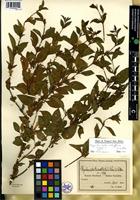
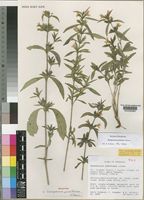
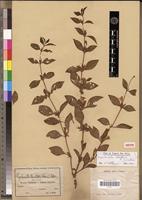
Isotype of Dyschoriste albiflora Lindau [family ACANTHACEAE]
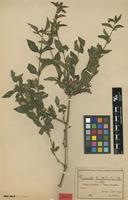
Type of Dyschoriste albiflora Lindau [family ACANTHACEAE]
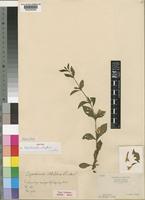
Isotype of Duosperma porotoense Vollesen [family ACANTHACEAE]
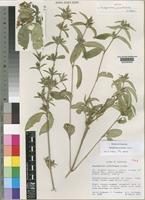
Holotype of Duosperma porotoense Vollesen [family ACANTHACEAE]
Type of Dyschoriste albiflora Lindau [family ACANTHACEAE]
Previous
Next

Name

Identification
Dyschoriste albiflora Lindau [family ACANTHACEAE ] (stored under name); Verified by K. Vollesen, 1992 Dyschoriste perrottetii (Pocs.) O. K?? [family ACANTHACEAE ] Verified by Not on Sheet,
Related name
  • Duosperma porotoense
  • Dyschoriste albiflora
  • Dyschoriste perrottetii

Flora

Entry for Dyschoriste albiflora Lindau [family ACANTHACEAE]
Herbarium
Royal Botanic Gardens, Kew (K)
Collection
Flora of Tropical East Africa
Resource Type
Reference Sources
Entry From
Flora of Tropical East Africa, page 1, (2008) Author: Kaj Vollesen
Names
Dyschoriste albiflora Lindau [family ACANTHACEAE], in E.J. 57: 21 (1920); Lebrun & Stork, Enum. Pl. Afr. Trop. 4: 479 (1997). Type: Tanzania, Rungwe District: Kyimbila, Bulambya, Stolz 1938 (B†, holo.; BM!, C!, K!, P!, iso.)
Dyschoriste perrottetii [family ACANTHACEAE], [sensu Gilli in Ann. Naturhist. Mus. Wien 77: 50 (1973), non (Nees) Kuntze (1891)]
Information
Shrubby perennial herb, subshrub or shrub; stems erect to decumbent, sparsely to freely branched, up to 1(–1.5) m tall, subglabrous to puberulous or sericeous-puberulous when young. Leaves ovate to elliptic, largest 4.3–10≈1.7–4.5 cm, apex acute to subacuminate (rarely rounded), subglabrous to sparsely puberulous, densest along veins with lamina often glabrous. Flowers in condensed axillary 1–12-flowered cymes, sometimes 2 cymes per axil (very rarely in elongated dichasial cymes with up to 15 flowers and with peduncle and branches up to 1.5(–2) cm long); peduncle and branches up to 4 mm long, indumentum as branches; outer bracts lanceolate to elliptic, up to 2 cm long; inner bracts and bracteoles linear to lanceolate, up to 1.2 cm long. Calyx subglabrous to puberulous, densest on lobes and veins, tube often glabrous, hairs up to 1 mm long, (very rarely also with capitate glands), 10–16(–19 in fruit) mm long; teeth 4–8(–10 in fruit) mm long, shorter than, same length as or longer than tube. Corolla slightly 2-lipped, pure white (very rarely with faint mauve markings on lower lip), puberulent or sparsely so (rarely with intermixed capitate glands), 14–28 mm long of which the linear tube (4–)7–11 mm, the throat 4–10 mm and the limb 4–8 mm; throat from slightly longer to up to 2 mm shorter than limb; lobes oblong, erect or reflexed in lower lip. Free part of filaments 3–7 mm long, with short stubby hairs near base, glabrous upwards; anthers 1–2 mm long, spurs ± 1/2 mm long. Capsule 11–13 mm long. Seed 2–3 mm long.
Range
DISTR. T 4, 6–8
Altitude range
(150–)1200–2100 m
Distribution
TANZANIA Ufipa District Kanda Hills, 10 March 1959, Richards 11114!TANZANIA Njombe District N slopes of Poroto Mts above Chimala, 24 March 1991, Bidgood, et al. 2108!TANZANIA Mbeya District Songwe Valley 2 km N of Mbeya–Tunduma road, 25 March 1988, Bidgood et al. 689!
Distribution (external)
Zambia
Malawi
Mozambique
Notes
A single collection (Richards8753) has a few capitate glands on the calyx, but otherwise this species is consistently separated fromD. piliferaandD.tanzaniensisby being eglandular.

Related Materials

  • Terms and Conditions
  • Privacy Policy
  • Cookie Policy
  • Cookie Settings
  • Accessibility
  • Help
  • Contact Us
  • Facebook
  • Twitter
ITHAKA

JSTOR is part of ITHAKA, a not-for-profit organization helping the academic community use digital technologies to preserve the scholarly record and to advance research and teaching in sustainable ways.

©2000-2026 ITHAKA. All Rights Reserved. JSTOR®, the JSTOR logo, JPASS®, Aluka®, and ITHAKA® are registered trademarks of ITHAKA.

╳