JSTOR Global Plants Home
  • Home
  • Browse
  • About
  • Access
  • Account
    • Saved Items
    • Profile
  • Log in

Global Plants

Skip to Main Content
  • JSTOR Global Plants Home
  • Global Plants

    • Browse
    • About
    • Access
    • Account
      • Saved Items
      • Profile
Log in
  • Browse
  • About
  • Access
  • Account
    • Saved Items
    • Profile
Advanced Search

Compilation
Duvalia transvaalensis

4 Images see all

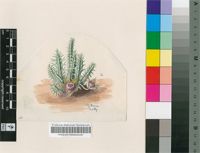
Type of Duvalia transvaalensis Schltr. var. parviflora L.Bolus [family APOCYNACEAE]
Duvalia transvaalensis Schltr.
Type of Duvalia polita N.E.Br. [family ASCLEPIADACEAE]
Type of Duvalia transvaalensis Schltr. [family APOCYNACEAE]
Previous
Next

Name

Identification
Duvalia transvaalensis Schltr. [family APOCYNACEAE ]
Related name
  • Duvalia transvaalensis

Flora

Entry for DUVALIA transvaalensis Schlechter [family ]
Herbarium
Royal Botanic Gardens, Kew (K)
Collection
Flora of Tropical Africa
Resource Type
Reference Sources
Entry From
Flora of Tropical Africa, Vol 4, Part 1, page 231, (1904) Author: (By N. E. Brown.)
Names
DUVALIA transvaalensis Schlechter [family ], in Engl. Jahrb. xx. Beibl. 51, 54.
Information
Stems attaining 2 1/2 in. in height, about 5 lin. thick, erect, 6-angular, glabrous; angles with spreading fleshy spines. Cymes few-flowered, arising near the base of the young shoots; pedicels 3/4 in. long, glabrous. Sepals 3 lin. long, linear-lanceolate, very acute, glabrous. Corolla-lobes 1/2 in. long, erect, ovate-triangular, acuminate, glabrous on both sides. Outer corona disk-like; inner coronal-lobes rhomboidal.
Distribution
Transvaal Mozamb. Dist. sandy places near Klipdam, 4600 ft., Schlechter, 4498.
Notes
This locality is about ten miles south of the Tropic, but the plant will probably be found in the tropical part also, and is therefore included. I have not seen a specimen.

Related Materials

  • Terms and Conditions
  • Privacy Policy
  • Cookie Policy
  • Cookie Settings
  • Accessibility
  • Help
  • Contact Us
  • Facebook
  • Twitter
ITHAKA

JSTOR is part of ITHAKA, a not-for-profit organization helping the academic community use digital technologies to preserve the scholarly record and to advance research and teaching in sustainable ways.

©2000-2026 ITHAKA. All Rights Reserved. JSTOR®, the JSTOR logo, JPASS®, Aluka®, and ITHAKA® are registered trademarks of ITHAKA.

╳