JSTOR Global Plants Home
  • Home
  • Browse
  • About
  • Access
  • Account
    • Saved Items
    • Profile
  • Log in

Global Plants

Skip to Main Content
  • JSTOR Global Plants Home
  • Global Plants

    • Browse
    • About
    • Access
    • Account
      • Saved Items
      • Profile
Log in
  • Browse
  • About
  • Access
  • Account
    • Saved Items
    • Profile
Advanced Search

Compilation
Duosperma trachyphyllum

2 Images see all

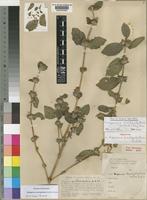
Holotype of Disperma trachyphyllum Bull. [family ACANTHACEAE]
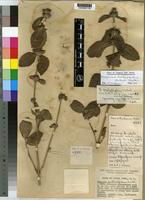
Isotype of Duosperma trachyphyllum Bullock [family ACANTHACEAE]
Previous
Next

Name

Identification
Isotype of Duosperma trachyphyllum Bullock [family ACANTHACEAE ] (stored under name); Verified by Vollesen K, 1995
Related name
  • Duosperma trachyphyllum
  • Disperma quadrisepalum
  • Disperma trachyphyllum

Flora

Entry for Duosperma trachyphyllum (Bullock) Dayton [family ACANTHACEAE]
Herbarium
Royal Botanic Gardens, Kew (K)
Collection
Flora of Tropical East Africa
Resource Type
Reference Sources
Entry From
Flora of Tropical East Africa, page 1, (2008) Author: Kaj Vollesen
Names
Duosperma trachyphyllum (Bullock) Dayton [family ACANTHACEAE], in Rhodora 47: 236 (1945); Brummitt in K.B. 29: 411 (1974); Lebrun & Stork, Enum. Pl. Afr. Trop. 4: 479 (1997); Vollesen in K.B. 62: 331, fig. 12 K–M (2006). Type: Tanzania, Mpwapwa, Greenway 2391 (K!, holo.; EA!, iso.)
Disperma trachyphyllum Bullock [family ], in K.B. 1933: 476 (1933); Milne-Redhead in K.B. 1935: 283 (1935); T.T.C.L.: 7 (1949)
Information
Erect shrubby herb to 1.3 m tall; young branches curly-puberulous or sparsely so, eventually pale yellow and with exfoliating bark. Leaves ovate to elliptic, largest 3–8≈1.4–3 cm, more than twice as long as wide or about the same, apex acute, base cuneate, decurrent into a distinct petiole to 8 mm long with long broad glossy hairs on edges, uniformly curly puberulous or sparsely so on both sides, margin dentate, venation beneath distinctly raised, reticulate; stipule sheath 1.5–3 mm long. Flowers in few- to many-flowered condensed widely separated axillary cymes; outer bracts foliaceous, to 2 cm long; inner bracts oblong, to 1 cm long, uniformly puberulous or sparsely so and with long broad glossy hairs along midrib and on margins; bracteoles similar, to 8 mm long, with scattered subsessile capitate glands. Calyx 6–8(–10 in fruit) mm long, uniformly finely puberulous and with scattered to dense long broad glossy hairs along midrib and on lobes, with scattered short-stalked capitate glands, tube 4–6 mm long; teeth triangular, acute, dorsal 2–3 mm long, ventral 2–3 mm long of which the free part 1–2 mm. Corolla white, 12–14 mm long, finely sericeous-puberulous; tube 7–8 mm long of which the throat ± 2 mm; lips 4–5 mm long; lobes oblong, ± 2 mm wide, emarginate; palate without long hairs. Filaments 2–4 mm long, with a few hairs near base; anthers ± 1.5 mm long, rounded at both ends, connective with subsessile glands. Dorsal stigma lobe about half the length of ventral. Capsule and seed not seen.
Range
DISTR. T 5, 7 not known elsewhere
Altitude range
1200–1450 m
Distribution
TANZANIA Mpwapwa District Mpwapwa, 18 Aug. 1930, Greenway 2391!TANZANIA Iringa District David Moyer’s Farm [7º48’S 35º48’E], 31 March 2006, Bidgood et al. 5266!
Notes
Despite the presence of glandular hairs on bracts and calyx D. trachyphyllum is probably closer to the group of species around D. crenatum than to the species around D. quadrangulare. It differs from the species of the D. quadrangulare group in the widely separated condensed axillary cymes and the white corolla without stiff hairs on the palate. Dayton (l.c.) possibly confuses D. trachyphyllum with D. crenatum when he writes that it is “reported to form impenetrable thickets on stony hill slopes in neighborhood (sic) of 4000 feet elevation in Dodoma Province, Tanganyika”. D. crenatum is (pers. obs.) a very common and often thicket forming species in the Mpwapwa–Dodoma area while D. trachypyllum (despite being described as “common” on the label of Greenway 2391) is known only from the two above mentioned collections. On the Iringa locality it was (pers. obs.) rare.

Related Materials

  • Terms and Conditions
  • Privacy Policy
  • Cookie Policy
  • Cookie Settings
  • Accessibility
  • Help
  • Contact Us
  • Facebook
  • Twitter
ITHAKA

JSTOR is part of ITHAKA, a not-for-profit organization helping the academic community use digital technologies to preserve the scholarly record and to advance research and teaching in sustainable ways.

©2000-2026 ITHAKA. All Rights Reserved. JSTOR®, the JSTOR logo, JPASS®, Aluka®, and ITHAKA® are registered trademarks of ITHAKA.

╳