

Compilation
Duosperma subquadrangulare
1 Images see all
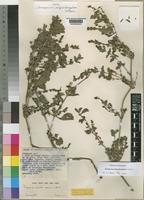
Name
Identification
Disperma unrecorded unrecorded [family ACANTHACEAE ] Isotype of Duosperma subquadrangulare Vollesen [family ACANTHACEAE ] (stored under name); Verified by Vollesen,
Related name
- Disperma unrecorded
- Duosperma subquadrangulare
Flora
Entry for Duosperma subquadrangulare Vollesen [family ACANTHACEAE]
Herbarium
Royal Botanic Gardens, Kew (K)
Collection
Flora of Tropical East Africa
Resource Type
Reference Sources
Entry From
Flora of Tropical East Africa, page 1, (2008) Author: Kaj Vollesen
Names
Duosperma subquadrangulare Vollesen [family ACANTHACEAE], in K.B. 62: 305, fig. 4 (2006). Type: Tanzania, Masai District: Ardai Plains, Greenway 6814 (EA!, holo.; K!, PRE!, iso.)
Duosperma sp. B [family ACANTHACEAE], of U.K.W.F., ed. 2: 270 (1994)
Information
Much branched perennial or shrubby herb to 75 cm tall with erect to procumbent stems, sometimes rooting at lower nodes, forming dense clumps; young stems quadrangular, subglabrous to puberulous or sericeous-puberulous and with slightly longer hairs on edges, no capitate glands, eventually with exfoliating bark. Leaves broadly elliptic-obovate to orbicular, largest 2–5≈1.3–4.5 cm (less than twice as long as wide), apex subacute to emarginate, base attenuate, decurrent to stem or with an ill-defined petiole up to 1.5 cm long, margin subentire to dentate, subglabrous to sparsely and uniformly sericeous-puberulous; stipule-sheath 0.5–1 mm long. Flowers solitary or in 3-flowered cymules (peduncles up to 5 mm long) which are arranged in narrow racemiform axillary sericeous-puberulous panicles; bracts foliaceous, gradually smaller upwards; pedicels 0.5–2 mm long, puberulous and with subsessile glands; bracteoles linear-lanceolate to obovate, up to 7 mm long, puberulous and with slightly longer ciliae, with or without subsessile (shorter than hairs) capitate glands. Calyx 5–8(–9 in fruit) mm long, puberulous and with scattered to dense subsessile (shorter than or same length as hairs) capitate glands, tube 4–5 mm long; teeth triangular, acute or subacute, dorsal 2.5–4 mm long, ventral 2–3 mm long with the free part 1–2 mm long. Corolla white to pale pink or mauve with orange patches on lower lip, 13–17 mm long, sericeous-puberulent on the outside; tube 8–10 mm long of which the throat 2–4 mm; lips 4–8 mm long; lobes oblong-obovate, 2–3.5 (upper lip) to 5 (lower lip) mm wide, retuse to truncate; palate with numerous long stiff straight hairs. Filaments 2–6 mm long, with scattered hairs and glands throughout; anthers 1.5–2 mm long, rounded, connective with sparse capitate glands. Dorsal stigma lobe about half the length of ventral. Capsule and seed not seen.
Range
DISTR. K 4; T 1–3, 5 not known elsewhere
Altitude range
1050–1400 m
Distribution
KENYA Machakos District Emali to Simba, Merueshi, no date, Wamukoya 1090!KENYA Kitui District Kitui area, 11 Aug. 1978, Chebii 34!TANZANIA Masai District Eleanata, 20 June 1941, Hornby 2115! & Ardai Plains, 10 July 1943, Greenway 6814!TANZANIA Dodoma/Mpwapwa District Dodoma–Mpwapwa road, 6 June 1937, Hornby 816!
Notes
This species occurs on the northern fringes of the widespreadD. quadrangulare, and was at first thought to be merely a form of it. But there are enough differences to recognise it as a distinct species; the main difference being the absence of capitate glands and long pilose hairs from most parts. Where capitate glands occur (mainly on the calyx) they are very short. The dimensions of the calyx and corolla are at the lower end of the variation inD. quadrangulare.