JSTOR Global Plants Home
  • Home
  • Browse
  • About
  • Access
  • Account
    • Saved Items
    • Profile
  • Log in

Global Plants

Skip to Main Content
  • JSTOR Global Plants Home
  • Global Plants

    • Browse
    • About
    • Access
    • Account
      • Saved Items
      • Profile
Log in
  • Browse
  • About
  • Access
  • Account
    • Saved Items
    • Profile
Advanced Search

Compilation
Dudleya candelabrum

3 Images see all

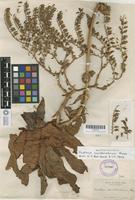
Holotype of Dudleya candelabrum Rose [family CRASSULACEAE]
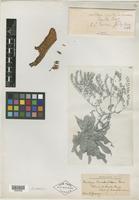
Type? of Dudleya candelabrum Rose [family CRASSULACEAE]
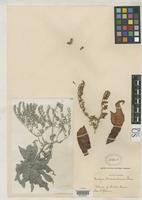
Filed as Dudleya candelabrum Rose, J.N. 1903 [family CRASSULACEAE]
Previous
Next

Name

Identification
Dudleya candelabrum Rose [family CRASSULACEAE ] (stored under name); Verified by Not on sheet,
Related name
  • Dudleya candelabrum
Common name
  • Candleholder dudleya, Flora of North America Vol. 8

Flora

Entry for Dudleya candelabrum Rose [family CRASSULACEAE]
Herbarium
Flora of North America (FNA)
Collection
Flora of North America
Resource Type
Reference Sources
Entry From
Flora of North America, Vol 8,
Names
Dudleya candelabrum Rose [family CRASSULACEAE], in N. L. Britton and J. N. Rose, New N. Amer. Crassul., 17. 1903 ,
Treatment Author(s)
Reid V. Moran
Information
Caudices simple, 0.1–20 × 2–8 cm, axillary branches absent. Leaves: rosettes solitary, not in clumps, 20–45-leaved, 10–30 cm diam.; blade green or, rarely, pale greenish white, obovate to oblong-oblanceolate, 6–17 × 3–7 cm, 1–4 mm thick, base 0.2–0.5 cm wide, apex acuminate, surfaces usually not farinose, not glaucous. Inflorescences: cyme 3–5-branched, densely rounded or becoming flat-topped; branches not twisted (flowers on topside), 1–2 times bifurcate, (5–25 cm diam.); cincinni ca. 3, 5–25-flowered, circinate, 2.5–13 cm; floral shoots 15–35 × 0.6–1 cm; leaves 20–35, spreading or deflexed, triangular-lanceolate, 30–70 × 10–20 mm, apex acute. Pedicels erect, not bent in fruit, 2–6 mm. Flowers: calyx 6–9 × 4–5 mm; petals connate 1.5–3.5 mm, pale yellow to white, 8–12 × 2.5–3.5 mm, apex acute, tips straight; pistils connivent, erect. Unripe follicles erect. 2n = 34.
Conservation Status
of conservation concern
Phenology
Flowering late spring–early summer
Altitude range
0–600 m
Distribution
USA Calif.
Discussion
Dudleya candelabrum is endemic to Santa Cruz and Santa Rosa islands; it is considered fairly threatened (California Native Plant Society, http://cnps.web.aplus.net/cgi-bin/inv/inventory.cgi). Among diploids, it seems most similar to the green phase of D. brittonii D. A. Johansen, of coastal northwestern Baja California, which also has a thick, unbranched caudex and large rosettes, and has somewhat similar leaf shape, inflorescence, and flowers. However, D. brittonii has more rosette leaves, which may be farinose or not, longer pedicels that are thickened distally, and conspicuously narrower sepals, with broad U-shaped sinuses.

Related Materials

  • Terms and Conditions
  • Privacy Policy
  • Cookie Policy
  • Cookie Settings
  • Accessibility
  • Help
  • Contact Us
  • Facebook
  • Twitter
ITHAKA

JSTOR is part of ITHAKA, a not-for-profit organization helping the academic community use digital technologies to preserve the scholarly record and to advance research and teaching in sustainable ways.

©2000-2026 ITHAKA. All Rights Reserved. JSTOR®, the JSTOR logo, JPASS®, Aluka®, and ITHAKA® are registered trademarks of ITHAKA.

╳