JSTOR Global Plants Home
  • Home
  • Browse
  • About
  • Access
  • Account
    • Saved Items
    • Profile
  • Log in

Global Plants

Skip to Main Content
  • JSTOR Global Plants Home
  • Global Plants

    • Browse
    • About
    • Access
    • Account
      • Saved Items
      • Profile
Log in
  • Browse
  • About
  • Access
  • Account
    • Saved Items
    • Profile
Advanced Search

Compilation
Dryopteris filipaleata

3 Images see all

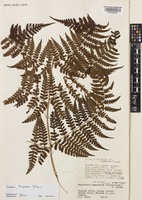
Isotype of Dryopteris filipaleata J.P.Roux [family DRYOPTERIDACEAE]
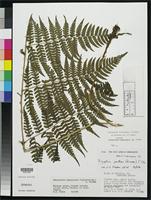
Isotype of Dryopteris filipaleata Roux, J.P. 2004 [family DRYOPTERIDACEAE]
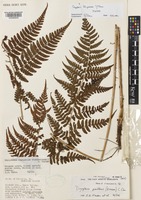
Isotype of Dryopteris filipaleata J.P.Roux [family DRYOPTERIDACEAE]
Previous
Next

Name

Identification
Isotype of Dryopteris filipaleata Roux, J.P. 2004 [family DRYOPTERIDACEAE ] (stored under name); Verified by Not on sheet,
Related name
  • Dryopteris filipaleata

Flora

Entry for Dryopteris filipaleata J.P.Roux [family DRYOPTERIDACEAE]
Herbarium
Royal Botanic Gardens, Kew (K)
Collection
Flora of Tropical East Africa
Resource Type
Reference Sources
Entry From
Flora of Tropical East Africa, page 1, (2007) Author: J.P. Roux, Monika Shaffer-Fehre & Bernard Verdcourt
Names
Dryopteris filipaleata J.P.Roux [family DRYOPTERIDACEAE], in Bothalia 34: 28, fig. 1 & 2 (2004). Type: Tanzania, Morogoro District, Uluguru mountains, Mwere valley, Faden et al. 70/596 [BOL!, holo. (2 sheets); K!, iso. (2 sheets)]
Information
Terrestrial; rhizomeshort-decumbent, up to 12 mm in diameter, with closely set stipe bases and ferrugineous to castaneous linear to narrowly lanceolate scales up to 15≈5 mm, acuminate, irregularly set with scattered capitate glands and long outgrowths. Frondstufted, suberect to arching, up to 1.1 m long; stipeproximally castaneous, stramineous higher up, up to 61 cm long and 7 mm in diameter, with proximally dense and distally sparse ferrugineous scales up to 18≈6 mm; laminaovate to broadly ovate, up to 59≈43 cm, 2-pinnate-pinnatifid to 3-pinnate; rachisstramineous, initially densely scaly, glabrescent, scales ferrugineous to castaneous, linear to filiform, up to 4≈0.5 mm, irregularly denticulate; pinnaeup to 13 stalked pairs, increasingly more broadly attached and basiscopically decurrent along rachis towards lamina apex, basal pair longest and mostly conspicuously basiscopically developed, inaequilaterally triangular, ovate, oblong-acuminate to lanceolate, up to 27≈13.5 cm, those higher up mostly near symmetrical, with up to 7 pinna pairs; pinna-rachisnarrowly winged towards apex, with some linear to filiform scales up to 3≈0.3 mm; pinnulespetiolate, increasingly more broadly attached and basiscopically decurrent along pinna-rachis towards pinna apex, up to 78≈26 mm, proximal basiscopic pinnules slightly basiscopically developed, narrowly lanceolate to oblong-acuminate; costanarrowly winged, with sparse scales up to 2.2≈0.1 mm; segmentsand lobes up to 15≈7 mm, ovate-obtuse to oblong-obtuse, basiscopically decurrent, shallowly lobed to denticulate, adaxially glabrous or with few hairs and filiform scales along costa, abaxially sparsely set with moniliform hairs up to 0.6 mm long on and between veins. Soripredominantly 2-seriate along pinnules, 2-seriate on lobes in larger plants, medial to inframedial on predominantly anadromous vein branches; exindusiate; sporangium stalk simple, glandular or haired. Sporeswith low reticulate ridged and bulges, 32–54≈18–34 µm.
Range
DISTR. K 4, 5; T 6 restricted to the mountainous areas of tropical East Africa
Altitude range
1250—2000 m
Distribution
KENYA South Nyeri District Thiba Fishing Camp, 31 July 1977, Gilbert & Rankin 4821!KENYA Meru District Meru, upper forest, Aug. 1949, H.D. van Someren 493!KENYA Kisumu-Londiani District Kisumu, Feb. 1915, Dummer 1524!, 1727! & 1728!TANZANIA Morogoro District Uluguru mountains, Morningside to Bondwa, July 1970, Faden et al. 70/351! & Northern Nguru, Kanga mountain, 2 Dec. 1987, Lovett & Thomas 2800!TANZANIA & “Bagamoyo District, mainland west of Zanzibar”, March 1885, Last s.n.!
Notes
USES. None recorded for our area. CONSERVATION Restricted in distribution, but appears not to be threatened.

Related Materials

  • Terms and Conditions
  • Privacy Policy
  • Cookie Policy
  • Cookie Settings
  • Accessibility
  • Help
  • Contact Us
  • Facebook
  • Twitter
ITHAKA

JSTOR is part of ITHAKA, a not-for-profit organization helping the academic community use digital technologies to preserve the scholarly record and to advance research and teaching in sustainable ways.

©2000-2026 ITHAKA. All Rights Reserved. JSTOR®, the JSTOR logo, JPASS®, Aluka®, and ITHAKA® are registered trademarks of ITHAKA.

╳