JSTOR Global Plants Home
  • Home
  • Browse
  • About
  • Access
  • Account
    • Saved Items
    • Profile
  • Log in

Global Plants

Skip to Main Content
  • JSTOR Global Plants Home
  • Global Plants

    • Browse
    • About
    • Access
    • Account
      • Saved Items
      • Profile
Log in
  • Browse
  • About
  • Access
  • Account
    • Saved Items
    • Profile
Advanced Search

Compilation
Droguetia umbricola

6 Images see all

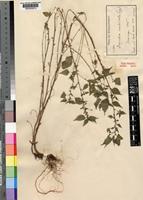
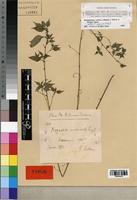
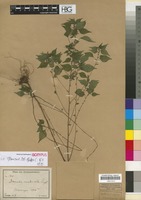
Isotype of Droguetia umbricola Engl. [family URTICACEAE]
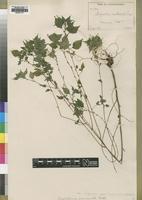
Type of Droguetia umbricola Engl. [family URTICACEAE]
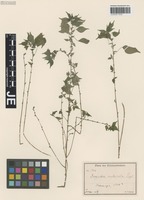
Isotype of Droguetia umbricola Engl. [family URTICACEAE]
Previous
Next

Name

Identification
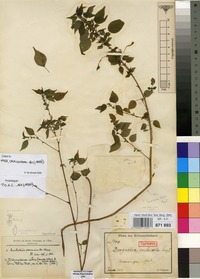
Isotype of Droguetia umbricola Engl. [family URTICACEAE ] Didymodoxa caffra (Thunb.) Friis&Wilmot-Dear [family URTICACEAE ] (stored under name); Australina acuminata Wedd. [family URTICACEAE ]
Related name
  • Australina acuminata
  • Droguetia umbricola
  • Didymodoxa acuminata
  • Didymodoxa caffra

Flora

Entry for AUSTRALINA acuminata Wedd. [family URTICACEAE]
Herbarium
Royal Botanic Gardens, Kew (K)
Collection
Flora of Tropical Africa
Resource Type
Reference Sources
Entry From
Flora of Tropical Africa, Vol 6, Part 2, page 240, (1917)
Names
AUSTRALINA acuminata Wedd. [family URTICACEAE], in Ann. Sci. Nat. 4me sér. i. 212.
Didymodora acuminata Wedd. [family ], Monogr. Urtic. 549.
Didymodora cuneata Wedd. [family ], in DC. Prodr. xvi. i. 235 61.
Droguetia umbricola Engl. [family URTICACEAE], Pfl. Ost-Afr. C. 164.
Parietaria cuneata E. Meyer ms. ex Wedd. [family URTICACEAE], in Ann. Sci. Nat. l.c. (quoted in synonymy).
Information
An annual herb branching from the base, 8–21 in. high; stem erect, slender, puberulous, as are also the very slender ascending branches. Leaves alternate, ovate, acuminate, base triangular to cuneate and entire, margin elsewhere crenate-serrate, in tropical African specimens 3/4–1 1/2 in. long, 5–10 lin. wide, 3-nerved, membranous, sparsely pilose on the upper face and on the veins beneath, dotted with cystoliths above, lighter green beneath, margin minutely ciliolate; petiole slender, from one-third to half the length of the blade, puberulous. Stipules ovate-lanceolate, thinly long-acuminate, up to 2 lin. long, scarious with green midvein. Inflorescences axillary, androgynous, consisting of an ebracteate cluster of numerous male flowers (often about 15) in the axil of one stipule and a bracteate cyme of a few (3 or more) female flowers in the axil of the other stipule, or sometimes female only; bracts much shorter than the flower. Male flowers shortly stalked, perianth after expulsion of the anther boat-shaped with a green setose acuminate apex, including the stalk about 1 lin. long. Ovary naked, ovoid, densely hispidulous; stigma linear, recurved, barely half the length of the ovary. Achene greenish-brown, ovoid with one edge slightly narrowly flattened, acute, tipped with the remains of the style, about 1 lin. long, hispidulous.
Distribution
German East Africa Mozamb. Dist. Kilimanjaro; Marangu, 4800 ft., Volkens, 1700!British East Africa Nile Land Eldama Ravine, 7000–7500 ft., Whyte !
Distribution (external)
South Africa

Related Materials

  • Terms and Conditions
  • Privacy Policy
  • Cookie Policy
  • Cookie Settings
  • Accessibility
  • Help
  • Contact Us
  • Facebook
  • Twitter
ITHAKA

JSTOR is part of ITHAKA, a not-for-profit organization helping the academic community use digital technologies to preserve the scholarly record and to advance research and teaching in sustainable ways.

©2000-2026 ITHAKA. All Rights Reserved. JSTOR®, the JSTOR logo, JPASS®, Aluka®, and ITHAKA® are registered trademarks of ITHAKA.

╳