JSTOR Global Plants Home
  • Home
  • Browse
  • About
  • Access
  • Account
    • Saved Items
    • Profile
  • Log in

Global Plants

Skip to Main Content
  • JSTOR Global Plants Home
  • Global Plants

    • Browse
    • About
    • Access
    • Account
      • Saved Items
      • Profile
Log in
  • Browse
  • About
  • Access
  • Account
    • Saved Items
    • Profile
Advanced Search

Compilation
Draba streptobrachia

3 Images see all

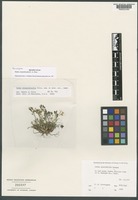
Paratype of Draba streptobrachia R. A. Price [family BRASSICACEAE]
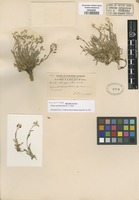
Isolectotype of Draba streptobrachia R.A. Price [family BRASSICACEAE]
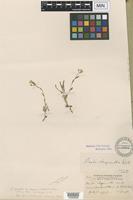
Isotype of Draba chrysantha S. Watson f. dasycarpa Schulz [family BRASSICACEAE]
Previous
Next

Name

Identification
Isotype of Draba chrysantha S. Watson [family BRASSICACEAE ] (stored under name); Verified by Not on sheet, Draba streptobrachia R.A. Price [family BRASSICACEAE ] Verified by Not on sheet,
Related name
  • Draba streptobrachia
  • Draba chrysantha

Flora

Entry for Draba streptobrachia R. A. Price [family CRUCIFERAE]
Herbarium
Flora of North America (FNA)
Collection
Flora of North America
Resource Type
Reference Sources
Entry From
Flora of North America, Vol 7,
Names
Draba streptobrachia R. A. Price [family CRUCIFERAE], Brittonia, 32: 168. 1980
Draba chrysantha S. Watson forma dasycarpa O. E. Schulz [family CRUCIFERAE], in H. G. A. Engler, Pflanzenr., 89[IV,105]: 195. 1927,. not D. dasycarpa Bernhardi 1800
Draba spectabilis Greene var. dasycarpa (O. E. Schulz) C. L. Hitchcock [family CRUCIFERAE]
Treatment Author(s)
Ihsan A. Al-Shehbaz
Michael D. Windham
Reidar Elven
Information
Perennials; caudex branched (often with persistent leaf remains, branches not creeping); not scapose. Stems unbranched, (0.1–)0.2–1(–1.3) dm, pubescent throughout, trichomes subsessile (often crisped), 3–5-rayed, stellate, 0.03–0.25(–0.4) mm, (rays sometimes forked). Basal leaves rosulate; petiole (obscure), usually not ciliate, rarely sparsely pubescent, (trichomes simple, to 0.6 mm); blade oblanceolate to linear-oblanceolate, (0.4–)0.5–3(–4) cm × 1–5 mm, margins entire, surfaces pubescent with short-stalked (crisped), 3–8-rayed trichomes, 0.05–0.4 mm. Cauline leaves (1 or) 2–4 (or 5); sessile; blade oblong to ovate or linear, margins entire, surfaces pubescent as basal. Racemes 4–10(–18)-flowered, ebracteate, elongated in fruit; rachis not flexuous, pubescent as stem. Fruiting pedicels ascending, usually straight, rarely curved upward, (2–)3–8(–12) mm, pubescent as stem. Flowers: sepals ovate, 2–3 mm, pubescent, (trichomes simple and short-stalked, 2–4-rayed); petals yellow, spatulate, 3–5 × 1.5–3 mm, (clawed); anthers ovate, 0.25–0.4 mm. Fruits (not appressed to rachis), ovate to elliptic or lanceolate, slightly twisted or plane, flattened, (3–)5–10 × 2–4 mm; valves often pubescent, occasionally glabrous, trichomes simple and minutely stalked, 2–4-rayed, 0.03–0.25 mm; ovules 10–16(–18) per ovary; style 0.3–0.8(–1.2) mm. Seeds oblong, 1–1.6 × 0.6–1 mm. 2n = ca. 64.
Phenology
jul-aug (summer)
Altitude range
3200–4000 m;
Distribution
USA Colo.
Discussion
As indicated by Price, Draba streptobrachia is an apomict, yielding abundant, well-developed seed despite producing only abortive pollen. Morphological studies (M. D. Windham, unpubl.) suggest that the species may be an allopolyploid containing a genome from D. crassa.

Related Materials

  • Terms and Conditions
  • Privacy Policy
  • Cookie Policy
  • Cookie Settings
  • Accessibility
  • Help
  • Contact Us
  • Facebook
  • Twitter
ITHAKA

JSTOR is part of ITHAKA, a not-for-profit organization helping the academic community use digital technologies to preserve the scholarly record and to advance research and teaching in sustainable ways.

©2000-2026 ITHAKA. All Rights Reserved. JSTOR®, the JSTOR logo, JPASS®, Aluka®, and ITHAKA® are registered trademarks of ITHAKA.

╳