

Compilation
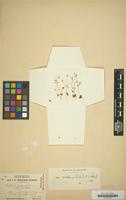
Draba praecox
2 Images see all
Name
Identification
Draba praecox Steven [family CRUCIFERAE ] Verified by Not on sheet., Erophila praecox [family CRUCIFERAE ] (stored under name); Verified by Not on sheet.,
Related name
- Erophila praecox
- Draba praecox
Common name
- Whitlow grass, Flora of North America Vol. 7
- whitlow wort, Flora of North America Vol. 7
Flora
Entry for Draba verna Linnaeus [family CRUCIFERAE]
Herbarium
Flora of North America (FNA)
Collection
Flora of North America
Resource Type
Reference Sources
Entry From
Flora of North America, Vol 7,
Names
Draba verna Linnaeus [family CRUCIFERAE], Sp. Pl., 2: 642. 1753
Draba boerhaavii (H. C. Hall) Dumortier [family CRUCIFERAE]
Draba praecox Steven [family CRUCIFERAE]
Draba verna var. aestivalis Lejeune [family CRUCIFERAE]
Draba verna var. boerhaavii H. C. Hall [family CRUCIFERAE]
Erophila boerhaavii (H. C. Hall) Dumortier [family CRUCIFERAE]
Erophila krockeri Andrzejowski [family CRUCIFERAE]
Erophila praecox (Steven) de Candolle [family CRUCIFERAE]
Erophila verna (Linnaeus) L. Chevallier [family CRUCIFERAE]
Erophila verna subsp. praecox (Steven) Walters [family CRUCIFERAE]
Treatment Author(s)
Ihsan A. Al-Shehbaz
Michael D. Windham
Reidar Elven
Information
Annuals; scapose. Stems (few to many from base), unbranched, (0.2–)0.5–2(–3) dm, pubescent proximally, glabrous distally, trichomes simple and 2(–4)-rayed, 0.1–0.4 mm. Basal leaves rosulate; petiolate; blade obovate, spatulate, oblanceolate, lanceolate, oblong, or, rarely, linear, 0.2–1.8(–3) cm × (0.5–)1–5(–10) mm, margins entire or 1–5-toothed on each side, surfaces pubescent with simple or stalked, 2–4-rayed trichomes, 0.1–0.5 mm. Cauline leaves 0. Racemes 4–20(–30)-flowered, ebracteate, usually considerably elongated in fruit; rachis usually flexuous, glabrous. Fruiting pedicels divaricate to ascending, straight or slightly curved upward, (2–)5–20(–35) mm, glabrous. Flowers: sepals (green or purplish), oblong, 1–2.5 mm, glabrescent or pubescent, (trichomes simple or 2-rayed); petals white, deeply 2-fid, (1.5–)2–4.5(–6) × 1–2 mm; anthers ovate, 0.2–0.4 mm. Fruits obovate, oblanceolate, lanceolate, elliptic, oblong, or linear, plane, flattened, (2.5–)4–9(–12) × 1.5–2.5(–3.5) mm; valves glabrous; ovules (20–)32–70(–84) per ovary; style 0.02–0.2 mm. Seeds ovoid (slightly flattened), 0.3–0.6(–0.8) × 0.2–0.4 mm. 2n = 14, 16, 20, 24, 28, 30, 32, 34, 36, 38, 40, 52, 54, 58, 60, 64.
Phenology
feb (winter), mar-may (spring)
Altitude range
0–2500 m;
Distribution
EuropeAsianw Africaintroduced also in Central AmericaSouth AmericaAustralia.USA Ala.USA Ark.USA Calif.USA Conn.USA Del.USA D.C.USA Ga.USA IdahoUSA Ill.USA Ind.USA IowaUSA Ky.USA MaineUSA Md.USA Mass.USA Mich.USA Miss.USA Mo.USA Mont.USA Nev.USA N.H.USA N.J.USA N.Y.USA N.C.USA OhioUSA Oreg.USA Pa.USA R.I.USA S.C.USA Tenn.USA UtahUSA Vt.USA Va.USA Wash.USA W.Va.USA Wyo.Canada Alta.Canada B.C.Canada N.B.Canada Ont.Canada Que.
Discussion
Draba verna represents a highly variable and taxonomically difficult complex within which species, subspecies, varieties, and forms have been named (O. E. Schulz 1927); only those synonyms pertaining to North America are listed above. Most of the taxonomic difficulties are the results of disploidy, autogamy, and hybridization. The morphological extremes are connected by intermediate forms in every conceivable character. Furthermore, there appears to be no correlation between morphology, cytology, geography, and ecology to support the division of this complex into meaningful taxa. A complex cytological picture was presented by Ø. Winge (1940), including the highest count of 2n = 94, which has not been confirmed by subsequent botanists.
Erophila vulgaris de Candolle is an illegitimate name for Draba verna.
Native/Introduced
introduced;