

Compilation
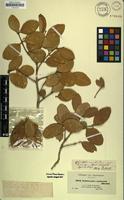
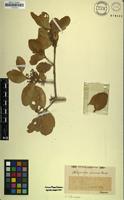
Dobera roxburghii
2 Images see all
Name
Identification
Dobera roxburghii Planch. [family SALVADORACEAE ] (stored under name); Verified by Not on Sheet, Schizocalyx coriaceus Hochst. ex A.Rich. [family SALVADORACEAE ] Verified by Bräuchler, C., 2012
Related name
- Schizocalyx coriaceus
- Dobera roxburghii
Flora
Entry for DOBERA loranthifolia (Warb.) Harms [family SALVADORACEAE]
Herbarium
Royal Botanic Gardens, Kew (K)
Collection
Flora of Tropical East Africa
Resource Type
Reference Sources
Entry From
Flora of Tropical East Africa, page 1, (1968) Author: B. Verdcourt
Names
DOBERA loranthifolia (Warb.) Harms [family SALVADORACEAE], in E. & P. Pf., Nachtr. zu II-IV: 282 (1897); Bak. in F.T.A. 4(1): 22 (1902); Engl., V.E. 3(2): 249 (1921); T.T.C.L.: 547 (1949); Verdc. in K.B. 19: 157 (1964). Tvpes; Tanganyika, W. Usambara Mts., Mashewa, Holst 8796 (B, syn. †, BM, K, isosyn.!) & Kenya/Tanganyika border, Lake Jipe, Volkens (B, syn. †, BM, isosyn.!)
Platymitium loranthifolium Warb. [family SALVADORACEAE], in P.O.A. C: 279, t. 31 (1895); Solereder in Ber. Deutsch. Bot. Gesell. 14: 264 (1896)
Dobera roxburghii [family SALVADORACEAE], [sensu Bak. in F.T.A. 4(1): 21 (1902), pro parte, quoad spec. Wakefield, non Planch.]
Dobera macalusoi Mattei [family SALVADORACEAE], in Boll. Ort. Bot. Palermo 7: 184 (1908); Chiov., Fl. Somala 1: 215 (1929) & 2: 283, fig. 163 (1932). Types: Somali Republic (S.), Brava, Giumbo and Mogadishu, Macaluso 25, 38 & 60 (? PAL, syn.)
Dobera glabra (Mattei) Fiori var. macalusoi [family SALVADORACEAE], in Bull. Soc. Bot. Ital. 1913: 48(1913); E.P.A.: 486(1958)
Dobera allenii N. E. Br. [family SALVADORACEAE], in K.B. 1914: 80 (1914) & in Hook., Ic. Pl., t. 3017 (1915). Type: Mozambique, Antari (not traced as a locality, and quite possibly a vernacular name), Allen 95 (K, holo. !)
Dobera glabra Engl. & Gilg var. subcoriacea [family SALVADORACEAE], [place of publication not traced]; T.T.C.L.: 547(1949). Type: Tanganyika, Kilosa, Brosig (B, holo. †), e descr. et loc.
Dobera glabra [family SALVADORACEAE], [sensu Brenan, T.T.C.L.: 547 (1949), pro parte, quoad spec. Burtt 5308, non (Forsk.) Poir.]
Information
A much-branched evergreen tree, 5–15 m. tall, with a bushy crown; bark variable, black and flaky, pale grey, fissured and rough, or, less often, grey and smooth. Leaves opposite; lamina thin or subcoriaceous, elliptic, obovate or more usually diamond-shaped, rarely almost round, 1.5–9.2(–10) cm. long, 1.2–4.4(–7.3) cm. wide, mostly acute, shining and quite glabrous or glaucous with a covering of minute glandular papillae on the lower surface; venation nearly always prominent and reticulate; petiole 4–5 mm. long. The leaves frequently bear small hard pea-shaped galls which are very characteristic. Flowers small, greenish-white or white, ± 3 mm. long, in axillary and terminal panicles. Calyx minutely papillate. Staminal tube sometimes with small teeth alternating with the upper free parts of the filaments. Ovules paired in the ovary but only 1 develops in the fruit. Fruit ellipsoid, 1–1.4(–1.6) cm. long, 7–10 mm. across. Seeds dark, ovoid, somewhat compressed, 9–11 mm. long, 6–7 mm. across. Fig. 2/1–10, p. 5.
Range
DISTR. K1, 4, 7; T3, 6, 8
Altitude range
0–810 m.
Distribution
KENYA Northern Frontier Province Kolbio, 29 Aug. 1945, J. Adamson 121!KENYA Kilifi District Kibarani, 21 Mar. 1946, Jeffery 499 !KENYA Tana River District Garissa, 26 Dec. 1942, Bally 1989 !TANGANYIKA Lushoto District Mfumba Steppe, Mnazi, 22 Dec. 1929, Greenway 1972!TANGANYIKA Uzaramo District Kisiju, Sept. 1953, Semsei 1370 !TANGANYIKA Lindi District lower slopes of Rondo escarpment approaching Lake Lutamba, Nov. 1953, Eggeling 6723 !
Distribution (external)
Somali Republic (S.)
Mozambique
Notes
VARIATION. In the northernmost parts of its range, i.e. in Kenya near the Somali border, atypical specimens are found with smooth bark and shorter very glaucous leaves, which are densely minutely glandular on their lower surfaces; the key characters still hold good even though along the Tana River both species undoubtedly occur. Further detailed collecting may well show that in this area the species have different ecological requirements. Judging by Chiovenda's useful comparison (Fl. Somala 1: 216 (1929)), and assuming he saw the types, D. macalusoi Mattei is certainly a synonym of D. loranthifolia; his mention of very small anthers 0–8 mm. long and glandular papillae shows that there can be no doubt. This northern form with glandular leaves could possibly be separated off as a variety using Mattel's name. Similar glandular forms occur in Tanganyika (Tanga), but the amount of this indumentum varies; much material from Tanganyika has entirely glabrous leaves with a more prominent venation. D. allenii N. E. Br. was said to differ by having broader leaves, obtuse petals, a larger staminal tube (though analysis says subduplo breviore) and teeth between the filaments. All these characters vary; teeth may be present in both glabra and loranthifolia. N. E. Brown's plant has prominently veined, entirely glabrous leaves and the name would be available if this form were ever considered worthy of varietal status.