

Compilation
Dissotis paludosa
1 Images see all
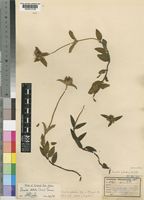
Name
Identification
Dissotis paludosa De Wild [family MELASTOMATACEAE ] Dissotis paludosa Gilg [family MELASTOMATACEAE ] Dissotis debilis (Sond.) Triana [family MELASTOMATACEAE ] (stored under name); Verified by Wickens, G.E.,
Related name
- Dissotis debilis
- Dissotis paludosa
Flora
Entry for DISSOTIS debilis A. & R. Fernandes var. debilis [family MELASTOMATACEAE]
Herbarium
Royal Botanic Gardens, Kew (K)
Collection
Flora of Tropical East Africa
Resource Type
Reference Sources
Entry From
Flora of Tropical East Africa, page 1, (1975) Author: G. E. WICKENS
Names
DISSOTIS debilis A. & R. Fernandes var. debilis [family MELASTOMATACEAE], ;in An. Junta Invest. Ultramar 10: 17 (1955) & in Mem. Soc. Brot. 11: 16, 71 (1956) & in Bol. Soc. Brot., sér. 2, 34: 182 (1960) & in C.F.A. 4: 137 (1970)
Osbeckia debilis Sond. [family MELASTOMATACEAE], in Linnaea 23: 47 (1850), non Naud. (1850)
Osbeckia phaeotricha (Sond.) Sond. var. debilis [family MELASTOMATACEAE], in Fl. Cap. 2: 519 (1862)
Dissotis penicillata Gilg [family MELASTOMATACEAE], in E.M. 2: 14 (1898); V.E. 3 (2): 748 (1921). Type: Angola, Huila, Antunes 126 (B, holo. †, COI, lecto.)
Dissotis paludosa Engl. [family MELASTOMATACEAE], in V.E. 3 (2): 748 (1921), nom. nud.
Information
Erect herb 9–40 cm. high. Leaf-lamina ovate, oblong-ovate or ovate-lanceolate, 1–6 cm. long, 0.8–1.6 cm. wide, base shortly attenuate. Stamens subequal or markedly unequal.
Range
DISTR. K3, 7; T4–8
Altitude range
10–1800 m.
Distribution
KENYA Uasin Gishu District Kipkarren R., Brodhurst-Hill 367 !KENYA Kwale District Vanga, Majoreni, Nov. 1929, R. M. Graham LL.731 in F.D. 2183 !TANZANIA Ufipa District 48 km. Mbala [Abercorn] to Sumbawanga, 3 Mar. 1951, Bulloch 3739 !TANZANIA Dodoma District Rungwa Game Reserve, Sulangi, 21 Jan. 1969, Ismail 4236 !TANZANIA Tunduru District Litungura, 6 June 1956, Milne-Redhead & Taylor 10669 !
Distribution (external)
Zaire
Mozambique
Malawi
Zambia
Rhodesia
Botswana
Angola
South Africa
Notes
A. & R. Fernandes, in An. Junta Invest. Ultramar 10: 17, 18 (1955) & in Bol. Soc. Brot., sér. 2, 34; 182 (1960), recognize forma debilis with unequal stamens and forma osbeckioides A. & R. Fernandes with subequal stamens. Both forms occur in the Flora area and have been found as mixed populations (see Milne-Redhead & Taylor 10479 & 10480). Plants from T6, such as Haerdi 328/0 from Ulanga District, Ifakara, with an indumentum intermediate between appressed and spreading, have been regarded as a hybrid between var. debilis and D. phaeotricha (Hochst.) Hook. f.