JSTOR Global Plants Home
  • Home
  • Browse
  • About
  • Access
  • Account
    • Saved Items
    • Profile
  • Log in

Global Plants

Skip to Main Content
  • JSTOR Global Plants Home
  • Global Plants

    • Browse
    • About
    • Access
    • Account
      • Saved Items
      • Profile
Log in
  • Browse
  • About
  • Access
  • Account
    • Saved Items
    • Profile
Advanced Search

Compilation
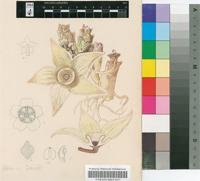
Diplocyatha ciliata

2 Images see all

Diplocyatha ciliata (Thunb.) N.E.Br.
Previous
Next

Name

Identification
Diplocyatha ciliata (Thunb.) N.E.Br. [family APOCYNACEAE ]
Related name
  • Diplocyatha ciliata

Flora

Entry for DIPLOCYATHA ciliata N. E. Br. [family ASCLEPIADACEAE]
Herbarium
Royal Botanic Gardens, Kew (K)
Collection
Flora Capensis
Resource Type
Reference Sources
Entry From
Flora Capensis, Vol 4, page 518, (1909) Author: By N. E. BROWN.
Names
DIPLOCYATHA ciliata N. E. Br. [family ASCLEPIADACEAE], in Journ. Linn. Soc. xvii. 168, t. 12, figs. 1–3
Diplocyathus ciliatus K. Schum. [family ], in Engl. und Prantl, Pflanzenfam. iv. ii. 281 and 279, fig. 84, G-H.; Schlechter in Journ. Bot. 1898, 485.
Stapelia ciliata Thunb. [family ASCLEPIADACEAE], Prodr. 46; Fl. Cap. ed. 2, ii. 168, and ed. Schultes, 240; Masson, Stap. 9, t. 1; Willd. Sp. Pl. i. 1277; Pers. Syn. Pl. i. 277; Poir. Encycl. vii. 377; Ait. Hort. Kew. ed. 2, ii. 85; Schultes, Syst. Veg. vi. 31; Spreng. Syst. Veg. i. 837; Loud. Encycl. Pl. 200, fig. 3314; Dietr. Syn. Pl. ii. 884; Decne in DC. Prodr. viii. 655.
Podanthes ciliata Haw. [family ASCLEPIADACEAE], Syn. Pl. Succ. 34; G. Don, Gen. Syst. iv. 118.
Tromotriche ciliata Sweet [family ASCLEPIADACEAE], Hort. Brit. ed. 2, 358.
Information
stems decumbent and ascending, 1 1/2–2 1/2 in. long, 1/2– 3/4 in. thick, exclusive of the teeth, obtusely 4-angled, with stout conical acute teeth 2–3 lin. long, glabrous, green, mottled with purple; flowers subsolitary from near the base or middle of the stems; pedicels 6–8 lin. long, erect, glabrous; sepals about 1/4 in. long, ovate or ovate-lanceolate, acute, glabrous; corolla about 3 in. in diam., smooth and glabrous outside, densely papillate-rugose on the innerface, according to Thunberg and Masson, greyish, with the tips of the papillæ reddish, but according to Masson's figure, pale yellowish with a greyish ring around the mouth of the tube, minutely dotted with red; tube campanulate, apparently slightly raised at its mouth around the very thick recurved papillate-rugose rim of the inner tube, which is densely covered with stiff purple hairs at the base around and under the corona; lobes about 1 in. long, 2/3– 3/4 in. broad, spreading, ovate, acute, ciliate from base to apex with clavate vibratile white hairs; outer corona-lobes arising above the base of the staminal column, connate at the base, somewhat spreading, with the free part 2/3– 3/4 lin. long, 1 lin. broad, transverse or subquadrate, very obtusely or subacutely bifid, glabrous, apparently yellowish dotted with purple-brown; inner corona-lobes incumbent on the backs of the anthers, about 3/4 lin. long, thick, ovate, acute, or acuminate with the tips produced into a very short erect point, apparently yellowish, dotted and marked with purple-brown. null
Distribution
CENTRAL REGION Calvinia Div.; near Hantam, Meyer! (Herb. Berlin). Ceres Div.; Karoo between the Roggeveld Mountains and Paarde Berg, Thunberg! Karoo between Bokkeveld and Paarde Berg (ex Banks' MSS. at British Museum), Masson. Beaufort West Div.; Nieuwveld, between Rhenoster Kop and Ganzefontein, Drège, 6396! Prince Albert Div.; Karoo near Prince Albert, Marloth, 4570!
Notes
Thunberg states that the flowers of this plant have scarcely any odour. The Paarde Berg above mentioned, according to Thunberg's travels, is situated between Ongeluks River and Doorn River.

Related Materials

  • Terms and Conditions
  • Privacy Policy
  • Cookie Policy
  • Cookie Settings
  • Accessibility
  • Help
  • Contact Us
  • Facebook
  • Twitter
ITHAKA

JSTOR is part of ITHAKA, a not-for-profit organization helping the academic community use digital technologies to preserve the scholarly record and to advance research and teaching in sustainable ways.

©2000-2026 ITHAKA. All Rights Reserved. JSTOR®, the JSTOR logo, JPASS®, Aluka®, and ITHAKA® are registered trademarks of ITHAKA.

╳