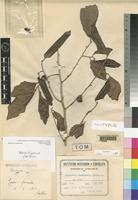
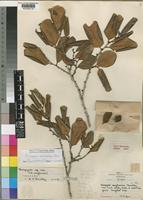
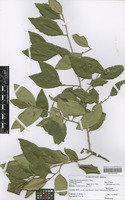
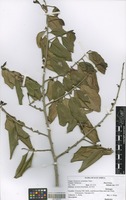
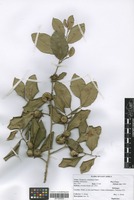
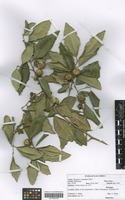
Much and stiffly branched erect evergreen shrub or small bushy tree 1.5–7(–9) m tall, with fairly dense irregular crown; bark grey to black, smooth, scaly or rough and longitudinally furrowed. Leaves drying pale brown or yellowish brown, often wilted on the tree or wilting soon after picking and consequently in herbarium specimens usually revolute or undulate at the margin; petiole 3–4 mm long; blade elliptic or obovate, 2.5–10.3 x 1.2–6 cm, cuneate to rounded at the base, mostly subacute to subacuminate but sometimes broadly rounded or emarginate at the apex, glossy above, glabrous beneath; lateral nerves in 5–9(–10) pairs, indistinct. Male flowers 1–3 together in leaf-axils and axils of fallen leaves; pedicels 1–3 mm long; calyx 4 mm long, minutely puberulous outside; corolla white, campanulate, c. 8 mm long; corolla-tube 4 mm long and wide; corolla-lobes 4, semiorbicular, 4 x 5 mm; stamens 20–30, c. 3 mm long, glabrous; filaments cream, c. 0.5 mm long; anthers pale yellow, lanceolate, c. 2 mm long. Female flowers solitary or in pairs in leaf-axils and axils of fallen leaves, subsessile; calyx c. 7 mm long, minutely puberulous outside; calyx-tube cup-shaped, c. 4 mm long; calyx-lobes 4(–6), reduplicate and alternating with slightly decurrent sinuses; corolla white, becoming creamy white, eventually turning brown, falling at a touch when open, funnel-shaped, c. 8 mm long, minutely puberulous outside; corolla-tube c. 4 mm. long, c. 2 mm wide below, expanded above; corolla-lobes 4(–6), rounded, c. 4 x 4 mm; staminodes 10–15, c. 3 mm long, glabrous, attached to the corolla-tube and blocking the throat; ovary c. 2 x 2 mm, 6–8-celled, minutely puberulous; styles 3–4, c. 3 mm long. Fruit greenish yellow or yellow, globose, 1.5 cm in diam., glabrous, slightly to very sticky and glossy, with fruiting calyx up to 1.2 cm long, frilled and held at right-angles to the fruit, and distinctly to indistinctly lobed, the lobes up to 1.3 cm wide. Seeds 6–8 or fewer by abortion, very dark brown, c. 1.2 x 0.6 x 0.4 cm.