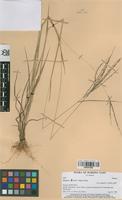
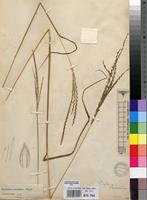
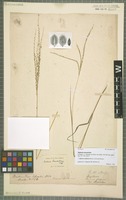
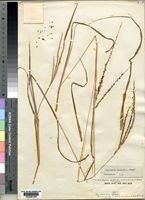
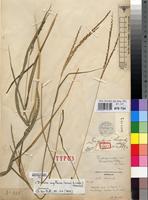
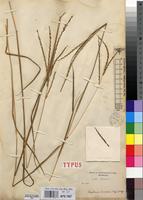
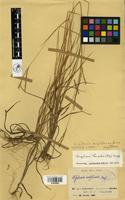
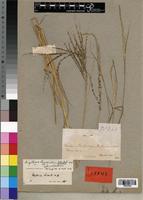
Annual (?). Culms (base unknown) over 2 1/2 ft. high, erect, slender, simple or with a branch from one of the lower nodes, apparently few-noded, the uppermost internode very long and long-exserted, glabrous, rough towards the inflorescence. Leaf-sheaths somewhat loose, finely striate, glabrous except at the loosely bearded nodes, or sparingly and finely hairy; ligules reduced to a membranous ciliolate rim with some long hairs from the back; blades linear from an equally broad base, 6–9 in. by 1 1/2–2 lin., flat, flaccid, rough, particularly above and upwards, glabrous or with a few very fine hairs near the base, midrib very slender, lateral nerves somewhat fine, close. Racemes 2–4, sessile, compound, at least in the lower part, subdigitate or with a slender rough common axis (1–1 1/2 lin. long), slender, erect or obliquely erect, straight, rather loose, 4–6 in. long; rhachis slender, triquetrous, 1/5– 1/4 lin. wide, straight or slightly wavy, finely puberulous, lateral angles marginate, scabrid, internodes 1 1/2–2 lin. long; pedicels in the upper part 3–4-nate, lower down fascicled with short sparingly spiculiferous branchlets, 3–6 (rarely up to 15) lin. long, very slender, angular, scabrid, often with a few very short hairs, the longest usually 1–2 lin. long. Spikelets oblong to ovate-oblong, acute, about 1 lin. long, pale or whitish-green with silky sides when young, at length greyish-green with a rufous fringe. Lower glume indicated by a very minute hyaline irregular rim at the base of the lower floret, or 0; upper lanceolate or narrowly oblong, acute or subacute, about 7/10 lin. long, very thin, 3-nerved, densely and at length spreadingly hairy all over, hairs slightly curved or straight, with short very acute points. Lower floret corresponding in outline and size to the spikelet: valve firmly membranous, slightly depressed and glabrous between the innermost side-nerves, 7-nerved, middle-nerve very slender, smooth, side-nerves approximate on the slightly bulging and rounded-off sides, with dense lines of hairs between the inner side-nerves (of each half) and along the margin, hairs as in the upper glume, if not longer and more rigid, with usually a few additional large almost bristle-like hairs from the inner line, forming at length a conspicuous rufous spreading fringe; valvule and lodicules minute. Upper floret broad-lanceolate, acute, early brown, at length almost black, shining, chartaceous to subcoriaceous, finely punctate-striate. Anthers oblong, about 1/8– 1/6 or 2/5 (Barter, 1370) lin. long, with papillose bases. Grain elliptic-oblong, plano-convex, 6/10 lin. by 1/3 lin., white; scutellum elliptic, equalling half the grain.