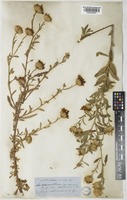
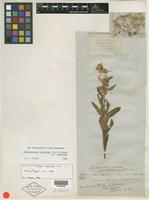
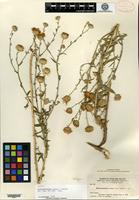
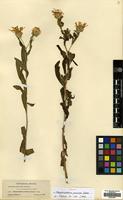
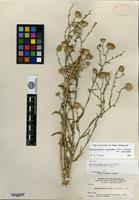
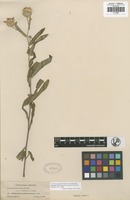
Machaeranthera pruinosaGreene [family COMPOSITAE ] Verified by Not on sheet, Dieteria asteroidesTorr. [family COMPOSITAE ] (stored under name); Verified by Not on sheet, Isotype of Machaeranthera pruinosaGreene [family COMPOSITAE ] Verified by Not on sheet,
Related name
Machaeranthera asteroides
Dieteria asteroides
Machaeranthera pruinosa
Machaeranthera verna
Flora
Entry for Dieteria asteroides Torrey [family ]
Herbarium
Flora of North America (FNA)
Collection
Flora of North America
Resource Type
Reference Sources
Entry From
Flora of North America, Vol 20,
Names
Dieteria asteroidesTorrey [family ], in W. H. Emory, Not. Milit. Reconn., 141. 1848
Biennials or short-lived perennials. Stems, branches, and peduncles usually hairy, puberulent, or canescent, often sparsely stipitate-glandular (glabrous or densely stipitate-glandular in var. glandulosa). Leaf blades lanceolate to oblanceolate, mid 20–100 × (2–)6–20 mm, margins entire to irregularly serrate, faces puberulent or canescent, often sparsely short-stipitate-glandular (densely, stiffly long-stipitate-glandular in var. glandulosa); distal bases cordate to auriculate, clasping. Involucres broadly turbinate to hemispheric. Phyllaries in 5–12 series, spreading to reflexed, apices acute to long-acuminate, 1–6 mm, herbaceous, faces puberulent or canescent throughout (on both indurate bases and foliaceous apices), sometimes sparsely stipitate-glandular (moderately to densely stipitate-glandular in var. glandulosa). Receptacles 3.5–7 mm diam. Ray florets pistillate, fertile; laminae white to purple, 10–20 × 0.8–1.5 mm. Disc corollas 5–8 mm. Cypselae glabrous or moderately appressed-hairy.