JSTOR Global Plants Home
  • Home
  • Browse
  • About
  • Access
  • Account
    • Saved Items
    • Profile
  • Log in

Global Plants

Skip to Main Content
  • JSTOR Global Plants Home
  • Global Plants

    • Browse
    • About
    • Access
    • Account
      • Saved Items
      • Profile
Log in
  • Browse
  • About
  • Access
  • Account
    • Saved Items
    • Profile
Advanced Search

Compilation
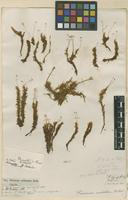
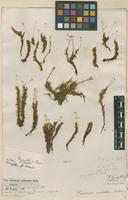
Dicranum undulatum

11 Images see all

Filed as Dicranum undulatum Schrad. ex Brid. [family DICRANACEAE]
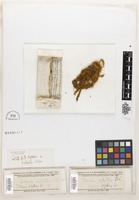
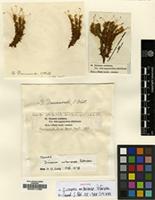
Type of Dicranum undulatum Schrad. & Brid. f. rugulosa Pilous [family DICRANACEAE]
Filed as Dicranum undulatum Schrad. ex Brid. [family DICRANACEAE]
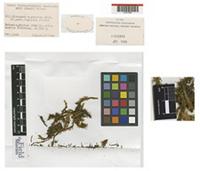
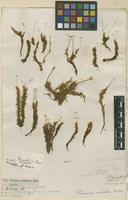
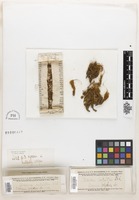
Isotype of Dicranum ontariense Petersen [family DICRANACEAE]
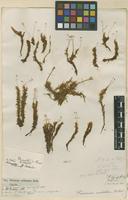
Filed as Dicranum undulatum Schrad. ex Brid. [family DICRANACEAE]
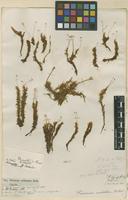
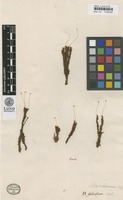
Dicranum schraderi Wahlenb. [family DICRANACEAE]
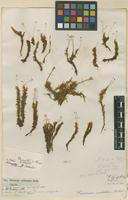
Filed as Dicranum undulatum Schrad. ex Brid. [family DICRANACEAE]
Previous
Next

Name

Identification
Dicranum undulatum Brid. [family DICRANACEAE ] Verified by Not on sheet, Dicranum ontariense Petersen [family DICRANACEAE ] (stored under name); Verified by Not on sheet, Isotype of Dicranum ontariense Petersen [family DICRANACEAE ] Verified by Not on sheet,
Related name
  • Dicranum undulatum
  • Dicranum ontariense
  • Dicranum polysetum

Flora

Entry for Dicranum undulatum Bridel [family ]
Herbarium
Flora of North America (FNA)
Collection
Flora of North America
Resource Type
Reference Sources
Entry From
Flora of North America, Vol 27,
Names
Dicranum undulatum Bridel [family ], J. Bot. (Schrader), 1800(2): 294. 1801,
Dicranum bergeri Blandow [family ]
Treatment Author(s)
Robert R. Ireland Jr.
Information
Plants in dense compact tufts, green to yellowish brown, shiny, rarely somewhat dull. Stems 3–8(–17) cm, densely tomentose with reddish brown rhizoids. Leaves erect-appressed or sometimes slightly falcate or flexuose, somewhat contorted when dry, the apex often twisted, weakly to strongly undulate, (4.5–)5–7.5(–11) × 0.7–1.2 mm, concave proximally, keeled above, lanceolate to oblong-lanceolate, broadly acute, rarely narrowly acute; margins plane, sometimes involute at base, broadly recurved at apex, entire proximally, serrulate to serrate in the distal half; laminae 1-stratose, sometimes with a few 2-stratose regions; costa strong, ending before the apex, sometimes nearly percurrent, 1/6–1/3 the width of the leaves at base, smooth to serrulate above on abaxial surface, with a row of guide cells, two stereid bands extending to apex, adaxial epidermal layer of cells not differentiated, the abaxial layer diffferentiated; cell walls between lamina cells weakly to strongly bulging abaxially and adaxially; leaf cells smooth to ± papillose near apex on abaxial surface; alar cells 2-stratose, differentiated, not extending to costa; proximal laminal cells elongate, incrassate, pitted, (22–)38–61(–79) × (2–)4–6(–8) µm; median laminal cells rectangular, pitted; distal laminal cells short-rectangular to irregularly angled, not pitted, (7–)11–14(–28) × (4–)11–12(–17) µm. Sexual condition pseudomonoicous; dwarf males on stem rhizoids of female plants; interior perichaetial leaves abruptly acuminate, convolute-sheathing. Seta 2–4 cm, solitary, yellow to brown. Capsule 2–2.8 mm, arcuate, inclined, furrowed when dry, ± contracted below mouth, yellow to yellowish brown or reddish brown; operculum 2–3 mm. Spores 14–28 µm.
Phenology
Capsules mature spring.
Altitude range
10–2200 m;
Distribution
GreenlandEuropeAsia.USA AlaskaUSA Calif.USA Conn.USA Ind.USA MaineUSA Mass.USA Mich.USA Minn.USA Mont.USA N.H.USA N.J.USA N.Y.USA N.C.USA OhioUSA Pa.USA S.Dak.USA Vt.USA Wash.USA W.Va.USA Wis.Canada Alta.Canada B.C.Canada Man.Canada N.B.Canada Nfld. and Labr. (Nfld.)Canada N.W.T.Canada N.S.Canada NunavutCanada Ont.Canada P.E.I.Canada Que.Canada Sask.Canada Yukon
Discussion
R. R. Ireland (1971b) recorded Dicranum undulatum from Colorado, but W. Weber (pers. comm.) believes this is a misidentification for D. polysetum. Dicranum undulatum is primarily a boreal species that is distinctive because of the yellowish green or yellowish brown, shiny, erect-appressed, lanceolate to oblong-lanceolate, undulate, keeled leaves, the leaf margins that are serrulate to serrate, and broadly recurved in the distal half, the leaf apices that are usually broadly acute, rarely narrowly acute, and the costae that are mostly subpercurrent or sometimes percurrent, smooth to serrulate above on abaxial surface. When the leaf apices are narrow, ± acute, and the costa percurrent, as some D. undulatum plants are on rare occasion, the species when sterile can be confused with D. ontariense. Dicranum undulatum has shiny leaves with twisted apices when dry compared to the more dull leaves that are variously contorted in D. ontariense. When sporophytes are present the aggregate setae (2–5 per perichaetium) of D. ontariense will immediately distinguish it from D. undulatum which has solitary setae. This species recently has been introduced on the University of California Berkeley Campus in a lawn-landscaping area; this is the only California locality where it has been found. The plants are sterile but appear morphologically similar to those growing in native habitats in other parts of North America. Dicranum undulatum of G. F. Weber & C. Mohr (1803) is not a synonym of the taxon treated here.

Related Materials

  • Terms and Conditions
  • Privacy Policy
  • Cookie Policy
  • Cookie Settings
  • Accessibility
  • Help
  • Contact Us
  • Facebook
  • Twitter
ITHAKA

JSTOR is part of ITHAKA, a not-for-profit organization helping the academic community use digital technologies to preserve the scholarly record and to advance research and teaching in sustainable ways.

©2000-2026 ITHAKA. All Rights Reserved. JSTOR®, the JSTOR logo, JPASS®, Aluka®, and ITHAKA® are registered trademarks of ITHAKA.

╳