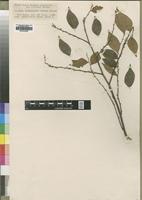
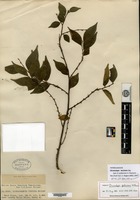
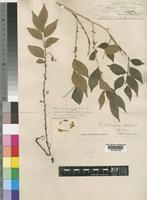
Dicranolepis pubescensH.Pearson [family THYMELAEACEAE ] (stored under name);
Related name
Dicranolepis pubescens
Flora
Entry for DICRANOLEPIS pubescens H. H. W. Pearson [family THYMELAEACEAE]
Herbarium
Royal Botanic Gardens, Kew (K)
Collection
Flora of Tropical Africa
Resource Type
Reference Sources
Entry From
Flora of Tropical Africa, Vol 6, Part 1, page 211, (1913) Author: (By J. G. Baker, with additions by C. H. Wright.)
Names
DICRANOLEPIS pubescensH. H. W. Pearson [family THYMELAEACEAE]
Information
Young branches densely pubescent, later glabrous. Leaves rhomboid or obliquely ovate, acuminate, obtuse, entire, glabrous above, with scattered adpressed hairs beneath, 2–2 1/2 in. long, 3/4–1 in. broad; petioles very short, pubescent. Flowers 5-merous, solitary in the leaf-axils, densely pubescent, sessile, nodding, 1–1 1/2 in. long. Calyx-tube pubescent within above the level of the ovary; lobes ovate, obtuse, parallel-nerved, pubescent, 1/3– 1/2 in. long. Petals divided almost to the base, not exceeding the calyx-lobes, glabrous; segments 10, oblong, incised at the broad apex. Ovary glabrous. Fruit not seen.
Distribution
French Guinea Upper Guinea Kassa, north of Sierra Leone boundary, Scott-Elliot, 5066!