JSTOR Global Plants Home
  • Home
  • Browse
  • About
  • Access
  • Account
    • Saved Items
    • Profile
  • Log in

Global Plants

Skip to Main Content
  • JSTOR Global Plants Home
  • Global Plants

    • Browse
    • About
    • Access
    • Account
      • Saved Items
      • Profile
Log in
  • Browse
  • About
  • Access
  • Account
    • Saved Items
    • Profile
Advanced Search

Compilation
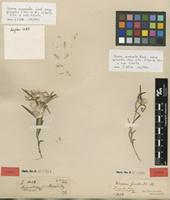
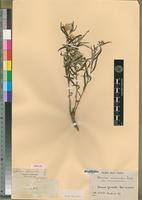
Dicoma gerrardii

2 Images see all

Isotype of Dicoma anomala Sond. var. microcephala Harv. [family ASTERACEAE]
Isotype of Dicoma gerrardii F.C.Wilson [family ASTERACEAE]
Previous
Next

Name

Identification
Isotype of Dicoma gerrardii F.C.Wilson [family ASTERACEAE ] (stored under name); Isotype of Dicoma anomala Sond. [family ASTERACEAE ]
Related name
  • Dicoma gerrardii
  • Dicoma anomala

Flora

Entry for Dicoma gerrardii Harv. ex F.C. Wilson [family COMPOSITAE]
Herbarium
Royal Botanic Gardens, Kew (K)
Collection
Flora Zambesiaca
Resource Type
Reference Sources
Entry From
FZ, Vol 6, Part 1, (1992) Author: G. V. Pope
Names
Dicoma gerrardii Harv. ex F.C. Wilson [family COMPOSITAE], in Bull. Misc. Inf., Kew 1923: 384 (1923). —Merxm., Prodr. Fl. SW. Afr. 139: 50 (1967). Type from South Africa (Natal).
Dicoma anomala var. microcephala Harv. [family COMPOSITAE], in Harv. & Sond., F.C. 3: 517 (1865). —Oliv. & Hiern in F.T.A. 3: 384 (1877). Type from South Africa (Natal).
Dicoma anomala subsp. anomala [family COMPOSITAE], sensu Wild in Kirkia 8: 189 (1972) pro parte, quoad specim. Richards 14557 et Molife 126; sensu Hilliard, Compos. Natal: 584 (1977) pro parte quoad specim. Edwards 2766.
Information
A caespitose ± bushy perennial herb, 10–30 cm. tall from a semi-woody rootstock; rootstock narrowly obconic or turbinate, up to c. 10 x 2 cm. Stems annual many densely leafy, branched, araneose-puberulous, somewhat glandular-viscid. Leaves subsessile, mostly 10–45(70) x 2–3(6) mm., linear, subobtuse at the apex, sharply callose-tipped serrulate on the margins, green drying darker and glandular otherwise glabrous on the upper surface, densely greyish-lanate beneath. Capitula numerous, solitary and terminal on leafy branches or short shoots, sessile subtended by 2-many leaves. Involucres mostly 10–15 mm. long, up to c. 15 mm. in diam., spreading to c. 20 mm. in diam., obconic. Phyllaries stiffly thinly coriaceous, shortly pungent at the apex, minutely serrulate on the margins, usually with a purplish groove on either side of a broad midrib, glabrous rarely puberulous; the outer c. 6 series each with many phyllaries, less than half the involucre in length, from c. 1.5 mm. long and narrowly triangular; the inner c. 3 series each with fewer phyllaries, not overlapping above, lanceolate and ± equalling the pappus in length. Florets 6–15; corollas purplish fading whitish, 9–11 mm. long, tubular in the lower half widening above into a cylindric, deeply-lobed limb; lobes erect, linear, glandular without near the apex. Achenes to c. 2.5 mm. long, turbinate, obscurely c. 10-ribbed, densely strigose-hispid between the ribs, glandular-viscid; pappus copious, many-seriate, setae to c. 11 mm. long, finely-barbellate, the outer filamentous, the innermost very narrowly scarious-winged in the lower part.
Habitat
Wooded grassland, miombo woodland or scrubland, on Kalahari Sand, bare sandy soils or stony hillsides.
Distribution
Zimbabwe S c. 8.6 km. S. of Mberengwa on Mnene Mission road, 4.v.1973, Biegel, Pope & Simon 4292 (COI; K; SRGH).Zimbabwe E Mutare-Umvumvumvu, v.1923, Swynnerton s.n. (K).Zimbabwe C Gweru Distr., Watershed Block, 10.iv.1968, Biegel 2595 (K; SRGH).Zimbabwe W Matobo Distr., Hope Fountain Mission, c. 1400 m., 18.iv.1973, Norrgrann 340 (K; SRGH).Botswana SE Digkatlong Ranch, 25°03?E, 25°40?S, c. 1030 m., 3.ii.1977, Hansen 3018 (C; GAB; K; PRE; SRGH).Zimbabwe N Gokwe Distr., Sengwa Res. Sta., 3.v.1974, Guy 2116 (K; SRGH).Botswana N Border near Plumtree c. 600 m., 7.iii.1961, Richards 14557 (K; SRGH).
Distribution (external)
Namibia
South Africa (Transvaal, Natal and N. Cape)

Related Materials

  • Terms and Conditions
  • Privacy Policy
  • Cookie Policy
  • Cookie Settings
  • Accessibility
  • Help
  • Contact Us
  • Facebook
  • Twitter
ITHAKA

JSTOR is part of ITHAKA, a not-for-profit organization helping the academic community use digital technologies to preserve the scholarly record and to advance research and teaching in sustainable ways.

©2000-2026 ITHAKA. All Rights Reserved. JSTOR®, the JSTOR logo, JPASS®, Aluka®, and ITHAKA® are registered trademarks of ITHAKA.

╳