JSTOR Global Plants Home
  • Home
  • Browse
  • About
  • Access
  • Account
    • Saved Items
    • Profile
  • Log in

Global Plants

Skip to Main Content
  • JSTOR Global Plants Home
  • Global Plants

    • Browse
    • About
    • Access
    • Account
      • Saved Items
      • Profile
Log in
  • Browse
  • About
  • Access
  • Account
    • Saved Items
    • Profile
Advanced Search

Compilation
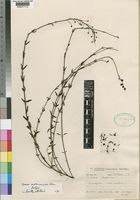
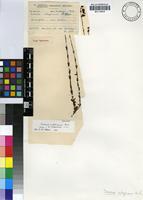
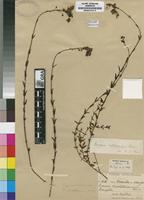
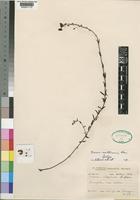
Diascia moltenensis

11 Images see all

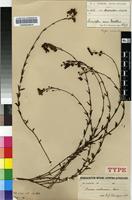
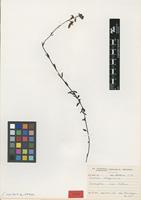
Isotype of Diascia moltenensis Hiern [family SCROPHULARIACEAE]
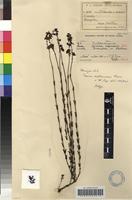
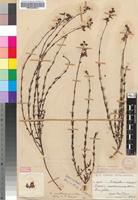
Holotype of Diascia moltenensis Hiern [family SCROPHULARIACEAE]
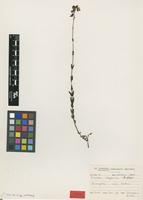
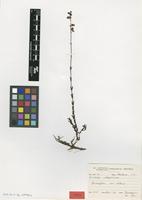
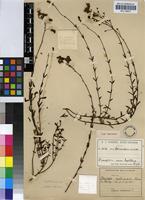
Isotype of Diascia moltenensis Hiern [family SCROPHULARIACEAE]
Previous
Next

Name

Identification
Isotype of Diascia moltenensis Hiern [family SCROPHULARIACEAE ] Verified by Not on sheet, Diascia integerrima Benth. [family SCROPHULARIACEAE ] (stored under name); Verified by Not on sheet,
Related name
  • Diascia integerrima
  • Diascia moltenensis

Flora

Entry for DIASCIA moltenensis Hiern [family SCROPHULARIACEAE]
Herbarium
Royal Botanic Gardens, Kew (K)
Collection
Flora Capensis
Resource Type
Reference Sources
Entry From
Flora Capensis, Vol 4, page 121, (1904) Author: By W. P. HIERN, F.R.S.
Names
DIASCIA moltenensis Hiern [family SCROPHULARIACEAE]
Information
a wiry herb, perhaps perennial, glabrous below, somewhat glandular-pilose about the inflorescence, 1–1 1/2 ft. high; stems decumbent with ascending or erect branches, the latter slender and tetragonous; upper internodes longer than the leaves, the lower shorter; leaves opposite, lanceolate-oblong, obtuse at the apex, more or less truncate or subauriculate at the base, glabrous, rather thickly herbaceous, with few teeth, 1/4– 1/2 in. long, 1/30– 1/8 in. broad; petioles not exceeding 1/10 in. long, narrowly decurrent at the base; racemes rather lax, terminal, several-flowered, 2–3 in. long; pedicels alternate, erect-patent, very slender, delicately glandular-pilose, 1/5– 3/5 in. long; bracts ovate, pointed, embracing the base of the pedicels, 1/12– 1/10 in. long; calyx-segments ovate or oval-oblong, obtuse or scarcely acute, minutely glandular-pilose, 1/12– 1/10 in. long; corolla about 2/3 in. broad; spurs 1/6– 1/4 in. long; filaments 4, linear, flattened, more or less densely clothed with stalked glands, all antheriferous, two of them curved about the middle; ovary glabrous. null
Distribution
CENTRAL REGION Albert Div.; Broughton, near Molteno, 6300 ft., Flanagan, 1616!

Related Materials

  • Terms and Conditions
  • Privacy Policy
  • Cookie Policy
  • Cookie Settings
  • Accessibility
  • Help
  • Contact Us
  • Facebook
  • Twitter
ITHAKA

JSTOR is part of ITHAKA, a not-for-profit organization helping the academic community use digital technologies to preserve the scholarly record and to advance research and teaching in sustainable ways.

©2000-2026 ITHAKA. All Rights Reserved. JSTOR®, the JSTOR logo, JPASS®, Aluka®, and ITHAKA® are registered trademarks of ITHAKA.

╳