JSTOR Global Plants Home
  • Home
  • Browse
  • About
  • Access
  • Account
    • Saved Items
    • Profile
  • Log in

Global Plants

Skip to Main Content
  • JSTOR Global Plants Home
  • Global Plants

    • Browse
    • About
    • Access
    • Account
      • Saved Items
      • Profile
Log in
  • Browse
  • About
  • Access
  • Account
    • Saved Items
    • Profile
Advanced Search

Compilation
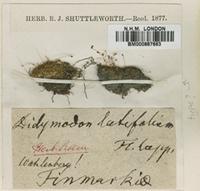
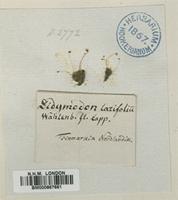
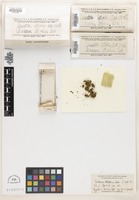
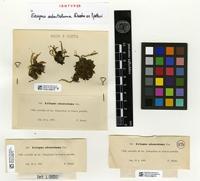
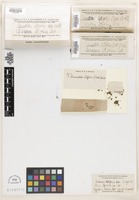
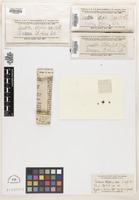
Desmatodon latifolius

6 Images see all

Filed as Desmatodon latifolius (Hedw.) Brid. [family POTTIACEAE]
Type? of Cynodontium latifolium Schwägr. [family DICRANACEAE]
Filed as Desmatodon latifolius (Hedw.) Brid. [family POTTIACEAE]
Previous
Next

Name

Identification
Desmatodon latifolius (Hedw.) Brid. [family POTTIACEAE ] (stored under name); Verified by Not on sheet,
Related name
  • Desmatodon latifolius

Flora

Entry for Tortula hoppeana (Schultz) Ochyra [family ]
Herbarium
Flora of North America (FNA)
Collection
Flora of North America
Resource Type
Reference Sources
Entry From
Flora of North America, Vol 27,
Names
Tortula hoppeana (Schultz) Ochyra [family ], Bryologist, 107: 499. 2005,
Trichostomum hoppeanum Schultz [family ], in C. F. Hornschuch, Syll. Pl. Nov., 2: 140. 1828
Desmatodon latifolius (Hedwig) Bridel [family ]
Desmatodon latifolius var. muticus (Bridel) Bridel [family ]
Tortula eucalyptrata Lindberg [family ]
Tortula euryphylla R. H. Zander [family ]
Treatment Author(s)
Richard H. Zander
Patricia M. Eckel
Information
Leaves ovate to oblong, apex broadly acute or occasionally rounded, apiculate or short- to long-mucronate, occasionally short-awned, margins recurved in middle 2/3 of leaf or occasionally almost plane, not or very weakly bordered distally with ca. 2 rows of rhomboid, less papillose cells; costa subpercurrent, percurrent or excurrent, lacking an adaxial pad of cells, distally narrow, 2–3 cells across the convex adaxial surface; distal laminal cells hexagonal, 15–20 µm wide, 1:1, densely papillose with several 2-fid papillae. Sexual condition autoicous. Sporophytes exerted. Seta 0.9–1.2(–1.9) cm. Capsule stegocarpic, rarely systylius, cylindric, erect and nearly straight, urn 1.5–2(–2.8) mm; peristome (150–)300–350 length µm, teeth 16, usually not twisted, divided to near the base or perforate basally, the teeth often basally fused in 2s or 4s, basal membrane very low; operculum 0.7–1 mm. Spores ca. 20–23(–25) µm, spheric or elliptic, densely papillose.
Phenology
Capsules mature summer.
Altitude range
low (in northern regions) to high elevations of over 3300 m;
Distribution
GreenlandEuropeAsian AfricaAtlantic Islands (Iceland).USA AlaskaUSA Ariz.USA Calif.USA Colo.USA IdahoUSA Mich.USA Mont.USA Nev.USA N.Mex.USA Oreg.USA UtahUSA Wash.USA Wyo.Canada Alta.Canada B.C.Canada Nfld. and Labr.Canada N.W.T.Canada NunavutCanada Que.Canada Yukon
Discussion
Care must be taken to not be confused by recent nomenclatural changes involving the epithet “latifolia” in the Pottioideae. Pottia latifolia is now to be found in Stegonia; Desmatodon latifolius is now Tortula hoppeana; Tortula latifolia is now Syntrichia latifolia. The strong 2-fid laminal papillae of Tortula hoppeana are distinctive, contributing to a crenulate leaf margin at the apex, which is surmounted, excepting specimens with muticous leaves, by a narrow, long mucro of smooth, clear, elongate cells. This is a very common species in subalpine and alpine areas, and in tundra. The present treatment agrees with modern perception (L. E. Anderson et al. 1990; M. J. Cano et al. 2006) that the muticous-leaved variant, which has much the same distribution as the piliferous expression, is not worth recognizing. The peristome teeth are essentially 16 but are commonly paired or in larger groups. Like T. cernua, T. laureri, T. leucostoma, T. obtusifolia, and T. systylia, this species has a capsule mainly maturing in summer, a feature supporting recognition of the group under the name Desmatodon, but possibly at only the subgenus level.

Related Materials

  • Terms and Conditions
  • Privacy Policy
  • Cookie Policy
  • Cookie Settings
  • Accessibility
  • Help
  • Contact Us
  • Facebook
  • Twitter
ITHAKA

JSTOR is part of ITHAKA, a not-for-profit organization helping the academic community use digital technologies to preserve the scholarly record and to advance research and teaching in sustainable ways.

©2000-2026 ITHAKA. All Rights Reserved. JSTOR®, the JSTOR logo, JPASS®, Aluka®, and ITHAKA® are registered trademarks of ITHAKA.

╳