JSTOR Global Plants Home
  • Home
  • Browse
  • About
  • Access
  • Account
    • Saved Items
    • Profile
  • Log in

Global Plants

Skip to Main Content
  • JSTOR Global Plants Home
  • Global Plants

    • Browse
    • About
    • Access
    • Account
      • Saved Items
      • Profile
Log in
  • Browse
  • About
  • Access
  • Account
    • Saved Items
    • Profile
Advanced Search

Compilation
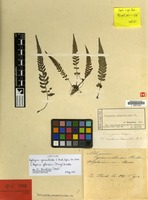
Deparia petersenii

9 Images see all

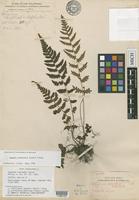
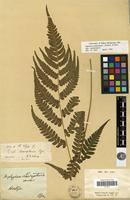
Isotype of Athyrium copelandii Christ [family ATHYRIACEAE]
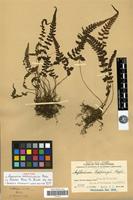
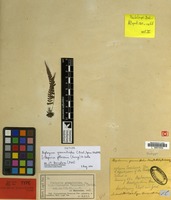
Isotype of Asplenium toppingianum Copel [family PTERIDOPHYTA]
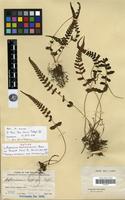
Type of Athyrium copelandii H.Christ [family PTERIDOPHYTA]
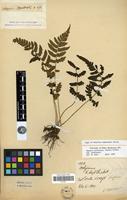
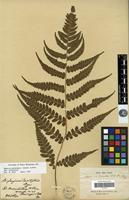
Type of Diplazium lasiopteris Kunze [family PTERIDOPHYTA]
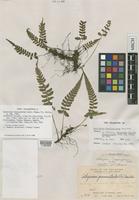
Isotype of Diplazium grammitoides C.Presl [family PTERIDOPHYTA]
Type of Diplazium lasiopteris Kunze [family PTERIDOPHYTA]
Lectotype of Asplenium toppingianum Copel. [family ATHYRIACEAE]
Isotype of Diplazium grammitoides C.Presl [family PTERIDOPHYTA]
Previous
Next

Name

Identification
Asplenium toppingianum Copel. [family ATHYRIACEAE ] (stored under name); Verified by M.G. Price, 1984 Deparia petersenii (Kunze) M.Kato [family ATHYRIACEAE ] Verified by Not on sheet,
Related name
  • Diplazium lasiopteris
  • Deparia petersenii
  • Athyrium copelandii
  • Asplenium toppingianum

Flora

Entry for Deparia petersenii (Kunze) M. Kato [family WOODSIACEAE]
Herbarium
Flora of North America (FNA)
Collection
Flora of North America
Resource Type
Reference Sources
Entry From
Flora of North America, Vol 2,
Names
Deparia petersenii (Kunze) M. Kato [family WOODSIACEAE], Bot. Mag. (Tokyo), 90: 37. 1977
Asplenium petersenii Kunze [family ASPLENIACEAE], Analecta Pteridogr., 24. 1837
Athyrium petersenii (Kunze) Copeland [family WOODSIACEAE]
Diplazium petersenii (Kunze) H. Christ [family WOODSIACEAE]
Treatment Author(s)
Masahiro Kato
Information
Stems creeping. Petiole dark brown or blackish at base, straw-colored distally, 10--30 cm, not swollen, teeth absent; scales pale brown, linear-lanceolate. Blade ovate-lanceolate, deeply pinnate-pinnatifid, 15--40 × 6--28 cm, moderately or slightly narrowed to base, broadest above base, abruptly narrowed to acuminate, pinnatifid apex. Pinnae oblong to linear-lanceolate, base ± truncate or broadly cuneate, apex acuminate to caudate; segments oblong, margins ± entire to serrate, apex obtuse or ± acute. Costae and veins with multicellular hairs. Veins pinnate, lateral veins usually simple, or sometimes forked in larger leaves. Sori elongate, straight or rarely hooked; indusia membraneous, margins laciniate.
Altitude range
0--100 m
Distribution
AsiaPacific IslandsAustralia.USA Ala.USA Fla.USA Ga.
Discussion
Deparia petersenii belongs to sect. Athyriopsis . It is an edible fern native to southeastern Asia, and it persists or escapes from cultivation in southeastern North America (C. V. Morton and R. K. Godfrey 1958) but does not seem to be truly naturalized (O. Lakela and R. W. Long 1976).
Specimens of D . petersenii from North America are often misidentified as the Asian species, Deparia japonica (Thunberg) M. Kato [ Diplazium japonicum (Thunberg) Beddome].
Native/Introduced
introduced

Related Materials

  • Terms and Conditions
  • Privacy Policy
  • Cookie Policy
  • Cookie Settings
  • Accessibility
  • Help
  • Contact Us
  • Facebook
  • Twitter
ITHAKA

JSTOR is part of ITHAKA, a not-for-profit organization helping the academic community use digital technologies to preserve the scholarly record and to advance research and teaching in sustainable ways.

©2000-2026 ITHAKA. All Rights Reserved. JSTOR®, the JSTOR logo, JPASS®, Aluka®, and ITHAKA® are registered trademarks of ITHAKA.

╳