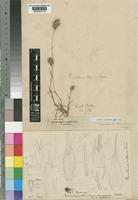
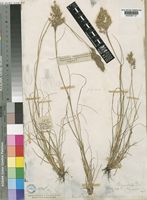
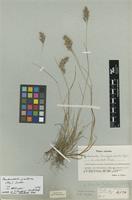
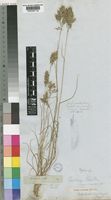
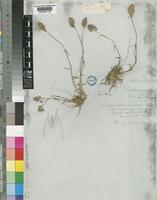
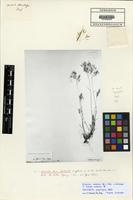
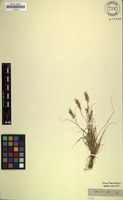
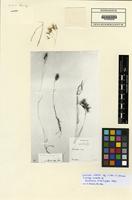
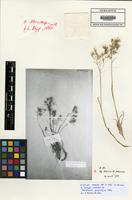
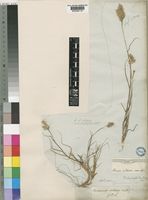
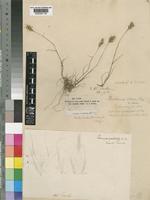
perennial, tufted; culms fascicled, very slender, geniculate, ascending, 1/2–1 1/2 ft. long, glabrous, smooth or scaberulous close below the panicle, 3–5- (rarely more) noded; upper 2 internodes usually occupying more than 1/2 of the culm, exserted; leaves softly hairy to villous, or glabrous, sometimes minutely tubercled; sheaths tight, rather thin and withering, conspicuously bearded at the mouth; ligule a fringe of hairs; blades very narrow, linear, tapering to a filiform point, 1–4 in. by 1/2–1 lin., rarely broader, usually filiform-involute, rarely flat, flaccid or flexuous, finely striate; panicle erect, more or less ovate, contracted, dense, or sometimes open and almost divaricate, 1–3 in. long; branches 2-nate, like the filiform axis and the capillary branchlets and pedicels scaberulous, glabrous except at the more or less hairy swollen axils, sometimes minutely tubercled, trichotomously divided from some distance above the base, lowest 1/2–1 1/2 in. long; ultimate divisions and pedicels short; spikelets crowded towards the ends of the branches, 2–2 1/2 lin. long, light green or tinged with violet, scarcely shining; glumes equal, lanceolate in profile, finely acuminate, subhyaline, 1-nerved, glabrous, keels finely scabrid; valves much shorter than the glumes, oblong in profile, body 1 lin. long, finely hairy from almost villous to subglabrous (hairs soft, seriate), faintly 5- to sub-9-nerved; lobes 1/4 to almost 1/2 lin. long, more or less acute, with a very fine bristle, 1–1 1/2 lin. long, from the inner side and more or less adnate to it, rarely free; awn about 3 1/2 lin. long, fine, kneed at 1/3 way up, twisted below; callus short, acute, minutely hairy; pales as long as the body of the valves, 2-toothed; anthers 3/4 lin. long; grain slightly over 1/2 lin. long. null