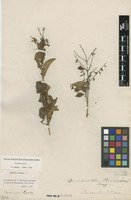
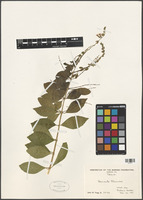
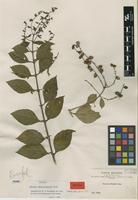
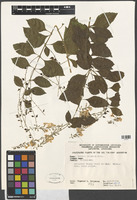
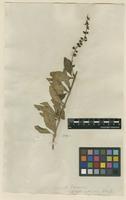
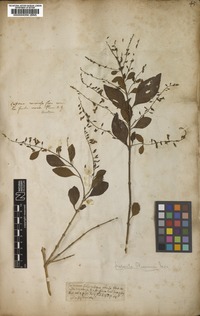
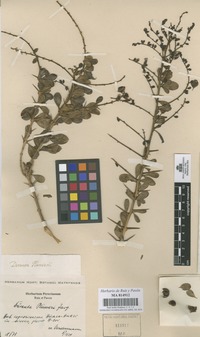
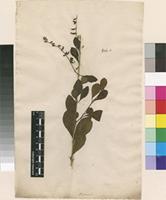
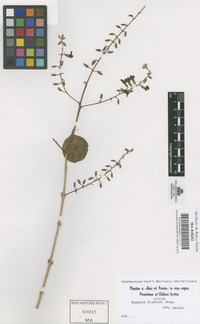
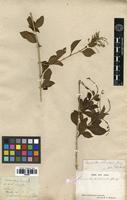
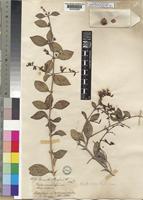
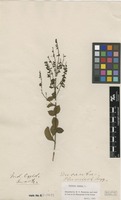
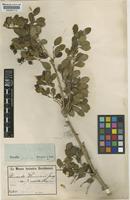
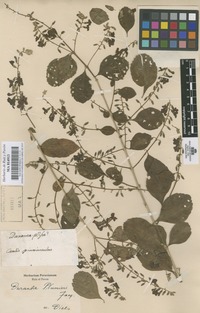
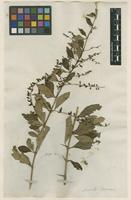
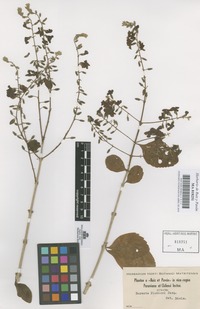
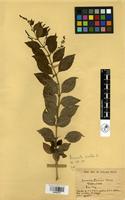
an unarmed or spinous shrub, 5–10 ft. high; branches angular or terete, glabrous or finely pubescent, with tawny bark and prominent lenticels; spines (when present) in or above the leaf-axils, spreading, straight or slightly curved, 1/3– 2/3 in. long; leaves opposite, shortly petioled, oblong, elliptic or ovate, acute or obtuse, cuneate or rounded at the base, entire or serrate above the middle, glabrous; petiole finely pubescent, 2–4 lin. long; lamina 2–2 1/2 in. long, 3/4–1 1/4 in. broad; racemes terminal and axillary, simple or panicled, many-flowered, lax, erect or drooping, 2–6 in. long; flowers blue, bracteate, on short pubescent pedicels; bracts very small, subulate, pubescent, the lower sometimes leafy; calyx of the flower tubular, with 5 very short subulate teeth, minutely puberulous without, 1 1/2–2 1/2 lin. long; corolla-tube at least twice as long as the calyx, curved, pubescent without in the upper half, puberulous within; limb pubescent, unequally lobed; drupe (when mature) globose, about the size of a pea, deeply 4-furrowed, completely enclosed in the accrescent calyx; pyrene 2–2 1/2 lin. long. null