JSTOR Global Plants Home
  • Home
  • Browse
  • About
  • Access
  • Account
    • Saved Items
    • Profile
  • Log in

Global Plants

Skip to Main Content
  • JSTOR Global Plants Home
  • Global Plants

    • Browse
    • About
    • Access
    • Account
      • Saved Items
      • Profile
Log in
  • Browse
  • About
  • Access
  • Account
    • Saved Items
    • Profile
Advanced Search

Compilation
Dioscorea asteriscus

2 Images see all

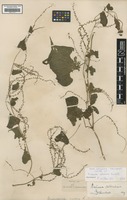
Isotype of Dioscorea asteriscus Burkill [family DIOSCOREACEAE]
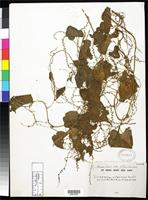
Isotype of Dioscorea asteriscus Baker, J.G. 1939 [family DIOSCOREACEAE]
Previous
Next

Name

Identification
Isotype of Dioscorea asteriscus Baker, J.G. 1939 [family DIOSCOREACEAE ] (stored under name); Verified by Not on sheet,
Related name
  • Dioscorea asteriscus

Flora

Entry for DIOSCOREA asteriscus Burkill [family DIOSCOREACEAE]
Herbarium
Royal Botanic Gardens, Kew (K)
Collection
Flora of Tropical East Africa
Resource Type
Reference Sources
Entry From
Flora of Tropical East Africa, page 1, (1975) Author: E. MILNE-REDHEAD
Names
DIOSCOREA asteriscus Burkill [family DIOSCOREACEAE], in B.J.B.B. 15: 356 (1939); Verdc. & Trump, Common Poisonous Pl. E. Afr.: 192, fig. 20/h–j (1969). Type: Malawi, without locality, Buchanan 11 (K, holo. !)
DIOSCOREA sativa [family DIOSCOREACEAE], [sensu Bak. in F.T.A. 7: 415 (1898), pro parte nec Thunb., non L.]
DIOSCOREA bulbifera [family DIOSCOREACEAE], [sensu R. Knuth in E.P. IV. 43: 88 (1924), pro minore parte, non L.]
Information
Tuber annual, spherical (fide Perdue & Kibuwa). Plant glabrous. Twining stems, up to 3 m. long. Leaves alternate; petiole up to 8 cm. long; blade heart-shaped, rather gradually narrowed to an acute acumen, up to 14(–18) cm. long and broad, often much smaller. Aerial tubers irregularly subglobose, up to 5 cm. in diameter, deep purplish. Inflorescences pendulous. Male racemose, up to 4 per leaf-axil or forming a terminal leafless panicle; racemes 10(–15) cm. long; flowers standing out on 1–2 mm. long pedicels at right-angles to the axis; perianth in flower spreading, star-shaped, ± 4 mm. across; tepals lanceolate, very acute. Stamens 6. Female inflorescences spicate, 1–3 per leaf-axil, up to 30 cm. long; flowers solitary at a node, directed downwards; perianth slightly spreading, ± 3(–6) mm. across. Ovary ± 4 mm. long, restricted just below the perianth. Capsule as in fig. 1/3, p. 4, 2.5(–3) cm. long, 1.2–1.5 cm. in diameter, directed upwards. Seeds (fig. 1/3a) winged at basal end, 16 mm. long.
Range
DISTR. ?U2; K5, 7; T1–3 5, 6, 8; ?Z; P and South West Africa
Altitude range
0–1400(–2300) m.
Distribution
KENYA Kericho District N.W. of Ngoina Tea Estate, 14 Dec. 1967 (♂ fl.), Perdue & Kibuwa 9379 !KENYA Kilifi District Mida, ♂ fl., R. M. Graham A520 in F.D. 1909 ! &Arabuko-Sokoke Forest, Jilori, 26 Nov. 1961 (♀ fl.), Polhill & Paulo 860 ! & Rabai, Aug. 1937 (young fr.), V. G. van Someren in C.M. 7164 !TANZANIA Tanga District about 6.5 km. ENE. of Korogwe, 27 June 1953 (♀ fl.), Drummond & Hemsley 3055 !TANZANIA Mpwapwa, 26 May 1938 ( ♂ fl. & fr.), Hornby 503 !TANZANIA Morogoro District Morogoro, Bahati, 21 Apr. 1935 (♂ fl.), E. M. Bruce 1083 !TANZANIA Pemba I., Mvumoni, 19 Aug. 1929 ( ♂ fl.), Vaughan 434A !
Distribution (external)
Zaire (Katanga)
Zambia
Malawi
Rhodesia
Mozambique
Notes
VARIATION. Two specimens (from Uganda, Ankole, Buganda Forest, Feb. 1939 (♂ fl.), Cree 254, and Tanzania, Shinyanga, ♂ fl., Bax 402) have exceptionally long pedicels, especially those in the lower part of the inflorescences, and these tend to ascend rather than spread at right-angles to the axis. It is possible that these specimens may represent a recognizable infraspecific taxon, but a decision cannot be made until further material is available for study. D. asteriscus has been much confused with the wild variety of D. bulbifera, which has rather similar rounded aerial tubers; in fact in the sterile state or in fruit it has not been found possible to distinguish these species. D. asteriscus is confined to the eastern side of Africa, where it has been collected more frequently than has D. bulbifera. A sterile specimen from Zanzibar I., Chwaka, 5 June 1963, Faulkner 3200, is probably D. asteriscus.

Related Materials

  • Terms and Conditions
  • Privacy Policy
  • Cookie Policy
  • Cookie Settings
  • Accessibility
  • Help
  • Contact Us
  • Facebook
  • Twitter
ITHAKA

JSTOR is part of ITHAKA, a not-for-profit organization helping the academic community use digital technologies to preserve the scholarly record and to advance research and teaching in sustainable ways.

©2000-2026 ITHAKA. All Rights Reserved. JSTOR®, the JSTOR logo, JPASS®, Aluka®, and ITHAKA® are registered trademarks of ITHAKA.

╳